
Opinion
Will ‘canoe theory’ guide California’s next governor?
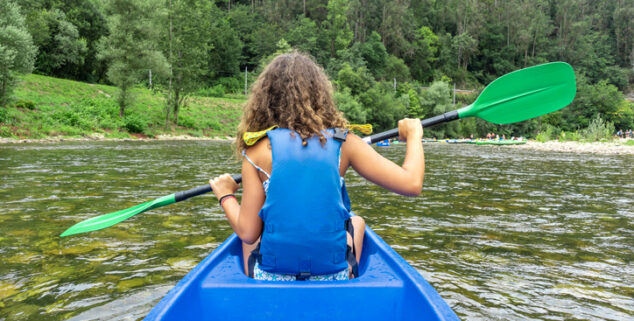 Rear view of a girl paddling in a kayak on the Sella river descent in Asturias, Spain. Active tourism activities. Rural tourism.
Capitol Weekly welcomes Opinions on California public policy or politics. Please read our guidelines for opinion pieces before submitting an Op-Ed. Submissions that do not adhere to our guidelines will not be considered for publication.
OPINION – Republican Gov. Earl Warren presided over the huge changes that defense industry spending and military deployment brought to California’s economy and population during and after World War II. The popular Warren proved so adept at managing the state’s challenges with a more pragmatic than partisan style that he ran unopposed in the 1946 general election. (He won three different party primaries in the cross-filing system, which ended in 1959.) His avoidance of ideological excess established a style of governance that his successors have largely followed.
In 1979, Gov. Jerry Brown, a Warren admirer, aptly described this approach as the “canoe theory”: “The way you have to approach the political process is something like piloting a canoe…. If you paddle a little bit on the left side, then you paddle a little bit on the right side, you keep going right down the middle.”
When Warren became chief justice of the U.S. supreme court in 1953, Lt. Gov. Goodwin Knight became governor. Knight, a conservative Republican who had criticized Warren as “nothing but a New Dealer,” moved to the center when he ran for governor in 1954. Though conservative Republicans were pushing for a right-to-work law – which would ban mandatory union membership and fees – Knight didn’t want to alienate moderate and liberal Warren supporters, including organized labor. He therefore opposed the right-to-work effort and raised the minimum unemployment insurance rate. He won the election handily.
In 1958, conservative Republicans forced Knight to not seek re-election and instead backed William Knowland, the Republican minority leader in the U.S. senate, who vilified labor and supported a right-to-work law. Knowland lost to Democrat Pat Brown in a landslide.
Hailed as a “giant killer” when he ran for reelection and defeated former vice president Richard Nixon, Brown sought a third term in 1966. However, California’s political center had moved to the right due to fallout from the Watts Riot in 1965 and the emergence of countercultural protests at UC Berkeley in support of “free speech” and against the escalating Vietnam War. His opponent, the amiable actor Ronald Reagan, ably depicted Brown as a coddler of campus radicals and indifferent to social unrest. Brown suffered a resounding defeat.
While Gov. Reagan continued to attack “filthy speech” at Berkeley and the emerging Black Power movement, he didn’t follow through on his big campaign promise to lower income taxes. In fact, he “bit the bullet” and raised them, ultimately increasing the top rate to a then-record high 11 percent in 1971. He also signed major environmental legislation that established the California Air Resources Board, Energy Commission, and Environmental Quality Act.
When Jerry Brown succeeded Reagan, his often-iconoclastic views overshadowed his fiscal prudence with the state budget, though he strongly supported organized labor and environmental causes that Californians embraced in the 1970s. Both of his Republican successors, George Deukmejian and then Pete Wilson, had rockier relationships with labor compared to Warren, Knight, and even Reagan. However, like Reagan, they both increased state taxes and vowed to be tough on crime. While neither Deukmejian nor Wilson were environmental stalwarts, they extolled California’s natural splendor and pledged to protect it.
In 2000, Gov. Gray Davis, who had vowed to be the “education governor,” invoked the efforts of Warren and Pat Brown in that regard, but also Reagan’s support for business. Davis’s policy inclinations were a synthesis of those from these three widely regarded “great” governors. His successor, Arnold Schwarzenegger, idolized Reagan, but unlike him, Schwarzenegger suffered major political defeats of his staunchly conservative ballot initiatives in 2005 before he became much more pragmatic.
In 2011, Jerry Brown paddled his canoe back to Sacramento. Near the end of his final two terms, veteran political columnist Dan Walters observed that during “his second governorship, an older, wiser and clearly more cautious Brown has practiced his [canoe] theory more diligently.” And even though some argue that Brown’s successor, Gavin Newsom, has been the most liberal governor in California history, Walters maintained in 2023 that Newsom’s governance indicates he “doesn’t want to be viewed as leaning so far left that he would fall out of [Brown’s] canoe.”
In our increasingly tumultuous and partisan times, it’s hard to gauge whether the next governor will adhere to the canoe theory. The leading candidates (according to polls) have touted views as deeply ideological as ever. Nevertheless, like his/her predecessors, the next governor will quickly learn that when the current is strongly flowing in a particular direction, it’s best not to paddle much against it.
Kurt Schuparra worked for three California governors and in the legislature.
Want to see more stories like this? Sign up for The Roundup, the free daily newsletter about California politics from the editors of Capitol Weekly. Stay up to date on the news you need to know.
Sign up below, then look for a confirmation email in your inbox.
Leave a Reply