
News
Polls vs prediction markets: Contrasting perspectives on the governor’s race
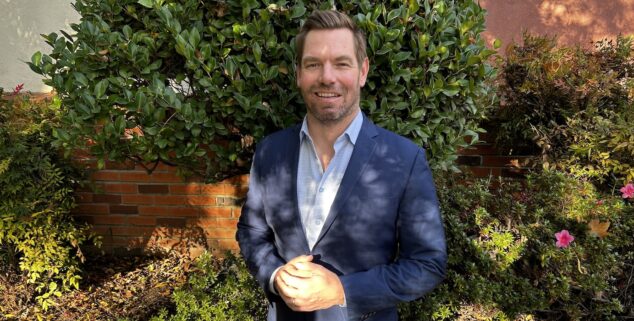 Congressman Eric Swalwell outside of the Capitol Weekly office. Photo by Tim Foster, Capitol Weekly
Recent polling paints a muddled picture of the California gubernatorial race.
Some forecast a doomsday scenario for Democrats with projections indicating that two Republicans, Steve Hilton and Chad Bianco, lead the race while a crowded field of Democratic candidates dilute their party’s overwhelming advantage in the state.
Others, however, show Hilton running ahead in the jungle primary with a Democrat polling second, either Eric Swalwell or Tom Steyer. Yet another shows Swalwell out front with Hilton and the rest trailing.
Major prediction markets, on the other hand, consistently peg Swalwell as the front runner. Kalshi, Polymarket, PredictIt and ForecastEx all say it’s the Congressman’s race to lose and according to their users it’s not even close. In fact, Kalshi gives Democrats an 83% chance of retaining the governor’s office in 2026.
Why are their predictions so different? Which is more likely to be correct? Might prediction markets and the wisdom of the crowds threaten pollsters who have taken a beating in recent elections?
Political insiders aren’t ready to cede election prognostication to another instrument – except maybe those in Swalwell’s camp – but they acknowledge prediction markets may offer some interesting, real-time insights that polling is slower to reveal.
“I realize for some people the value in polling is prediction,” said Mark Baldassare, survey director for the Public Policy Institute of California.
But polling, he said, offers much more than an up-to-the-minute forecast of who will win. It exposes the social, political and economic context of a race in a way that a mere prediction can’t.
“The reason we do polling,” Baldassare said “is around the whys.”
A disruptor in bloom
Prediction markets seem to be everywhere right now with wall-to-wall coverage touting the disruptive force of the platforms, which allow consumers to bet on anything and everything from the daily high in Los Angeles to when season 3 of The Last of Us will drop.
Prediction markets pose a major threat to sports betting and even to the overall gaming industry in the United States. Unlike sportsbooks, which are licensed on a state-by-state basis and only in states where sports betting is legal, prediction markets are regulated by the federal government and may offer event contracts on sports in any state today – even in California, where gaming tribes spent a fortune to stop the legalization of sports betting in 2022.
Two Republicans lead polling in the California gubernatorial race, but major prediction markets like Kalshi, Polymarket, PredictIt and ForecastEx all say it’s Congressman Eric Swalwell’s race to lose. Why are their predictions so different?
As they have with cardrooms, the state’s gaming tribes are going to war with prediction markets to protect their lucrative casinos and political influence. But that’s not the only policy concern swamping prediction markets these days. Gov. Gavin Newsom recently joined the growing ranks of politicians worried about insider trading on prediction markets when he issued an executive order banning state officials from using their inside knowledge to make wagers on the platforms.
Polymarket founder and CEO Shayne Coplan raised eyebrows earlier this year when he defended insider trading on prediction markets as a public good that spreads accurate information quickly. Both Coplan’s company and Kalshi have since tightened up insider trading restrictions as politicians have complained while the press has exposed how bettors with inside information may be profiting.
Prediction markets have also faced criticism for offering event contracts on the U.S. strike against Iran, raising moral concerns about profiting from war both by people with inside information and idle observers.
Forecasting elections
The state of Nevada recently secured a temporary restraining order against Kalshi banning the platform from offering event contracts on sports, elections and entertainment within its borders, arguing that such offerings constitute regulated wagering activity under Silver State law.
But as the wagering on California’s gubernatorial race might suggest, prediction markets could be able to unlock insights that polling today cannot. Indeed, with pollsters continuing to face heavy criticism over what’s perceived as inaccurate forecasts, some have even wondered whether prediction markets offer a better way to handicap elections than traditional polls.
To that, Paul Mitchell, the vice president of Political Data, Inc., says hold your horses.
“Polling is far superior to a betting market,” he told Capitol Weekly, pointing to the nuanced demographic data polls capture and the efforts pollsters make to survey a representative sample of the populace.
Prediction markets, on the other hand, just rank candidates by betting activity, and as Mitchell said, there’s no telling who is doing the betting – or why.
The prominent Sacramento pollster conceded that prediction markets could be effective if the wagerers included a lot of deeply knowledgeable people, say a bunch of legislative aides, lobbyists and Capitol reporters betting on whether the governor will sign a particular bill.
But in the absence of the widespread adoption of prediction markets by political insiders, he said the best the platforms can do is reflect immediate impact of breaking news on a race, like how a high-profile endorsement could affect voter sentiment.
Less signal, more noise?
Then again, he said, even that could be fool’s gold.
Recently, San Jose Mayor Matt Mahan was a something of a trendy pick for California governor, but Mitchell dismissed that as noise from Silicon Valley’s early tech adopters backing a familiar name or even Mahan supporters betting on him to try to prove his viability.
Prediction markets today don’t have him in the top two, and neither does recent polling. Jack Ohman, the San Francisco Chronicle’s former Pulitzer Prize-winning cartoonist, recently opined that Mahan is running out of time to make a name for himself in the race.
Mitchell said it’s possible that prediction markets are reflecting something about Swalwell that polling hasn’t had time to pick up, such as the congressman’s feud with the FBI over an old investigation into his connection to alleged Chinese honeypot spy, which for some may further establish him as a Trump foil in the mold of Gov. Gavin Newsom.
Still, Mitchell recommended that you “follow the polling over prediction markets until or unless some big breaking news changes the market.”
‘Still a believer’
Mark DiCamillo, director of the Berkeley IGS Poll, said he didn’t know what to make of Swalwell’s support on prediction markets, but he called the platforms “suspect” because don’t know why wagerers are backing one candidate over another.
“It seems like a wild west of a market,” he said, “Who knows if it’s being corrupted in any way.”
On the other hand, thanks to transparency in polling, DiCamillo said he thinks he knows why his poll and the EVITARUS poll sponsored by the California Democratic Party agree that Hilton and Bianco are leading the field – because unlike other polls they both include the official job descriptions that will be displayed for the candidates on the ballot.
“The job description is a big deal,” he said, noting that a description like Bianco’s, Riverside County Sheriff, lends credibility to a candidate.
Compared with the IGS poll last fall on the governor’s race, DiCamillo said the more recent polls clearly shows Hilton’s message is resonating with Republicans while Steyer’s campaign ads are raising the billionaire’s profile. Otherwise, he said the candidates for governor haven’t moved much, reflecting what he called a disengaged, uninterested electorate, which could be disastrous for Democrats.
“I think the two Republicans are ahead,” DiCamillo said, placing his faith in the rigors of polling protocols and dismissing recent criticisms of the business. “I’m still a believer of polls,” he said.
Pick your analogy: Horserace, fist fight or stock trade
Democratic strategist Bill Wong acknowledged that polling can be deeply flawed but said it’s a much better tool for assessing elections than prediction markets.
For example, he said Swalwell’s lead on the platforms could be driven by wagerers’ belief that the congressman looks like a winner with big-name endorsers. But Wong said such traditional indicators of electoral success aren’t necessarily what moves the needle with voters today as he evoked Kamala Harris’s failed bid for president.
He likened prediction markets to investing in stock based on a read of the company’s financials while polling is more like interviewing the company’s board of directors. With polling, he said, you’re speaking directly to voters about their opinions, not listening to a third party’s analysis of what voters think.
But even then, Wong expressed skepticism about the predictive value of recent polling because he said there’s still two month of the campaign to go and for most of the candidates it hasn’t really started yet.
“In the political world we’ve got a lot of time left,” he said. “It’s not like a horserace. It’s more like a fist fight” – and punches haven’t even been thrown yet.
Utility versus profits
Republican campaign consultant Rob Stutzman told Capitol Weekly that wagerers backing Swalwell on prediction markets may be looking ahead to what they think the most likely election outcome will be. That, he acknowledged, could prove to be a good money-making strategy if the jungle primary produces a Democrat and a Republican for the runoff.
A Democrat in that case is, obviously, virtually assured to be the winner.
“It seems like a wild west of a market…Who knows if it’s being corrupted in any way.”
But polling, Stutzman noted, is trying to do much more than just predict the winner. It’s trying to provide a snapshot of what the electorate is thinking right now. That’s not only a more complicated picture, but Stutzman said from a campaign professional’s perspective it’s also infinitely more valuable.
With polling results, he said campaign strategists can identify pockets of voters who may be amenable to your client’s message and how best to speak to them. In the hands of a skilled consultant, that kind of knowledge can be used to flip the script on an expected frontrunner, making a wager on them now look foolish come election time.
To that end, Stutzman said he doesn’t think prediction markets hold any utility for campaigns, other than perhaps in a situation where breaking news brought negative attention to a candidate. If the candidate’s fortunes on prediction markets don’t drop all that much, he said, it could signal that the news isn’t all that significant.
So, like the others, Stutzman was in no rush to replace polling with prediction markets, saying that the story of this race is still yet to be written and cautioning that the platforms are “too bullish on Swalwell.”
“There’s just a lot of moving parts, particularly in this race, for prediction markets to capture,” he said.
Want to see more stories like this? Sign up for The Roundup, the free daily newsletter about California politics from the editors of Capitol Weekly. Stay up to date on the news you need to know.
Sign up below, then look for a confirmation email in your inbox.
Leave a Reply