
News
Why the Insurance Commissioner race is about more than insurance
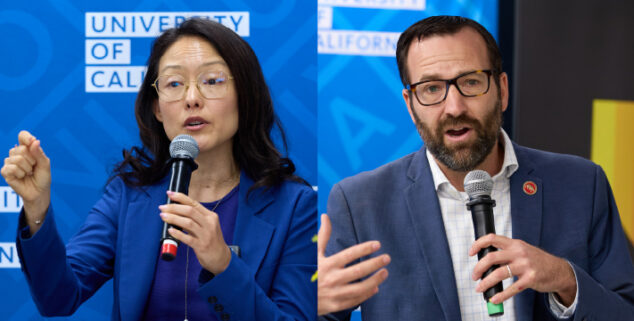 Insurance Commissioner candidates Jane Kim, left, and Ben Allen, right, during the “Can California Fix Its Insurance Crisis? event co-hosted by CalMatters and UC Student and Policy Center in Sacramento on Oct. 8, 2026. Photo by Fred Greaves, CalMatters
As the only statewide race pitting two Democrats against each other, the contest for insurance commissioner offers more than just election-night drama among a slate of otherwise predictable constitutional officer campaigns. It arguably serves as something of a proxy fight for the soul of the California Democratic Party.
“Who knew it would be so juicy?” quipped termed-out state Sen. Ben Allen of Santa Monica, who is facing off against former San Francisco Supervisor Jane Kim in the down-ballot race.
Allen is generally considered the establishment candidate who promises to continue the reform efforts of current commissioner Ricardo Lara, a platform known as the Sustainable Insurance Strategy. Allen is endorsed by both of California’s U.S. senators, as well as the California Democratic Party.
Kim, on the other hand, is the change candidate, promising sweeping changes, including the establishment of a single-payer disaster insurance policy. She, too, is endorsed by several big-name California Democrats, including Lt. Gov. Eleni Kounalakis and State Controller Malia Cohen, but her support from Vermont Senator Bernie Sanders and SEIU California President David Huerta are defining in more ways than one.
Kim beat Allen by nearly 700,000 votes in June, and recent polling by Probolsky Research found Kim continues to hold a small lead over Allen, with a large number of voters undecided, particularly Republican voters.
Kim’s front-runner status worries insurance industry insiders, who privately complain she doesn’t understand the first thing about the sector, while her bold pronouncements about the much-maligned industry obviously appeal to some frustrated voters.
But her candidacy is about much more than just insurance regulation.
After her stint as a county supervisor, Kim served as the California political director for Sanders’ 2020 presidential campaign, then became the statewide director of the Working Families Party in 2022. The populist, progressive minor political party works within the much larger Democratic Party to push its platform further to the political left.
A victory by Kim would be seen by many as tangible proof of the viability and influence of the Working Families Party in California, and would put enormous pressure on the California Democratic Party.
This is why many in and out of the insurance industry are concerned. They see Kim’s rhetoric as political performance, not the words of a knowledgeable would-be regulator or even a reformer.
They say Kim’s platform is a combination of recycled ideas that were rejected by previous commissioners and unrealistic proposals that will never get through the Legislature, even though it’s controlled by the Democrats. Kim conversely markets her agenda as an ambitious plan to hold a greedy industry accountable.
Former insurance commissioner candidate Patrick Wolff, called Kim’s campaign one “of profound intellectual dishonesty.”
And yet, her ideas are compelling in a state where the recent destruction of wildfires has crystalized public frustration over record insurance profits, denied or delayed claims and rising rates. Kim is campaigning on ideas like preventing insurance companies from charging more than they need to cover claims and “a reasonable profit” and requiring that insurers give customers a six-month notice for changes in coverage.
Allen, meanwhile, is campaigning on striking “the right balance between protecting consumers and ensuring insurers can sustainably operate in the state” and modernizing the state’s rate-setting process — ideas that are more likely to land with industry insiders than the man on the street.
‘This is not new subject matter for me’
Allen rejects the framing of the race as the establishment candidate versus the protest candidate. He told Capitol Weekly it’s a battle between one candidate who has a long history of working on insurance-related matters and another with no experience at all.
“I would say that I’m the candidate in this race who’s actually been working on these issues for a long time, who actually had a massive disaster in his own community and got to see the dysfunction of the system up close and personal (and), running legislation to make the system more fair for people,” he said. “This is not new subject matter for me.”
Allen said he’s repeatedly found himself immersed in insurance policy even when focused on other issues, from climate policy to public safety.
“Over and over again I came to find that the issues that I cared about and that I was working on had a direct connection to insurance policy and the Department of Insurance,” he said. “I just came to appreciate what an intensely important area of work this is when it comes down to trying to make our state more affordable and more livable, more safe. ”
The 2025 Palisades and Eaton fires are a definite theme in Allen’s campaign, and his Senate office mobilized quickly to help residents devastated by the destruction.
“I share the frustration. I share the anger….My focus is on actually trying to fix the problems and less on trying to push an ideological agenda.”
“We got to see how underinsurance, lack of insurance and certain insurance industry business practices have really harmed the ability of a community like ours to rebuild,” he said. “We were able to help hundreds and hundreds and hundreds of people get the payouts that they deserved in the wake of the losses.”
But, he said, the experience also showed him how dire the need for insurance reform is.
“Why do you have to call your state senator to be able to get help for policies you’ve been paying into for years in many cases? Why aren’t you able to get that assistance directly from the insurance company?”
Allen said when he met with Kim last year, she was thinking about running for governor, underscoring for him the different motivations of the two candidates.
“I think she and her team correctly identified the insurance commissioner’s race as a place to jump in and rail against capitalism,” he said, noting his own frustration with the system as well.
Allen attributed Kim’s strong showing in the primary election to the crowded field running for insurance commissioner, but said he expects to pick up “support across the political spectrum” in the general election.
Allen acknowledged the appeal of Kim’s populist message, but expressed confidence in his track record and broad base of support heading into the General Election, which he called “a very different round” from the primary.
“I share the frustration. I share the anger,” he said. “My focus is on actually trying to fix the problems and less on trying to push an ideological agenda.”
‘The status quo is not the safest route’
Unlike Allen, Kim doesn’t shy away from the protest candidate label she’s gotten in the race.
“My opponent and I are not running for the same office,” she told Capitol Weekly. “He is running for what this office used to be. I’m running for what this office could be.”
“I’m running against the status quo — a status quo which is failing many Californians if not most Californians and is bankrupting hardworking families across the state.”
Kim also doesn’t shy away from the political implications inherent to her candidacy. When asked directly whether her candidacy is part of a larger effort to push the Democratic Party further left, she didn’t deny it:
“I am running on a corporate-free agenda that is hyper-ly fixated on working families first and not corporate billionaires, regardless of who the party is,” she said. “And yeah, I do want a political system and a governance that puts working families first.”
Kim said she sees the office of the insurance commissioner as an “under-the-radar, underleveraged” platform “to make this economy work for all of us.” She said she and her team believe the insurance commissioner has “broad executive authority” that has not been “fully leveraged” by previous commissioners to enact ambitious changes.
“He is running for what this office used to be. I’m running for what this office could be.”
“There are many things that we believe we can do immediately, because this office, one, gets to license who gets to do business in the largest property and casualty insurance market in the country, the fourth largest in the world,” she said.
“We’re 10 to 15% of the major carriers’ bottom line here in the United States. Second, they get to approve and reject rate increases and decreases and ensure that rates are neither inadequate, excessive or discriminatory.”
Kim said she does not think Allen’s argument that he’s the candidate with experience plays well with voters in today’s climate.
“He’s had 12 years to address the systematic failure that is the insurance industry and this has been the outcome thus far,” she said. “I’m very proud of the fact that I’m independent of the insurance industry. I have never taken a single check from an insurance carrier or an insurance PAC. He has cashed their checks 76 times in his career.”
Kim said voters’ frustration with the insurance industry is what propelled her to victory in the June primary.
“What the outcome showed our campaign was actually just how tired Californians are of the status quo and that they don’t believe that it is working for them and that they’re tired of getting fleeced by the insurance industry,” she said.
Kim said at the beginning of the campaign many observers figured it would be “a fight between Northern California and Southern California.” But in the primary she not only won big in her home base of San Francisco (by 23 points), but also took a double-digit win in Los Angeles.
“We came in first in every SoCal county, including the red ones like San Bernardino and Riverside,” she said. “So again, what I think the results showed is that there is widespread hunger for something different and for someone who is going to fight for Californians.”
Kim said she’s campaigning on an ambitious platform because incremental reform isn’t enough.
“I don’t think that tinkering with the system is going to solve a systematic failure that is our insurance industry today for most Californians,” she said. “So, yes, I am running on some very big ideas.”
That said, she acknowledges that those reforms would need to be negotiated “with the governor’s office, with the state legislature, with the insurance industry and consumer advocates.”
“I know the man in the White House would like us to believe that we live in a dictatorship, but we don’t. We live in a democracy with checks and balances so that no single individual can be a dictator on how policy is implemented. And that’s the right way for big ideas to move forward. They should be debated. They should be negotiated and then executed after there’s broad consensus on moving forward.”
Kim framed the race not the through the lens of party or even insurance policy experience,but as the present versus future. She said California needs bold leadership to guide it through these troubled times.
“The status quo is not the safest route,” Kim said. “It is the most expensive one.”
Kim’s effort is bolstered by the support of influential voices within the labor movement, including Cal Fed, SEIU, the nurses and the teachers. Their backing of Kim over Allen, a staunch labor ally, speaks to the uncertain nature of the race.
Every other constitutional office on the ballot, except the non-partisan Superintendent of Public Instruction, pits a Democrat versus a Republican — and the GOP hasn’t won a statewide race in California in two decades.
Users on the prediction market Kalshi overwhelmingly project the Democrat to win in four of the constitutional officer races listed on the platform: Governor, Lieutenant Governor, Attorney General and Secretary of State. The races for Controller and Treasurer aren’t even listed on the platform.
The race for Insurance Commissioner is, however — and Kalshi users favor Allen to get the nod. California will soon see if the wisdom of the crowd got it right. The stakes and the electoral drama are high.
Want to see more stories like this? Sign up for The Roundup, the free daily newsletter about California politics from the editors of Capitol Weekly. Stay up to date on the news you need to know.
Sign up below, then look for a confirmation email in your inbox.
Leave a Reply