
Opinion
The solutions for boys and men already exist
Capitol Weekly welcomes Opinions on California public policy or politics. Please read our guidelines for opinion pieces before submitting an Op-Ed. Submissions that do not adhere to our guidelines will not be considered for publication.
OPINION—In 2018, I attended my first Alliance for Boys and Men of Color (ABMoC) event as a partner. It was my first time lobbying at the state level, and my first time stepping foot in the State Capitol. For many people, stepping into the Capitol leaves them in awe. What stayed with me were the organizers.
I remember the radical spirit of our grassroots partners. The love. The authenticity. I remember encountering a professor—and my eventual friend and collaborator—Dr. David Turner III in a “police-free schools” shirt and thinking: Can we really show up to the halls of power like this?
We could—and we have continued to bring that same spirit every time we show up.
This year marked my eighth ABMoC Day at the Capitol—and my fourth as executive director. Over the last 15 years, our network has helped pass 126 bills in California and secure major investments in youth employment, leadership development and community schools.
Last November, I wrote about Gov. Gavin Newsom’s executive order on boys and men and the importance of working with the ecosystem that has been building this work for over a decade. Many of the solutions now being elevated by the Governor are solutions that grassroots organizations across California have already helped build and continue to advance today—including our current $120 million budget advocacy effort to expand the California Opportunity Youth Apprenticeship Program, the California Youth Leadership Corps, and secure $1 billion in ongoing community school funding.
Since the executive order was announced, we’ve continued organizing alongside hundreds of organizations across the state. We held a policy summit in Oakland with more than 300 people and over 160 organizations. We hosted hearings alongside Assemblymember Isaac Bryan, the California Funders for Boys and Men of Color, and other partners — including one in Los Angeles where lawmakers heard directly from impacted youth inside Los Padrinos Juvenile Hall before traveling to the Youth Justice Coalition’s Chuco’s Justice Center, a former youth jail transformed into a community space for healing and leadership.
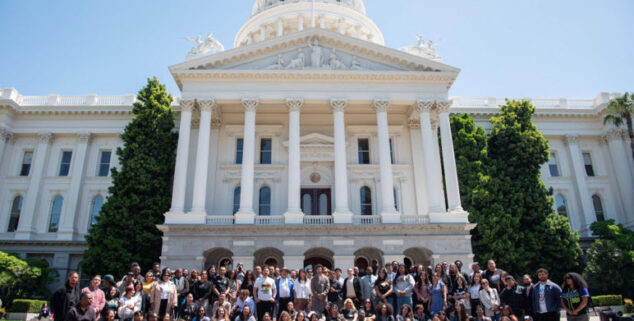
In April, we brought 200 community members to the Capitol, met with 60 legislative offices and organized a hearing where parents, students, organizers, researchers and labor leaders made the case for fully funding community schools and ending punitive discipline practices that continue to push many boys and young men out of school.
This is what it looks like when community leads.
We’re cautiously optimistic about the state’s growing attention to boys and men but we’re clear that if California is serious about changing outcomes, it will not come from new committees, service programs, or public messaging alone.
A job alone will not solve decades of organized abandonment and underinvestment. A 2018 study found that Black boys raised in wealthier families still faced a higher likelihood of downward economic mobility than white boys raised in poorer families.
Nor will individualizing mental health while separating it from poverty, school pushout, violence, housing instability and the long-term erosion of community infrastructure get boys and young men the healing they need.
What we saw at the Capitol was a glimpse of what becomes possible when the people closest to the problem are trusted to lead the solutions. These are the very same people implementing those solutions long after legislation is signed and elected officials move on to their next priorities.
They are the ones building trust, mediating conflict, supporting healing, and sustaining this work long after media attention and political momentum shift elsewhere.
Without deep investment in community-rooted infrastructure and culturally-rooted healing, these efforts risk remaining partial responses to a structural crisis while the underlying conditions continue to worsen.
When I came to that ABMoC briefing all those years ago, I found my political and social home—a place where I could heal from past trauma, build community, and better understand myself and the world around me. Every young person deserves spaces like that.
In many ways, chronic underinvestment in these organizations and spaces has created the vacuum that reactionary forces have been able to exploit among isolated and disconnected young men. We cannot afford to wait. The decisions we make now will shape the political, social, and emotional conditions future generations inherit.
California does not need to invent pathways to purpose for boys and young men. Grassroots organizations across this state have already been building them for years.
The question is no longer whether solutions exist. It’s whether the state is willing to trust, fund, and follow the communities already implementing them.
Eric Morrison-Smith is the executive director of the Alliance for Boys and Men of Color.
Want to see more stories like this? Sign up for The Roundup, the free daily newsletter about California politics from the editors of Capitol Weekly. Stay up to date on the news you need to know.
Sign up below, then look for a confirmation email in your inbox.
Leave a Reply