
News
The fight against Newsom’s death row commutations
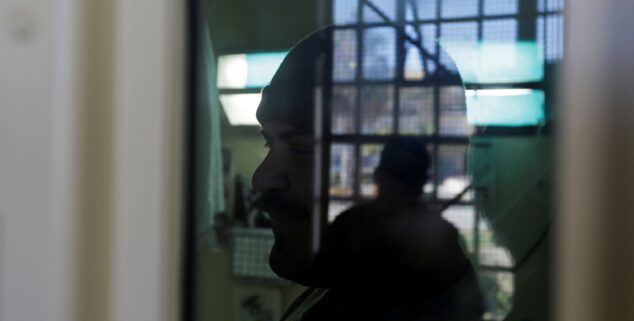 California's death row. Photo by AP.
Orange County District Attorney Todd Spitzer has launched a Hail Mary against Gov. Gavin Newsom’s death row plan, filing a brief with the California Supreme Court urging justices to stop the sweeping transfer of all of the state’s condemned inmates to life in prison without the possibility of parole.
“I’m praying, and I think we may have to actually get down on our knees on this one,” Spitzer said when he first announced the filing at a somber press conference last week at the Orange County Crime Victims Monument in Santa Ana.
A former assemblymember known for his bombast and fighting resolve, Spitzer told gathered relatives of death row inmate victims that he’s “horribly afraid” of Newsom’s plan because it upends the justice system and renders the state’s written law meaningless.
“Nothing means nothing anymore,” he said.
Spitzer, a Republican, casts Newsom’s broad clemency for all 548 inmates on death row as not a personal act of conscience but rather as the next step in a covert campaign by Democrats to end the death penalty in defiance of the will of the people.
Californians have affirmed their support of the death penalty eight times in the last 50 years, passing Proposition 17 in 1972, Prop. 7 in 1978, Prop. 195 and 196 in 1996, Prop. 18 in 2000, Prop. 66 in 2016 and defeating Prop. 34 in 2012 and Prop. 62 also in 2016.
Newsom, a long-time opponent of capital punishment, promised during his 2018 run for governor that he would not let his personal views override the will of the people. But after he entered office the following year, he issued a moratorium on executions.
For most of the governor’s eight years in office, death row inmates sat in a kind of limbo. Then, a month before Newsom announced the mass commutations, new regulations approved by the Board of Parole Hearings were enacted. Spitzer thinks the regulations are critical to understanding the Democrats’ ultimate intentions.
The regs allow inmates sentenced to life without parole (LWOP) to apply for a resentencing hearing after they’ve served at least 25 years in prison. The hearings could result in the eventual release of LWOP inmates.
A single line in the regulations prohibits the 548 death row inmates Newsom plans to commute from being eligible for these hearings. Spitzer and other critics think it’s only a matter of time before that line is deleted, leading to the release of inmates formerly on death row.
The prosecutor acknowledged that some have accused him of fear mongering, that the inmates will never be released. But he points to the oversight and power of the Board of Parole Hearings as his justification.
The little-scrutinized board, working under the umbrella of the California Department of Corrections and Rehabilitation (CDCR), is authorized to rewrite sentencing regulations. Its members are appointed by the governor and confirmed by the Senate.
Spitzer claims the board is simply executing the policy wishes of the Democrats who control California politics, and it operates under the radar.
“Life without the possibility of parole is absolute nonsense,” Spitzer said. “We know that these are regulations, done through the backdoor through CDCR, to effectuate an outcome that’s not even in the light of day through the Legislature,” he said.
“Life without the possibility of parole is absolute nonsense.”
Among those who also spoke at the Orange County press conference was Steve Herr, the father of one of the victims of Daniel Wozniak. Wozniak was sentenced to death more than decade ago for the murders of Juri “Julie” Kibuishi and Army combat veteran Sam Herr.
In 2010, Wozniak was in debt and wanted money for his upcoming wedding and honeymoon. Sam Herr was his neighbor in Costa Mesa. Wozniak killed Herr for his combat pay, then tried to throw off police by killing Kibuishi, Herr’s friend and college tutor, and framing him for her murder.
Wozniak dismembered Herr’s body and left his severed head and other body parts in El Dorado Park in Long Beach.
Steve Herr said he personally attended 203 of Wozniak’s court hearings before he was convicted of murder. When he was finally sentenced to death row, Stever Herr said he “thought that was the end of that horrible nightmare.”
But then Newsom announced the moratorium on the death penalty. That was infuriating, Steve Herr said, but the latest moves by the governor and board were crushing. He said it was cowardly of the governor not to talk to people like him, the family members of the death row victims.
“Dan Wozniak broke my heart,” Steve Herr said. “Gavin Newsom broke my soul.”
Spitzer’s amicus brief concerns just a portion of the nearly 50 death row inmates from Orange County. Three-hundred-eight-two of the state’s death row inmates had previously been convicted of felonies before they were sentenced to death. Under the state constitution, a majority of the Supreme Court, four of the justices, has to approve a reduction in their sentences.
Newsom has the authority to unilaterally commute the sentences of the other death row inmates with a just single felony conviction. Spitzer’s amicus brief, filed Monday, focus on the 30 Orange County death row cases subject to Supreme Court review. Spitzer’s office announced that it will also seek writ relief for the remaining commutations of Orange County cases that do not require a review by the court.
Spitzer’s office hopes for a decision from the Supreme Court in the next few weeks.
Spitzer’s efforts are separate from a legal challenge of the commutations announced last week by the Criminal Justice Legal Foundation. The foundation is led by former Sacramento District Attorney Anne Marie Schubert, who is an independent after leaving the Republican Party in 2018.
“He is entitled to oppose the death penalty,” Schubert said of the governor on the steps of the capitol. “But personal beliefs cannot replace individual judgements. Let’s be clear, our announcement today that we are challenging Gov. Newsom is not about whether you support or oppose the death penalty here in California. It is about much more fundamental issues. That is, the rule of law, the limits of executive power, and the rights of crime victims.”
Los Angeles County District Attorney Nathan Hochman announced his support of foundation’s legal challenge. Hochman also is an independent after leaving the Republican Party.
“Blanket commutations represent an abdication of the Governor’s responsibility to evaluate each case on its merits,” Hochman said in a statement. “Each one of these cases leaves behind a victim’s family that went through agonizing proceedings for years or decades, reliving the tragedies that befell their loved ones over and over until they finally thought they had achieved some level of closure and finality — only to have it violently disrupted.”
It’s rare for commutations by California governors to be overturned, even when they are controversial. The family of Luis Santos tried unsuccessfully to overturn Gov. Arnold Schwarzenegger’s reduction in Esteban Núñez’s voluntary manslaughter sentence in 2011.
Nunez, the son of former Assembly Speaker Fabian Núñez, was sentenced to 16 years in prison for killing Santos. Schwarzenegger, a political ally of the former speaker, reduced the sentence to seven years. Esteban is now a registered lobbyist and managing director for his father’s lobbying firm Actum, one of the top firms in Sacramento.
Today I am acting on my long and deeply held conviction that individually and collectively we are stronger as a society when we reject state-sanctioned killing.
Newsom’s office referred a Capitol Weekly request for comment to the governor’s open letter to the people of California on his death row plan as well as a fact sheet on the commutations.
His office pointed specifically to two extended quotes from the letter. The first speaks to how Newsom said he wrestled with his decision:
“This decision is among the most difficult of my career, not because I doubt its necessity for our state but because I know its announcement may surface excruciating memories for victims’ families. I deeply respect the views of those who will strongly disagree with my decision, including some families of victims who have suffered the worst possible loss. I hold this painful truth along with the belief that this is a righteous action. Today I am acting on my long and deeply held conviction that individually and collectively we are stronger as a society when we reject state-sanctioned killing.
“I follow the moral leadership of past presidents, including our Founding Fathers, and governors across America, from all political parties, who used their executive authority to commute death sentences. I have also listened to crime victims and survivors, public safety experts, and religious, civil rights, and other community leaders. They do not speak with one voice, but from these conversations, with parents and children of murder victims, prison wardens, and jurors who served in capital cases, I have taken counsel and I am grateful. I will remember their voices long after I leave office.”
The second affirms that his commutations don’t repeal the death penalty in California:
“California voters have voted to keep the death penalty on the books, and I respect that. I recognize the limits of this clemency action, which does not repeal the death penalty and is limited to commuting California’s current death sentences. The power to repeal the death penalty rests with the Legislature and voters. The discretion to seek, impose, and uphold death sentences in individual cases remains, as ever, in the hands of prosecutors, juries, and courts. But the constitution also gave every governor clemency authority, and that power exists for moments when law as applied cannot be squared with justice. For me, this is that moment.”
Spitzer isn’t swayed by the governor’s words. He said at the press conference last week that he believes Newsom decided to commute the sentences for his own political self interest in the wake of the Democrat’s sweeping wins in the midterm election.
“He put his finger up into the wind and measured the political will of the nation to move far, far, far to the progressive side,” he said. “And in order to become president of the United States, he has been advised and believes that he needs to move as hard as he can to the left in order to become the nominee in 2028.”
Want to see more stories like this? Sign up for The Roundup, the free daily newsletter about California politics from the editors of Capitol Weekly. Stay up to date on the news you need to know.
Sign up below, then look for a confirmation email in your inbox.
Leave a Reply