
News
The Capitol Weekly Election Post-Mortem
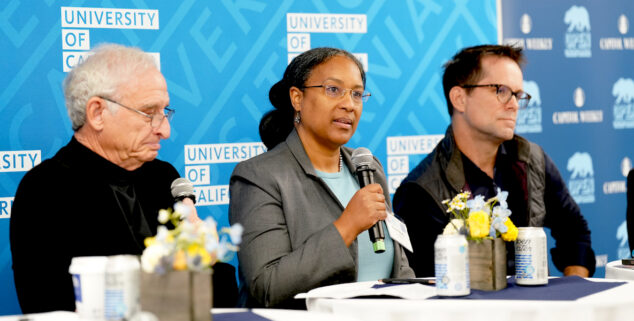 Mark DiCamillo of the Berkeley IGS Poll, Dr. Shakari Byerly of EVITARUS and Paul Mitchell of Political Data Inc., speak at a panel on polling at A Post-Mortem of the 2026 Election, November 5, 2026. Photo by Joha Harrison, Capitol Weekly.
Capitol Weekly’s much-anticipated Post-Mortem of the 2026 Election on Thursday was a singular look into the hows and whys of the candidates, propositions and polls that shaped the California election, in particular.
More than 20 speakers shared their knowledge with the audience across six panels over the course of several hours, in front of a large audience at the UC Student and Policy Center in downtown Sacramento, just steps away from the Capitol.
Though the “blue tsunami” enjoyed by the Democrats Tuesday evening was at the forefront of conversation, panelists also had insightful commentary on the aftermath of Proposition 50, the success of pollsters, why certain propositions succeeded or failed, the character of the new governor-elect and what the official parties should do next as California moves toward 2028.
Panel 1: Blue Wave or Washout?
In the first panel of the day, political columnist Dan Morain discussed the overall takeaways from the election with Sean Clegg of Bearstar Strategies; Rusty Hicks, Chairman of the California Democratic Party; Lindsey Hopkins of SEIU California; and Andre Levesque of Gilliard Blanning and Associates.
“I don’t think there has been a greater self-inflicted defeat; you’d have to go back to Marie Antoinette and the French Revolution,” Clegg said of the national Republican Party.
When asked by Morain about the ideological split in the party, Chairman Hicks said that the “Democratic Party is a big tent” and they now have “an opportunity to prove it.”
“Putting the right candidate in the right seat at the right time is frankly more important to me than getting caught up in who fared better,” Hicks said.
Clegg said the debate between the Democratic Socialists and the moderate wings of the party shouldn’t be the discussion: “We gotta stay away from that and recognize that, ultimately, winning campaigns is about winning coalitions.”
Panel 2: The Ballot Initiatives
The second panel was a focused discussion on the state propositions between Brandon Castillo of Bicker Castillo Fairbanks & Spitz Public Affairs; Teri Holoman of the California Teachers Association; Thad Kousser, UC San Diego; and Rob Lapsley, with the California Business Roundtable — moderated by Seema Mehta of the Los Angeles Times.
Mehta jumped right into a discussion of the state’s controversial propositions concerning wealth taxes — 40, 41 and 42. (As of writing, propositions 40 and 41 look poised to fail, while Prop. 42 is ahead.)
Kousser began the conversation lamenting that Prop. 40 had been structured the way it was, with most of the windfall from the proposed tax going toward the backers of the proposition.
He said the “decision to focus revenues in one particular area, helping one particular group, had divided the progressive coalition. “(The division) made it a David and Goliath fight” when it could have been “Goliath vs. Goliath,” he said — uniting the unions against billionaires.
Holoman said most Californians are in favor of wealth taxes, but people trusted the direction of unions who came out against the bill, including the California Teachers Association and the California Building Trades.
Holoman also gave credence to the generalized anti-tax messages that were not targeted at a particular measure. “There’s not a single one of us who doesn’t have a family member, neighbor or friend who’s not financially struggling in some way,” she said.
Luncheon Keynote: The Polls
KCRA 3 political journalist Ashley Zavala led the noontime discussion with a stacked panel of California pollsters, including Mark Baldassare of the Public Policy Institute of California; Shakari Byerly of Evitarus; Mark Di Camillo of the UC Berkeley Institute of Governmental Studies; and Paul Mitchell of Political Data, Inc.
The main topic of discussion for these panelists was whether or not the polls got it right this year — which they overwhelmingly did. They also discussed how to find trustworthy polls, especially given the influx of betting markets and the way those can affect public responses.
Byerly said the polls saw the blue wave coming, “but not the blue tsunami.”
“Polls are not a crystal ball,“ she joked.
Baldassare said that he has been particularly concerned about how the betting market polls have been infiltrating the news media’s coverage of elections, and urged journalists who are concerned about the validity of a poll to reach out to pollsters with verifiable backgrounds, and look at the data to confirm.
“(It’s) easy for sensational information to catch fire which further undermines public trust,” Byerly said.
Panel 6: The Dem on Dem Races
Panel 6 was ostensibly a discussion about the Democrats’ intraparty contests in certain California districts, which have set up tense battles between younger, democratic socialist-affiliatted candidates and older, moderate Democrats.
But the campaign managers for the Mai Vang and Rep. Doris Matsui — Nairka Joe Treviño Müller with Vang, and Bill Wong with Matsui — came out swinging with a contentious discussion that mimicked much of the conversation coming from the campaigns in the last few months. (The CA-7 race has yet to be decided, though Matsui is currently leading by double digits)
Doug Herman of the Strategy Group and a former campaign strategist for Karen Bass’s 2022 LA mayoral campaign, reminded both campaign managers that “voters think there’s a lot of petty backfighting going on when they hear a conversation like that and it turns them off.”
Ruth Bernstein, with EMC Research, agreed and said that it was labeling that voters don’t like to hear: “They want to learn about the candidate and what they stand for, and they get frustrated by being treated like they don’t know anything,” she said. “They don’t want to hear these accusations going back and forth.”
“Every campaign has an obligation to look at the Republican vote and see (who) is going to vote. Do you need to persuade them or dissuade them? That’s the real game,” Herman said.
“And let’s not forget about the (No Party Preference) voters,” Bernstein said. “Understanding them is important. This really is much more nuanced than just party; this goes beyond that.”
Other panels during the day’s event included Capitol Weekly reporter Leah O’Tarrow moderating a discussion between California Democratic Party and California Republican Party operatives on what did and didn’t work for each in this election, and editor Rich Ehisen interviewing Francisco Silva of the California Primary Care Association on Governor-elect Xavier Becerra.
Want to see more stories like this? Sign up for The Roundup, the free daily newsletter about California politics from the editors of Capitol Weekly. Stay up to date on the news you need to know.
Sign up below, then look for a confirmation email in your inbox.
Leave a Reply