
Podcast
Special Episode: Intersection of Climate and Housing policies
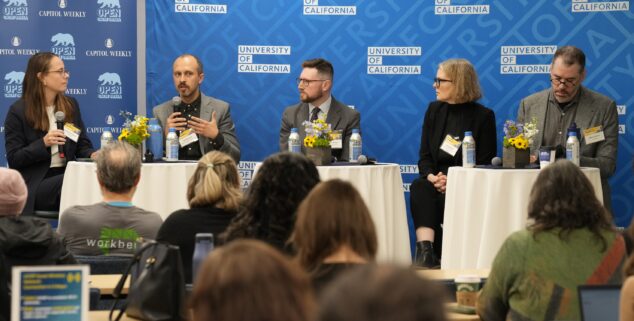 L-R: Camille von Kaenel, Politico; Zak Accuardi, Natural Resources Defense Council; Jordan Grimes, Greenbelt Alliance; Moira O’Neill, UCSF School of Law; Brian Hanlon, CAYIMBY. Panel 2 at A Conference on Housing, Feb. 24, 2026 in Sacramento. Photo by Joha Harrison.
CAPITOL WEEKLY PODCAST: This Special Episode of the Capitol Weekly Podcast was recorded live at A Conference on Housing, which was held in Sacramento on Tuesday, February 24, 2026.
This is Panel 2: Intersection of Climate and Housing Policies
Zak Accuardi, Natural Resources Defense Council; Jordan Grimes, Greenbelt Alliance; Brian Hanlon, CAYIMBY; Moira O’Neill, UC College of Law, San Francisco
Moderated by Camille von Kaenel, POLITICO
This transcript has been edited for clarity.
CAMILLE VON KAENEL: Thanks for that introduction, and thanks to the panelists for joining me today. I’ll just do really brief introductions. We have Zak Accuardi from the Natural Resources Defense Council. Jordan Grimes, from the Greenbelt Alliance. Moira O’Neill, from UC Berkeley. She’s a public law scholar, and Brian Hanlon from California, YIMBY. I wanted to start with kind of a broad question for all of you, and we can kind of go down the line. I used to hear a lot about infill housing being a climate solution. Even from environmental groups who were once opposed to development, I don’t hear a ton about that anymore. I wanted to just kind of ask you guys, why is that? Is it just kind of accepted wisdom now, or what is the status of the Environmental Climate Housing Coalition on the ground? Do you want to start, Zak?
ZAK ACCUARDI: Sure. Thanks for having me, and glad to be with you all. NRDC has been working at this intersection of housing and climate for a long time, and in California, that history goes back in probably as long as we’ve been working in California. We’ve also been doing this work federally back into the 70s and talking to EPA about rules about housing and parking regulations and how that connects to our national clean air goals.
So, this thread has been alive for a long time, and I think it’s astute to see, to observe that the way that coalition is comprised in present day looks a little bit different, and that discourse looks a little bit different than it has in the past. There are some, I think, slightly less interesting sort of systemic reasons for that. They include kind of the approach of the state’s political leadership in some of the recent years, which is a little bit less focused, by my observation, on big compromises and kind of forcing everyone into a room and around the negotiating table. I think there’s a little bit of that.
There’s a kind of boring nonprofit reason, which is I’d say, less of a philanthropic funding appetite to support the kind of smart growth advocacy that really flourished in, is still alive and well in California. It’s just constituted differently. The groups that are funded and better best resourced to do it. But certainly, as the first panel discussed, and as the next one will too, I’m sure there’s still a ton of this work happening. There are still a really active group of environmental organizations that are actively promoting infill housing. NRDC supported SB 79 last year, and thanks to the leadership of a couple of other folks on this panel, that bill signed into law just as a recent top of mind example.
There isn’t a more interesting answer to the question in terms of how the constitution of the environmental community has changed in the past several years. I’d say a balance that climate and environmental coalitions are still working to strike in the right way.
There’s been a lot of grappling, especially in the past ten years, maybe even more starting in 2020 with the murder of George Floyd. A reckoning in the environmental community about some of the exclusionary, racist, environmentally unjust impacts that our work historically has had. I’d say in some parts of the environmental movement, there’s been an overcorrection to being extremely dug in on certain parts of the environmental policy landscape. That, and a continued grappling in this moment of what is the right balance to strike between protecting community voice, especially in environmental justice communities, and the ability to defend the rights of those communities to the rights to self-determination, to protect the air that they breathe, the water that they drink, and so on.
A grappling with how you do that in a way, especially in the context of housing, where you’re also allowing the market to create affordable housing, to preserve affordable housing, and to build the housing that we know the state needs in order to in order to grow affordability in the state. That is a live tension in the environmental movement, and it has caused to some degree. In some groups it’s heterogeneous. In some parts of the community, it’s caused a step back from engaging on these issues, so I think that’s a real phenomenon and an area of active tension.
CVK: Thanks.
JORDAN GRIMES: Yeah, great question. I think it’s a real one. I agree with everything I just heard from Zak. I will say it’s certainly a tension that we see at Greenbelt. Our organization’s been around since 1958, working predominantly throughout the Bay area. We have really gotten involved in Sacramento and the legislative world in the last couple of years largely due to this issue. Largely due to what we have seen is to be quite frank, a lack of leadership in this particular space.
Greenbelt Alliance was proud to co-sponsor SB 79 last year with California YIMBY and many other really great organizations. We’re also, I think, the only environmental organization to support AB 609 by Assembly member Wicks. The sequel infill exemption, the statutory exemption for infill housing. We recognize we’ve been doing this work for a long time.
We had our first housing working group in 1978 and have recognized that you do need to give people an alternative to sprawl. You have infill, you have sprawl, and you can choose one or the other, but people are going to come to the state and they are going to want to live. They’re going to have children. You need to provide somewhere for them to live. I think there has been a real lack of leadership in the environmental movement, and frankly, on this issue. I think we’re starting to see things change. We’ve been really proud to co-sponsor a statewide group called the Alliance for Housing and Climate Solutions with our partners at Prosperity California, really trying to bring environmentalists and housing advocates together, but I think there just are a lot of tensions still.
Many of the tensions that Zak mentioned around environmental justice. Sort of that overcorrection that we saw that are still getting worked out. I think core to the environmental movement in the 1970s was really a focus on, small is good and big is bad, and a focus on real direct democracy, the voice of the people being the ultimate thing that we should focus on.
I think there’s a real question that environmentalists have not grappled with of whether that is true or not, and in which circumstance is that true? Is it allowing communities, especially wealthy communities to use environmental law and to use process to block everything that they don’t like. Is that the most democratic way of doing things? Is forcing people to come to city council meetings and stay until 1 a.m. to fight over an apartment project the environmental outcome that we would want from that law? I would say no. So, I think there has been this reticence to address these things and to address some of our core beliefs from the 1970s, but I think we’re starting to move into new territory.
MOIRA O’NEILL: I’m faculty at UC law, so I’m not involved in coalition building or mobilization of communities in the same way that the other panelists are. I can’t really speak to the temperature among the groups that you’re working with, but what I can say is, stepping back as a scholar who’s invested and interested in seeing how the law is evolving and responsive to this demand for a need for infill development is to sort of see what’s going to happen now that we’ve had some big ideas codified, right? Like SB 79 is a big idea, but sometimes people accept great ideas at a distance. I think, as Jordan was just sort of explaining, I mean, you were detailing in a way what can happen when it shows up within your space.
So, I think what we have to watch is what’s going to happen with presentation of alternative plans. What are they going to look like? Are there going to be efforts to avoid SB 79, in ways that actually avoid the policy goals of SB 79, or are they going to be nuanced ways of complying with SB 79 that are sensitive to the tensions that I think both of the prior speakers are speaking to? There is a complexity with which communities, which neighborhoods carry the weight of what we need to accomplish to address climate. There is a tension with how we define participatory democracy in this space. Right? Like at what scale? Who are we responding to and at what need? Those are tensions we have to deal with. The law that we have right now, some of the recent law does seem to try to confront these conflicts, but we don’t know yet what implementation is going to look like. From that perspective, for what I care about, I’m watching implementation.
BRIAN HANLON: Let’s see. Okay. We’re on. Hi. As the housing guy in the panel, let me just say that I too am a real make fundable environmentalist. I start every morning with a bowl of homemade granola and goat milk kefir. I’m 43, and I bought my first car last year. Just this weekend, I was trespassing on some timberland roads, hopped two fences to go on a hike between Santa Cruz and Silicon Valley. I’m into all the same stuff, and I gotta say, God damn, is it frustrating? If you go back and look at some of the Sierra Club’s writings from the late 90s, early aughts, they were all in on infill.
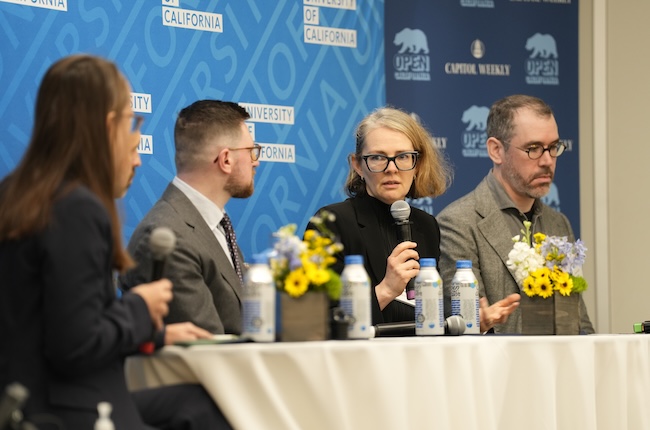
L-R: Camille von Kaenel, Politico; Zak Accuardi, Natural Resources Defense Council; Jordan Grimes, Greenbelt Alliance; Moira O’Neill, UCSF School of Law; Brian Hanlon, CAYIMBY. Panel 2 at A Conference on Housing, Feb. 24, 2026 in Sacramento. Photo by Joha Harrison
In fact, when I wrote the first version of the bill that became SB 827, which became SB 50, which became SB 79. I was really thinking of that old sort of smart growth writing from the Sierra Club, from other groups in this like late 90s, early aughts environmentalism. So, what happened? Well, I don’t entirely know the full history here, but two big things. One of the billions of dollars spent every year in climate philanthropy is basically zero for infill housing advocacy. That is totally correct. There’s almost nothing out there. They’re just not interested in it, and then two, I think what happened in the you know, this has been going on in California for a while but really got turbocharged after George Floyd’s murder. A whole bunch of enviro funders and big enviro groups began like a left coalitional first like advocacy approach and this sort of sense that you need to be totally deferential to any sort of environmental justice organization.
Well, the thing is, environmental justice concerns are very real, right? They put the battery recycling plants in certain neighborhoods. They cited public housing near highway interchanges and that sort of thing. There are very real environmental justice concerns that need to be addressed, but like building an apartment building near a bart station, that’s not it. What’s more, a lot of these organizations opportunistically use the language of EJ in order to achieve their other, larger ideological goals and factional political goals.
Since I’m at a UC affiliate event, I’ll just go ahead and use some jargon right now. You have effectively a number of organizations, led by Gramsci, who are fighting a war of position for hegemonic dominance within the left ideological space. A whole bunch of enviro groups decided that I need to partner with them and defer to them on any of our policy positions, including bills like SB 79. That has created this bizarro and counterproductive focus from a policy perspective. Not like they just advocate for bad policy that hurts people. And then two, from a coalitional perspective, you can kind of squint. That actually does sometimes make sense in deeply progressive cities in California and sometimes even in the California state legislature with its supermajority Democratic tilt. When that kind of politics gets exported to other states and nationally, it’s an absolute disaster, because you actually do need to convince people who are not on the left.
CVK: Great. Well, that was pretty frank, let’s keep that going.
BH: You wanted to keep it spicy, right? I mean, like our five five-minutes call.
CVK: Spicy and informative, both at the same time. Politico brand. When I think of the intersection of housing and climate change, I think about emissions. Obviously, we talked about that a little bit, but also about the impacts of climate change. I think sometimes those can be at odds with each other and nowhere is that more visible than in the LA rebuild effort. I mean, we saw Newsom offer an exemption to SB09. For example, there’s this debate over density and affordability in the rebuild. Should we even rebuild in those areas? I wanted to ask our housing experts about that. Maybe Brian and Jordan, if you guys want to weigh in, how are you thinking about this debate on housing in very climate impacted areas?
BH: Sure. I’ll say one, I think we need to fix the insurance system and allow home insurers to price risk properly. Quite frankly, that would effectively stop sprawl in welfare areas. If we could just do that one thing. You don’t really need any other policy hacks there. In terms of the specific question, though, of like, well, what about SB9?
The governor declared, like an SB9 holiday in this area. Well, obviously I think that’s silly and nonsense and it hurts a lot of folks who want to rebuild because if you are, effectively, you’re no longer house rich because you no longer have a home, but you might still be land rich. Well, if you don’t have enough money, if your insurance didn’t cover the cost to rebuild and clear, most insurance policies for folks who are impacted by the fire did not cover the full cost of rebuild, then SB9 allows you to sell half of your land in order to cover that cost.
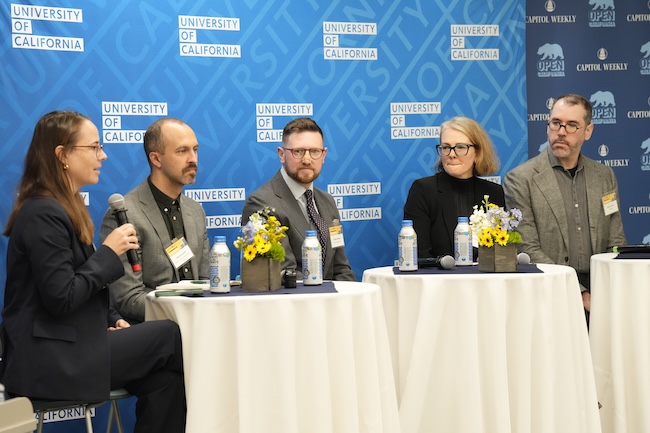
L-R: Camille von Kaenel, Politico; Zak Accuardi, Natural Resources Defense Council; Jordan Grimes, Greenbelt Alliance; Moira O’Neill, UCSF School of Law; Brian Hanlon, CAYIMBY. Panel 2 at A Conference on Housing, Feb. 24, 2026 in Sacramento. Photo by Joha Harrison
So, I mean, I actually think it is a positive, helpful thing for folks there. I think the espionage holiday is silly. That said, like you can’t take the politics out of politics. There was something like 6 or 7 espionage applications, in order of magnitude or two more ADU applications, like, you know, guys like, I don’t know, let’s just chill about it. SB9 has become this strange fetish bill that folks attribute all this like magical power and ill will towards, and it’s frustrating. There are other statutes and housing programs that can accomplish effectively the same ends. Increasingly, ADU law and the Starter Home Act are able to do that quite frankly, more effectively, so I think we should just let the SB9 issue lie in that area and not make a big stink about it.
JG: Yeah, I don’t know that there’s a good answer to this one. It’s tremendously complicated when you’re talking about rebuilding in communities that have experienced this kind of event because you do have so much pain wrapped up in it. I think at the same time, it’s pretty important to allow communities to build back to higher safety standards. I think we don’t want people replacing tinderboxes from the 1950s with new Tinderboxes. I do think we should want them to build back more safely. I think the bigger question is, are there areas where we don’t want to build back? What does that conversation look like? You know in a state where you had cities and suburbs that were vastly more affordable than California, like maybe that could be a real question of what do we do? Are there communities that we should ,essentially, the physical places abandoned and move people to new places.
Given that we don’t have that affordable housing stock in cities, as it stands, I think that’s a much harder proposition. In terms of the SB9 conversation, though, I would have to agree with Brian. I think, certainly we would like to see people be able to utilize the laws that we’ve passed if they want to. This fundamentally is about choice, right? So, I do think that is what comes down to in terms of Brian’s comments on insurance, I think that is right as well. We don’t adequately price risk in this state. I think we all know that, and I think if we did, we would see some very different development patterns in California than we currently do. Brian, I look forward to running that bill with you someday.
BH: Man. I mean, Matthew’s been trying to drag me into fixing the insurance industry for the past five years and talk about, like a.
JG: I’m very grateful to him for it. Yeah, I do think if you look at how and where California builds right now, we have started post-great recession, like moving in the right direction in terms of building less sprawl. I do recognize that BIA is a sponsor of this. Again, thank you for having me, even though we obviously disagree on that point. I think in terms of the issue that we haven’t really solved, we have not rightsized the incentives on infill not only from, zoning, permitting, everything else, but also in terms of financial incentives, sprawl versus infill and where our money goes.
CVK: You guys are talking about a market fix, like if we price insurance, right? Maybe this will solve itself on its own, but I wonder more. You look at land use regulations really closely. Is there a land use fix as well? Do land use rules incentivize development in areas that don’t have good insurance availability or affordability?
MO: Well, land use rules incentivize or disincentivize development just broadly, right? The work that I do explores not just sort of density controls, design controls, but also the procedural delays that flow from combination of those kinds of controls and the forms of approvals that attach to land use approvals. So, it’s dated.
The work that I have in terms of actually looking at a large number of entitlements to sort of see what’s going on with timelines. It’s true that prior to some of the law that’s recently been enacted, that when colleagues, I, and students would compare what was happening in jurisdictions that were infill, what we would describe as more broadly, having more parcels that we think of as infill and less likely to be at risk for some of the events that other panelists are describing, those processes were longer. They were more difficult. It was much comparatively more difficult to develop in the city of San Diego compared with in the county in the data that we had right now, whether some of that’s going to change after some of the rules that have just been enacted is something I don’t know yet, hopefully.
But with respect to how that intersects with the comments that Brian just made about pricing, insurance and so on; I mean, if you’re building in the WUI and I can imagine that is a riskier development in terms of what’s going to happen, and that would suggest that probably isn’t sensitive to what we need to do with respect to insurance as compared to being able to develop infill spaces where you just have less fire risk and less other risks that I think are driving this question.
CVK: Thanks. On infill, on emissions, we do have some sort of broad framework for a while now on trying to tie housing and emissions goals together in SB 375. It’s been a while, and I want to revisit it and ask, is it working? What could we do to improve it? Maybe Zak and Jordan, you guys can weigh in on that.
ZA: Yeah. Thank you. For those who aren’t familiar, SB 375 the Sustainable Communities and Climate Protection Act was passed and signed into law in 2008. In California, NRDC co-sponsored that bill, then tracked implementation in the years since.
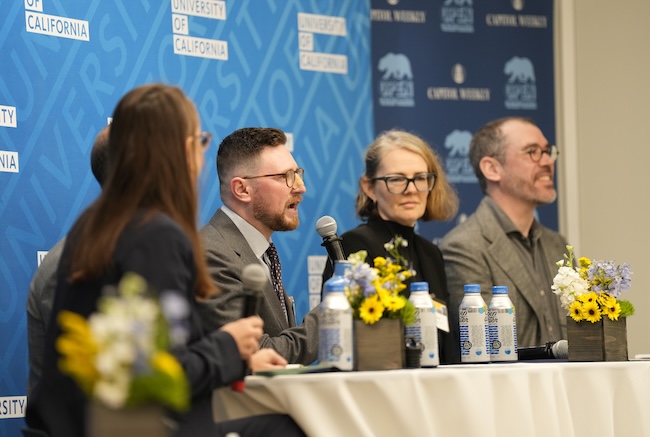
L-R: Camille von Kaenel, Politico; Zak Accuardi, Natural Resources Defense Council; Jordan Grimes, Greenbelt Alliance; Moira O’Neill, UCSF School of Law; Brian Hanlon, CAYIMBY. Panel 2 at A Conference on Housing, Feb. 24, 2026 in Sacramento. Photo by Joha Harrison
What the law did is a landmark law, the first of its kind in the country that established a framework for aligning land use and transportation planning decisions at the regional level, meaning the metropolitan regions in the state with the state’s newly ambitious climate goals, climate change mitigation goals so reducing greenhouse gas emissions. This is a really powerful idea. We need to decide where and how we’re going to build homes, commercial development, and where we’re going to site new transportation infrastructure. What kind of transportation infrastructure are we going to build? Is it going to be more highways? Is it going to be transit? Is it going to be infill development? Is it going to be sprawl?
This law was really confronting as Jordan said earlier, this really clear binary. We can incentivize sprawl; we can incentivize infill development, and we know quite well that the cycle of more subdivided sprawl development, followed by and preceded by new highway expansions, new interchanges that allow people to get to these new subdivisions.
This is a Ponzi scheme. It adds to the financial burden of the state to maintain the road infrastructure, to supply new infrastructure to these new subdivisions. It erodes the state’s amazing natural resources and the ecosystems that we’re trying to preserve. It adds time to people’s commutes. It forces these zero sum trade offs that anyone who wants to buy and afford a home in California needs to negotiate.
Where can I afford a home, and what does that do to my commute? What does that do to my ability to visit my family, to visit the things that I want to do? This was a law that was intended to really turn the corner in California for and disrupt this unproductive cycle, that this state and the broader country has been in for a long time. It hasn’t worked the way that we hoped it would. It has had probably we think, we hope some beneficial impact. It certainly has. There’s certainly within the MPOs, the metropolitan planning organizations who are primarily charged with implementing this law.
We can feel quite confident that it has helped them make better decisions over the course of the 18 years this law has been enacted, but it absolutely has not delivered on its kind of full, ambitious promise. There are a few reasons for that. One is that the law, as it’s being implemented now is just laden with loopholes. This is especially true from my perspective. I’m a transportation person, and it’s especially true in the transportation infrastructure space where we still have far too many of our public dollars going to invest in these wider and wider roads. We know from every piece of academic literature that doesn’t work. These investments, which cost at least hundreds of millions of dollars each project and often into the billions, they fail to deliver the basic benefits that they promise of reduced traffic, of cleaner air.
It just doesn’t materialize. In fact, those things often end up getting worse, so we’re still spending, as a state, billions of dollars every year that could be spent bringing people closer to their communities and actually cleaning the air, on these terrible projects. There’s also some real problems in the accountability, the fundamental accountability structure of the bill. This operates in a bunch of different ways, including, accountability. The accountability measures that do exist in the law are often disconnected from the actual ability to act in the law, so there are strong accountability provisions that do exist for NPOS, but NPOS don’t actually control local land use decisions. There are still ways that state agencies under this law are able to skirt the rules of the law and still build these highway expansion projects, including in the regions that are best positioned to build infill housing.
NRDC sued and has an active appeal against the state in a project in the Sacramento region, the Yolo 80 corridor highway capacity project, and that project should have been subjects to SB 375 rules, but the project that the state, in partnership with Yolo County have actually built is not the project that was described in the SB 375 approved plan. That’s our contention. We’ll see if the courts eventually agree. This is a law that offers a very powerful promise and hasn’t fully delivered on its on that promise.
JG: Yeah, It hasn’t worked, since we’re having a frank conversation. It hasn’t worked. Obviously, there are other factors that go into this, but if you look at where emissions were in 2008 and where emissions are, almost 20 years later, we’re not where we want to be going. Literally, all you have to do is look at I-80 and see, a couple miles from here and go like, yeah, we’re still doing the same things that we’ve always done that we know don’t work, and that’s a shame. There are no reasons for that, and as Zak said, it really has to do with the accountability mechanism or rather lack thereof.
Regional governments are, and this is where we get to the spicy part for all intents and purposes, a figment of our imagination. At least under California law, they do many wonderful things. In fact, I see some of my friends who are planners with those organizations in the audience, but the fact is, they don’t have the power to compel local jurisdictions to actually do the things that we want them to do. If they did, Brian and I wouldn’t have to run bills like SB 79. The local governments would just do it, and that is why the state has stepped in the way it has, and why advocates have moved into this new venue is because just suggesting to local jurisdictions that they do something has been the path that we tried to do for about 40 years, including through 375.
There was accountability at the regional level, which I said largely a figment of our imaginations but not at the local level, and so that is where the disconnect is. I do want to acknowledge there are many good cities across the state that do care about housing, that do understand these patterns. I want to call out, because we’re in Sacramento the city of Sacramento as a good actor, the city of San Diego as a good actor, but if you look at where our land use patterns are now versus 20 years ago, they have not shifted dramatically in the way that we have needed them to, especially on the side of producing that infill, so no. 375 has not worked.
We need to do a lot more to actually you know, hold local jurisdictions accountable and to actually help people understand the tradeoffs that we make when we choose not to build in urban cores to help people understand that the apartment building that you don’t build in San Francisco or Palo Alto or Piedmont does not just go away when you don’t build it. It rematerializes in Tracy and Manteca and Lathrop and Victorville as sprawl that, by the way, we are all paying for in terms of higher transportation costs, higher infrastructure costs and taxes and things of that nature.
BH: Can I just real quick, I mean, just for those in the audience who are engaged in policy making. I guess I thought I’d see more students here, but, whatever. Maybe you’re all lifelong learners. Sometimes, crafting policy to actually work is challenging in certain areas. There are unknown unknowns. There are second order impacts that may have been very difficult to forecast, but to be clear, this bill was amended in order to make explicitly clear that the actual land use planning done, as a result of it, the sustainable communities strategies would not override local zoning.
It was clear from the beginning, this was, quite frankly, all just a bunch of kumbaya nonsense of a bunch of Californians that want to get together, be like, oh, we’re tackling climate change and blah blah, blah. No, you weren’t, It was a coalitional exercise to pass a bill over really hard opposition. I’m not saying you could have gotten a better deal or anything, but it was clearly like not going to work from the beginning. Jordan and I could spend a weekend, and we could write a version of this that would actually work, but now could we get it passed? No, but we could do it. Oh, one thing I should say though, everyone’s saying it hasn’t worked. It has worked extremely well to enrich consultants and planners and environmental and economic consultancy firms, so a bunch of folks have made a lot of money off this bill, drafting plans that do nothing.
MO: Not to be controversial, but I think something that has to be acknowledged because in the comments, what I think I’m hearing is the recognition that really fundamentally local, general purpose governments hold land use authority still for the most part, and the fact is though, is that there really has not been an appetite for true regional government for a long time. The law has shifted dramatically through things like Senate Bill 79 423, even 35, and shifting some authority that has historically been held by general purpose local governments.
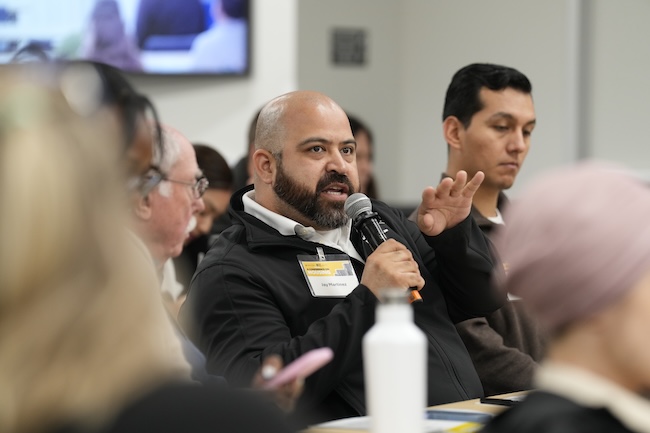
Audience member poses a question during Panel 2 at A Conference on Housing, Feb. 24, 2026 in Sacramento. Photo by Joha Harrison
That is a big deal, so I just want to call out like, I hear the fact that I’m sitting among colleagues who could have written something different in terms of efficacy, but I think it’s even bigger than a political appetite question. I think that there is a historical sort of legal structure that’s been in place that predates all of us. That is not easy to unwind. I do think we have to just take stock of the fact that what has happened in recent years is a pretty big deal in terms of some major shifts in how we allocate power over land use development between localities in the state.
It’s a wait and see as to whether it’s going to address all of the things that I think we’re all sitting here talking about and concerned about, but I’m just saying, like when we evaluate efficacy of different law, particularly law written years prior, it’s like we do have to take into consideration the state legal framework that is embedded in our Constitution and has been in place for a while, and it’s not easy to unwind.
CVK: How much do each of you spend time and effort on the state level versus the local level? I’m in Sacramento. I get sometimes Sacramento tunnel vision. How much time do you spend in Sacramento versus locals?
MO: In terms of analysis? That’s like pretty much all I spend my time paying attention to is the balance of power between the two levels of government, and which one is the appropriate venue to address. Some of the questions that I think other panelists have raised, how are we going to address environmental justice while also addressing climate or other environmental harms? How are we going to deal with the democracy question, how are we going to allow for people who live in a given place to participate in a way that doesn’t actually derail policy goals that are important to everyone within the jurisdiction or the region? And how are we going to deal with the supply issue at the same time? I mean, I spend my time looking at these questions in depth, and I find that I have yet to find really solid, straightforward, easy answers.
BH: I guess I don’t want the answers to be quite so complicated, so I focus entirely at the state level. While organizing at the local level is very important, local governments still have a lot of power. Local governments, like local officials themselves, are very influential in the state legislature. Many state legislators used to be in local government. They certainly know the local mayors, their city council members, they talk to them.
They matter politically quite a bit. All that said, I never thought local NIMBYism would actually change things in a substantial way. I always thought you had to go to high level government. While it is true that the California Constitution does devolve a lot of responsibilities down to the local government, in the American system of government right, local governments are creatures of the state and have no rights. Like Jimmy Madison, didn’t care about local government. I do think ultimately what we’re talking about here is elevating land use decisions, where they properly belong, which is at a much higher level than like local governments.
It makes no sense that Palo Alto can okay a whole bunch of office space and then East Palo Alto gets screwed like that. Like why was that like a Democratic Lib markets work across these kinds of borders., and because we don’t have regional governance governments. And I actually don’t think that we should, because I mean, how many Californians even know there’s a state Assembly?
You need to make accountability, like, much more clear and transparent over who is responsible for what, and given that local governments are pretty clearly not the correct site in order to be making these decisions, then the state seems the only real option and you can still do a whole bunch like local planning and participation and all the rest to understand the contours of it. Let local officials still decide, “oh, do I want to fund, I don’t know, an ice-skating rink or a basketball court or like, you know, like whatever”. I’m not saying they should be made totally redundant, but in terms of land use, it’s got to be the state level.
JG: Yeah, I’ll say so. Greenbelt has worked at the local and regional level for a long time. Obviously, our foray into Sacramento is newer, so I think we do take a little bit of a different tack than Brian in that we do see the value in working locally and regionally. This is a big state with a lot of very different communities, and we try and I think rather what we were, trying to do right now is filter up the things that we have learned at the local and regional level into state planning. I think fundamentally, the reality is, especially on local land use efforts. In my previous role at Greenbelt, I was our South Bay manager in the Bay area, not in Southern California, and during the recent housing element process worked on maybe, I don’t know, 20, 25 different housing elements. It is playing whack a mole to a certain extent, and there, the value proposition of, doing that city by city, wall to wall rather than at the state level. I think is really something that we are, sort of reevaluating and thinking about just in terms of is this, the local sort of planning efforts that we have pursued over the last 58 years?
Has that led to the results that we want? I would say predominantly, no. There are good things that have come out of it and it is still absolutely worth it to do local and regional work, but there are certain things that should be decided at the state level. There’s a reason that we have, a state Board of Education. There are certain things that fundamentally, we know we have to do as a state that everyone needs policies that benefit everyone, and we can’t just let certain jurisdictions opt out. That’s why we’re starting to focus more at the state level.
ZA: The simple answer to your question for NRDC, is that NRDC is an international environmental nonprofit, so we work internationally. We work in the US federally. We were really founded in a moment there was a lot of federal work needed, so it’s been a lot of our organization’s bread and butter. But increasingly, we work at the state level. We’ve actually done a lot of work at the local level as well, including on local land use and zoning policy at the municipal level, so work at all of these levels is important, and the way that they’re interconnected, as everyone has thoughtfully just discussed, is really important as we think about the broader design. I want to pick up on maybe two threads.
One of them is personal. I think the reason for me personally, I find work at the state level and this really important conversation about what’s the right jurisdiction, especially for land use policy decisions. Two personal examples; I grew up in Oregon, in 1970 or thereabouts, established an urban growth boundary law that is also not a perfect policy, but has had huge beneficial impacts in terms of ecosystem preservation and smart growth implications.
I’m really proud of that being, having grown up in Portland, seen, and experienced very vividly the benefits of that legal framework. I moved to Berkeley about four years ago. I noticed when I was walking around my neighborhood that there was this plaque that said something that I thought made me curious about the history of my neighborhood, let’s say. I looked into it, and it turns out that my neighborhood was just called the Claremont neighborhood. I live in an Adu, so shout out to all Adu legal reforms that allow me to afford to live where I live.
The Claremont neighborhood was one of two neighborhoods in Berkeley that was largely developed in the 1920s and 30s. It was developed by a former president of the Sierra Club as one of the board members, and they were making this investment. They were seeing this landscape of land use regulation, and they were thinking these tools are not sufficiently exclusionary for us. Racial covenants weren’t strong enough to protect this investment that they were making.
They wanted it to be even more airtight. That undesirable people, poor people, people of color, couldn’t move into this neighborhood where they were making a big investment and they wanted to make sure it penciled out, so they invented this interesting idea called single family zoning. Berkeley was the first city in America where this policy was enacted, and it was enacted as an exclusionary tool by a person. One of many of the investors was this person who later, I think, served as the president of the Sierra Club, and to this day, I moved into this neighborhood.
One of my neighbors had a sign hanging from his balcony that said, “A war on single family zone homes is a war on families.” He lives alone. This is a thing that really plays out in really active, specious ways, and the politics of local government action on this issue. The cities that Jordan very appropriately shouted out are the exception, not the rule here, and even the progressive leadership in Sacramento, San Diego, or any of the other cities who have lead on this is tenuous. It could go the other way in response to some change in local politics and the backlash that we see on so many issues, so it really is appropriate to be working at the state level on, this set of issues in my view.
BH: I strongly encourage folks, if you want to learn more about the history of Berkeley zoning, read the 1915 edition of the Berkeley Civic Bulletin. There was a zoning issue that year, and they didn’t use euphemisms in 1915. They knew exactly what they were doing, and it worked.
CVK: We’re going to be moving to audience questions soon, so just start thinking about those, but I have a few remaining ones. Speaking of local projects, I wanted to talk about California forever because I know we have some differences on the panel, so is California Forever a climate solution? Brian and Jordan hash it out.
BH: Well, I would argue that California Forever is a great idea on balance, as to what I defended on the merits like climate solution. I don’t know I’d go that far. I mean, I think it’s cool that an immigrant wants to build a little bit of a Czechia in Solano County. That’s awesome. I think like for those who don’t know, the California Fair Project is a proposal to build a city of about 400,000 people in this sort of mid-rise walkable neighborhood with complete streets and great internal transit, and if you look at the plans and if you look at the ballot initiative before they pulled it, I thought it was great. It really would have accomplished its goals. It would have been arguably the most walkable, bikeable city in the entire state of California.
In terms of how you would estimate, what is the VMT impact? It’s pretty tough to do because it was highly contingent upon like, what kind of external connections there are between California forever and other regions? One of the proponents said it would be lower than San Francisco’s. We were skeptical. Our back of the envelope analysis suggested to be on par with Walnut Creek, which is still actually pretty good.
Because we, of course, favor building more housing in Walnut Creek, I do think it’s important. The reason we support it as an organization, for basic reasons, one, I think it’s good the merits, it’s a whole bunch more housing. I think they’re actively working on increasing rail connections to Capital Corridor and Bart.
Two, it’s a great example of what new development can be. The vast majority of development in the, United States and globally is greenfield development. A very small percentage of development is actually urban infill. Almost all greenfield development in America is garbage, I would argue. I mean, garbage isn’t fair. People like different things, but from a climate perspective, it’s not good. This, I think can be a real positive example, especially if investors make money off of it. It’s like, oh, wait a minute, like, can I do this in Texas? Can I do this in Florida? Can I do this in places that build tons and tons and tons of detached single family homes? Sprawl? That would be really useful, and then two other reasons were less policy driven.
One, I was, folks have like disagreements and I think it’s okay to be a YIMBY and not support this for other reasons. We were clear about that in our endorsement letter, but I did see a lot of really bad epistemic practices around this. I thought, folks being disingenuous, like what the actual plans were. I see this in a lot of advocacy communities where folks, I think sometimes instrumentally be like, oh, it’s actually good if we just sort of like, ignore truth in some cases in order to get like what we want.
I think YIMBYs have been pretty good about not doing that. A lot of us are very nerdy. We’re deeply enmeshed in the academic literature and like the reality based academic literature, not like Marxist geographers, so I saw that as a problem, and wanted to step in. Also, I felt bad, the head planners gave Metcalfe, who was like Mr., you know, urban infill for a quarter century, and I’m like, he’s like old friends were like, Gabe who? I don’t know. I thought that was also a little bit unfair.
JG: There’s a phrase in common vernacular now falling off which, essentially means, that you once had good opinions and now no longer do. While I have great respect for the work that Gabe has done in the past, I would say that this qualifies to the question of would you say, Cami, what was the actual question?
CVK: Is it a climate solution?
JG: Oh, yeah. That’s an easy one for me. No. Do I think taking 17,000 ish acres of land that has, vernal pools on it that is nowhere near any existing public transportation network, and plopping down a brand new city, do I think that is a climate solution, expanding the existing freeway from two lanes to six lanes? No. I don’t. I think I will start by saying that new cities are not inherently a bad idea.
We do need to do a lot of work on our existing cities, our existing codes. It is not unreasonable. The idea of building new cities is not unreasonable. I will say that location matters. I think that is a big problem with this one. I will say I love the actual plans of the city, and I do think I will say I think much of this is vaporware. I think this is exactly the kind of thing that tech billionaires would dream up.
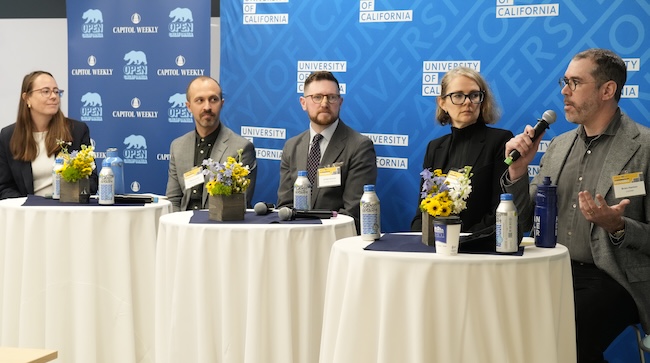
L-R: Camille von Kaenel, Politico; Zak Accuardi, Natural Resources Defense Council; Jordan Grimes, Greenbelt Alliance; Moira O’Neill, UCSF School of Law; Brian Hanlon, CAYIMBY. Panel 2 at A Conference on Housing, Feb. 24, 2026 in Sacramento. Photo by Joha Harrison
A lot of the plans for the actual city itself I think are really wonderful. I would love to live in a walkable, bikeable community. I currently live in a suburb where, it’s sort of like flip a coin every time I get in my bike and wonder if I’m gonna make it to the train station alive or not. That is a community that I would like to live in. The problem is whether you’re able to attract. I think the jobs to that area is a real question.
Is this going to be a true full community or is this going to be somewhere you know a community predominantly occupied by homes, where people then commute to their jobs in the Bay area? I think it’s the latter, quite frankly, the way the city is set up. The city is walkable and bikeable but does have space for I think it’s around 100,000 parking spots on the periphery.
These big sort of parking garages located on the periphery where everyone will park their cars, and you take your bike or the bus to the garage, then you get in your car, and then you drive to the Bay area, to your job in Silicon Valley. From many standpoints, that feels not great. Certainly, from the environmental standpoint where you’re replacing all these vernal pools and things that do have significant ecological benefits. Then, you are replacing that with a bunch of people driving every day.
No, I think there are not environmental benefits there. The way that you would like. I think that money and that effort would be better spent focused on building in existing communities, especially in Solano County, especially in Sacramento, for example. There are cities that do want to build and there’s capacity in those cities, and that is where we should focus. I also want to talk a little bit about the public. Actually, I don’t I’m being waved off. So, I won’t talk about that part.
Rich: Cami, thank you, by the way, for that question for anyone who hasn’t read the program, Jim Wunderman of California Forever is on the third panel today, so you can get lots more on that. If you’ve already asked the question, we’re going to go to somebody else first. Tim, why don’t you grab somebody over there?
AUDIENCE MEMBER: Hi. Good morning. Had a question earlier on the correlation between thinking about housing policy within the context of state governments and local governments throughout any of your work. Do you sort of see city residents, do you have them in mind within the same framework of either rural residents or also residents who live in suburban areas that are urbanized but not incorporated?
BH: I’m having trouble understanding exactly what you’re trying to get at.
Question 1: Yeah. Just sort of generally for when you’re thinking about your work of housing policy, if you think of folks within the state as all sort of living in cities, or do you also think about rural and folks who live in unincorporated areas also throughout the state.
BH: So that’s a great question. I would say like California YIMBY, most of our work, especially zoning work, is really geared towards cities and suburbs in existing urbanized areas. That said, a number of the laws that we’ve championed, like ADU law and then a lot of process-based laws like the Housing Accountability Act and others do also apply in, rural areas. For many of the same reasons, Jordan, like, we’ve chosen to focus our, efforts on infill, and less in rural areas. We haven’t worked to stop development in those other areas, but we’ve just not prioritized it as an organization.
Rich: We have a question right here.
AUDIENCE MEMBER: How do you see community engagement changing, like with people being able to call in to commissions, and not just those who were retired and could show up at 1:00 in the afternoon? The planning commission, I mean, and then my other thought is that these commissions are like a 19th century artifact of the fathers of the community to advise, like we have so many better ways to get engagement and community input. How do you see that as a way to influence?
JG: Yeah, I can take this one. You know, I think. It is great that we are allowing people more opportunity to provide public comment, people who, would not normally be able to. I am grateful that last night my city had a zoning code update meeting and had an item on the agenda, and I was able to call in from the comfort of my home and not have to schlep down to City Hall and stay there until 10:30 at night. When? When the item finished.
That said, even better than that would be that I didn’t have to go to that meeting at all. I would have much rather, enjoyed, dinner with my girlfriend or reading or many other things, so I think there has historically been this idea of, community input as the pinnacle of democracy. I would actually say, I don’t think that’s real or true for most people.
I don’t think most people do want to spend three hours at a public meeting on these things, whether you know it is in person or not and thinking through how we can eliminate that. There are real things that are worth spending your time on, in both the public domain right now. There are real serious issues in our country happening. I would rather spend my time organizing around those things than talking about our zoning code update. Maybe we could figure out a way to allow people to do that instead have to spend hours in public comment.
BH: One quick, hot take. Representative democracy is a good idea, and we should have it.
MO: I just wanted to comment, though, that I do think on the community engagement question. There’s actually scale matters here, so it’s a big difference to have to participate in a three-hour meeting in reference to your housing element, as compared to spending time in an eight hour meeting for a single project approval.
I do think our law is actually quite, recent law I think, has been thoughtful about trying to address that and to shift participation to earlier stages. I think that’s a good thing. To your other point, though, about transitions and format, I think it’s a bit of an empirical question that I can’t yet answer, but I think it’s one that’s deserving of research, because it’s not entirely clear to me that transitioning from an in-person to an online or other medium of communication shifts the ability in terms of individual resources to participate, because resources to participate have to do with one’s capacity to understand what it is that you’re evaluating, your ability to make time for it in your schedule, which may not just be related to time of day.
Like the difference between choosing having dinner with your partner or participating in a meeting is not the same thing as to whether or not you’re working two jobs and you have any time at all to engage in public activities. I do think to the earlier conversations around environmental justice issues and other issues, the fact is that eliminating all participation at all levels could be extremely disastrous for those issues. But, I think being very thoughtful about point in time could be the way to split the difference, so I’m excited about the fact that recent changes do encourage us to do more at the housing element stage, and some of the law that shifts away from discretionary processes to ministerial one moves us away from the project by project. I think that’s a good thing, but I’m not yet sure what we’re seeing in terms of the transitions post Covid with online and other formats.
RE: We have time for one more. We’re going to do it right here.
TF: One minute of questions.
AUDIENCE MEMBER: I just want to thank all of you for spending the time and being here today. My question is, first, a statement. We live in a car society. I’m sorry. It’s just a brief, but anyway, what are you supportive of? The bullet train in California and two what can we do to provide more outreach on public transit? More bicycle friendly, more walkability, regionally?
ZA: Yeah. The high-speed rail project is a really important project for the state, and it’s important in the context of the state’s climate goals, in part because the biggest driver of vehicle miles traveled, which is like a fancy just measure of how much driving and traffic there is. The biggest driver of that is long-distance trips, so building high speed rail from a climate perspective is critical because it’s going to allow people to make long distance trips really fast in a way that isn’t in a car.
Lots of other things that are important about the project. I’ll keep that short in terms of kind of better promoting transit, walkable communities. I think that in the context of this conversation about state policy, I think getting the policy incentives right and getting just the way the state itself prioritizes its own investments aligned with projects that promote this, these kinds of travel choices is really critical. We’re still spending way too much money investing, kind of doubling down in car infrastructure. Of course, we live in a society we still need to be attentive to the needs of people who depend on cars, which is most people. There are, by our estimates, about a third of Californians who can’t depend on a car themselves to meet their needs every day. That’s a lot, I think, more than a lot of people realize. We need to start investing our dollars and making policy in ways that support those people in getting where they need to go.
JG: And we need a state agency, a state transportation agency that actually cares about people who do things other than drive.
Rich: And with that, we’re going to wrap it up. Thank you. What a great panel. Thank you. Thank you for all the panelists.
Capitol Weekly intern Jasleen Kaur contributed to this report.
Thanks to the Conference on Housing Sponsors:
THE CALIFORNIA BUILDING INDUSTRY ASSOCIATION, THE TRIBAL ALLIANCE OF SOVEREIGN INDIAN NATIONS, WESTERN STATES PETROLEUM ASSOCIATION, KP PUBLIC AFFAIRS, PERRY COMMUNICATIONS GROUP, CAPITOL ADVOCACY, THE WEIDEMAN GROUP, CALKIN PUBLIC AFFAIRS, STUTZMAN PUBLIC AFFAIRS, RANDLE COMMUNICATIONS and CALIFORNIA PROFESSIONAL FIREFIGHTERS
Want to see more stories like this? Sign up for The Roundup, the free daily newsletter about California politics from the editors of Capitol Weekly. Stay up to date on the news you need to know.
Sign up below, then look for a confirmation email in your inbox.
Leave a Reply