
Podcast
Special Episode: Housing, Reforms – Permits, Building Code, CEQA
 A Conference on Housing, Panel 1: Reforms: Permits, Building Code, CEQA. L-R: Liam Dillon, POLITICO; Asm. Alex Lee; Sen. Jesse Arreguín; Jennifer Barrera, California Chamber of Commerce; Dan Dunmoyer, California Building Industry Association; Chris Elmendorf, UC Davis School of Law. February 24, 2026. Photo by Joha Harrison, Capitol Weekly.
CAPITOL WEEKLY PODCAST: This Special Episode of the Capitol Weekly Podcast was recorded live at A Conference on Housing, which was held in Sacramento on Tuesday, February 24, 2026.
This is Panel 1: Reforms: Permits, Building Code, CEQA
Sen. Jesse Arreguín; Asm. Alex Lee; Jennifer Barrera, California Chamber of Commerce; Dan Dunmoyer, California Building Industry Association; Chris Elmendorf, UC Davis School of Law
Moderated by Liam Dillon, POLITICO
This transcript has been edited for clarity.
LIAM DILLON: Hi there. Good morning everyone. It’s great to be here. Thanks for having me. As Tim mentioned, there will be some audience questions at the end, so we’ll save time for that. So, as Tim said, I’m Liam Dillon with POLITICO. I’ve been writing about housing issues in California for the last decade or so at the LA Times, and just went to POLITICO last fall. So [I’m] very excited for this conversation. I’m going to ask everybody to introduce themselves very briefly since their bios are in your program. So to my left. Hello. There you go. Hello. Hello, hello, hello, hello.
ASM. ALEX LEE: Well, my name is Alex Lee, California State Assemblymember representing the 24th district in the Silicon Valley. And I’m one of the few renters in the state legislature.
SEN. JESSE ARREGUÍN: I’m a last minute addition to the program. I’m state senator Jesse. I’m the new chairman of the California State Senate Housing Committee. I’m also a renter, one of the members of the Renters’ Caucus and a lifelong advocate for affordable housing and affordability, housing production, [and] tenant protection. So I come to this work with a deep body of experience working on housing policy in California.
JENNIFER BARRERA: Good morning everyone.
AL: Yes.
JB: Okay. Good morning everyone. Jennifer Barrera I’m the president and CEO of the California Chamber of Commerce.
DAN DUNMOYER: Good morning everyone. Dan Dunmoyer, president and CEO of the California Building Industry Association. We’re the association that represents home builders of all types, so think Pure Charity, legally defined, affordable, for rent, for sale. [We] build about 85 to 90% of the housing units in the state. Thank you.
CHRIS ELMENDORF: And I’m Chris Elmendorf. I’m a law professor at UC Davis. I write a lot about California land use and housing, among other issues.
LD: All right, Chris, keep the microphone because I’m going to start with you. So there was a major legislative change last year with significant reforms to the California Environmental Quality Act. I’m hoping that you could summarize for us what they were quickly, particularly as it relates to housing.
CE: That’s a great question. So California Environmental Quality Act, or CEQA, as it is sometimes known, has become a little bit of a bogeyman in the housing space as a root of all problems or at least many problems. It’s a nominally procedural law that requires any state or local agency to analyze the potential environmental effects, and then try to mitigate the potential environmental effects of any project they undertake. And “project” has been construed broadly by the courts to include issuing any permit where the agency has any element of discretion, and with respect to most permits, there is at least some element of discretion.
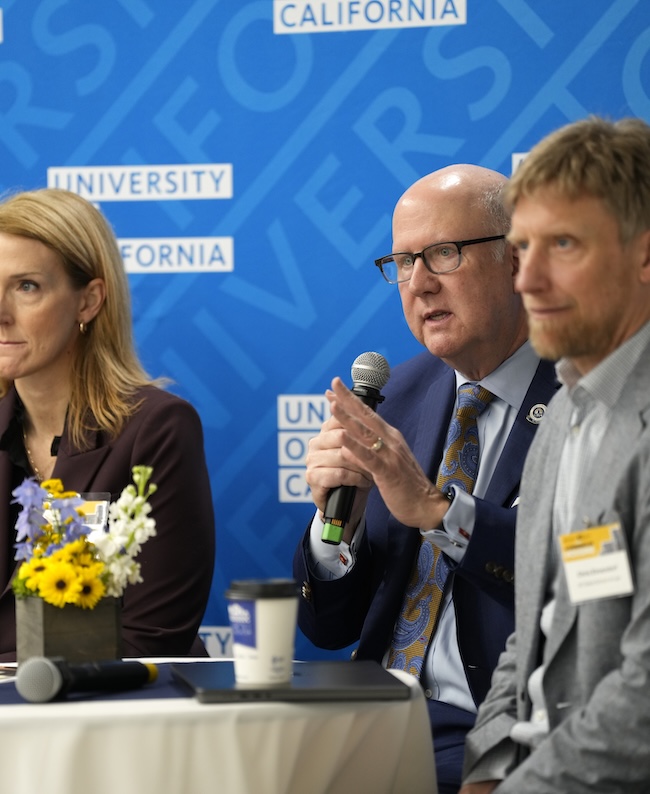
A Conference on Housing, Panel 1: Reforms: Permits, Building Code, CEQA. L-R: Liam Dillon, POLITICO; Asm. Alex Lee; Sen. Jesse Arreguín; Jennifer Barrera, California Chamber of Commerce; Dan Dunmoyer, California Building Industry Association; Chris Elmendorf, UC Davis School of Law. February 24, 2026. Photo by Joha Harrison, Capitol Weekly.
And over the years, CEQA became a law that was used not only for environmental purposes, but anybody who wanted to get anything out of a developer could threaten a CEQA appeal, which would immediately put the project before the city council. And then a lawsuit which would delay the project for a couple of years and use that as leverage to extract, maybe it’s a prevailing project labor agreement with the labor union, or maybe it’s a side payment to a homeowners association, or whatever else you might want, CEQA was the tool to get it.
And the legislature, for a decade, or [for]15 years has been nibbling at the problem, but the typical form of the legislative nibble was to say, we will exempt from CEQA that sports stadium, provided that you use those union workers and provide those affordable housing units as part of your sports stadium.
I’m exaggerating a little bit, but more or less, that’s what the legislature was doing. And labor unions were simply too influential in Sacramento for any kind of broader CEQA reform that would allow housing to be built with workers earning market wages, rather than workers who are part of the 5% of the state’s construction workforce as part of a labor union and earns way above market wages through their labor deals.
But through a kind of amazing set of circumstances two legislators, Buffy Wicks and Scott Wiener, each proposed very, very substantial CEQA reforms that would apply without regard to any kind of special affordability rules or any kind of labor rules.
And those bills are slowly working their way through the legislative process. I think the general expectation was that they would be whittled down very substantially if they made it to the second house, which is where most bills in California become whittled to insignificance. But, through a surprise turn of events, the governor announced in mid-May he wanted the bills passed as part of the budget package, meaning by the end of June. And further, he said he wouldn’t sign the budget unless the bills were passed.
So all of a sudden the governor made a big gamble and there was suddenly pressure on the legislature to pass the bills. And one of the two bills, the Wicks bill, was enacted pretty much in the form that it was proposed and has the effect now of eliminating CEQA review for almost every housing project in an existing urban area, or even near to an existing urban area, if your project is on a site of 20 acres or less, and either complies with the city’s zoning as modified by state law, or fits into one of the other buckets of allowable developments that under other state laws like SB 79, the transit up zoning bill that passed this past year. So that was one big achievement.
“If you look at the codes in 2025, it’s about six feet of codes, individual single-spaced pages. So why does it cost so much more to build in California? It’s because we build perfect homes, but we just don’t build enough of them” – Dan Dunmoyer
The other bill, [is] as complicated as a lot of different things, but for housing purposes, probably the most significant thing it does is it exempts from CEQA review rezonings and other actions that are undertaken to comply with the city’s housing element. The housing element is a once every eight year document that a city adopts to show how it will accommodate its share of regionally needed housing. So you put these two bills together, and cities are going to have to do one big CEQA document every eight years when they adopt these housing plans, and then afterwards everything should be pretty smooth sailing.
LD: So that was a good, really good summary. Dan, I want to move to you and ask you, I believe as part of that legislation as well, there was an effort to pause changes to the building code. And can you sort of explain what that what that may do and why that’s significant?
DD: Glad to again, just before I start off, Tim, Rich, Catherine, thank you so much for putting this together. Appreciate your leadership. And as a USC graduate, it’s a little tough to be in this room right now, but kudos to the UC system for taking policy seriously. So to your question, Liam, so in California, when we build a home and if you look in this room, every single thing in this room is a code related requirement whether the ceilings, the lighting, the electrical outlets. So in California, we’re unique, we’re always special. And what makes us special is we change our codes more quickly than any other jurisdiction or state in the nation by a factor of probably 12. If you look at states like Ohio, they’re working on 2010 codes.
California is working on 2028 codes. I know it’s only 2026, but that’s where we normally go. We change our codes every three years, but there’s this 18 month in-between pause to do technical fixes. But “technical” in California means everything’s fine to be changed. So to the question, Liam, what was special about this? The speaker of the assembly took this issue on, same concept, he was able to put this issue of a code pause. So hitting the pause button on not doing code changes every 18 months and taking a breath for six years. So through 2031. And I’m going to hand this around to you. You can’t see this from here, but I’ll hand this around. So the codes in 1985 were roughly about a foot and a half.
If you look at the codes in 2025, it’s about six feet of codes, individual single-spaced pages. So why does it cost so much more to build in California? It’s because we build perfect homes, but we just don’t build enough of them. So what this really does is two things. It pushes a pause button. So what does that mean to a builder? So every time you make a change it seems so simple. But you have to redesign the homes. You have to hire architects. You have to redesign your floorplan, even if it’s just to add a simple 80 square foot electric heat pump. And so the other thing that it does is it makes it difficult for you as a builder to figure out exactly what you should build and where you should build it. It just adds cost and complexity.
There’s one other key component of this. If you’re building the exact same home on December 31st of last year, you can build that exact same home for a decade. So it’s a six year pause plus a ten year kind of freeze if you’re building the identical home. And many builders will build the same home because they’ve gone through, got the bugs out of it. They figured it out and it works well in multiple states, so they’ll build to that direction. What’s the savings here? We actually think it’s over $1 billion in six years. Why is that? It’s because each of those changes adds cost, complexity, redesign, [and] rearchitectural activity.
LD: $1 billion to who? Who gets the billion dollars? To builders, and then that gets passed on?
DD: It does actually. So right now, actually for the first time in US history, new homes are cheaper than used homes for lack of a better term. So, the National Association of Home Builders just came out last week with this analysis. So we are seeing costs coming down for new homes. And so yeah the consumer sees that. And if you look at our stock prices the consumer is seeing it. I’ll leave it at that. Thanks Liam.
LD: Senator, I want to turn to you. You know, I often get asked, I’m sure you do, too, why every new apartment building looks the same. And, you know, a lot of that has to do with stairways, right? And maybe you can explain a little bit more about that and why that’s been an issue for you.
AL: Yeah, absolutely. So to one of the things Chris is talking about, why we have exemptions, one of my concerns about the building freeze code was about why are we freezing out efficiencies and deletions of things? And that was my big thing [that] I raised. So luckily the speaker heard some of these concerns. And in the building code freeze, it actually allows for, should this go forward, a building code change related to single stair reform, which is actually an efficient way to build more buildings. So, if you haven’t ever heard of single stair, it’s been a very niche issue for a long time. Imagine, if you’ve ever been to Central Europe or been to Japan, there are these skinny buildings. They could be 5, 6 stories tall. They could each have a flat or apartment or condo in each of them.
But there’s only one staircase that goes to them. In America, we are very often used to single buildings. They’re called townhouses. They could be four stories tall, three stories tall, and it’s a single family dwelling, in essence. Right? But in California and many jurisdictions in the United States, that’s illegal. You can’t have a 3,4 story, a 4 or 5 story building that is not a single family home. You can’t have just a townhome. So imagine those skinny buildings you see in so many places in Europe where [there is] great infill housing. That’s not allowed in California.
And so I’ve been really passionate about trying to bring what I call skinny buildings, skinny infill buildings, to our landscape so we can have more affordable constructs. And why this, CBIA can help explain more of this, too, why this is more expensive for consumers and builders is if you have the same tiny lot, think of all the downtown lots that are existing here, if you have to build two staircases, that increases the entire footprint of the building and that is cost inefficiency.
And that’s why I always bring up the point about townhouses, right? You have townhouses that are pretty tall as long as it’s one family for some reason, that’s okay. It’s one single staircase inside of it.
I’m not advocating for all of them to be designed that way, but when you come to have just 2 units in them, or 3 units in them, suddenly that’s not allowed. And that’s why you’re seeing a big push right now towards townhomes. Even in my district. They are small footprint buildings. They are efficient in space, efficient and cost efficient building. But we aren’t able to deliver that in a multifamily, multifamily setting. And that’s why I was really proud to have passed AB 835 in 2023, which would [make] the fire marshal study this issue and recommend building code changes. It is 2026.
“There has to be enforceable deadlines within the approval process. So there is certainty for investors. So there is certainty with regards to how these projects are going to move through the approval process” – Jennifer Barrera
They still have not finished that study, unfortunately. But this year I’m going to be pushing on single stair reform again in AB 2252. And that’s going to be a big front you’re going to see. I think in the legislature, you’re seeing with my colleagues and Senator Arreguín as well, is that we’ve done a lot of the important but I think first step work and legalizing and upzoning and doing all those things. Now we’re focusing on construction, on financing and getting to the next level where we’re actually getting more shovels in the ground.
LD: So I just want to stick with you on that last point. Your legislation required, right, the study you mentioned to be finished January 1st of this year? It’s not finished. Why isn’t it finished? And when do you expect it to be finished?
AL: I do not know when it will be finished. And I don’t really [think] publicly I can say why. I don’t think it’s done.
LD: I think we’re all friends here. You can say it publicly.
AL: I think, look, I’ll just say it’s a pattern in legislative oversight where we submit deadlines or we have legally statutory deadlines on our agencies to do things. And I will say this is not the first time that I’ve done something where I said, this is your deadline. This is your deadline class, you got to turn it in. And they say, okay, I’ll turn it in next year. So they are working on it. They’re close to the finish, they’re still drafting and stuff. So I kind of know elements and pieces of it privately. But this is not the first time that we’ve encountered a situation where a department or an agency doesn’t complete their homework on time.
LD: But I think that also speaks to how political these sorts of things are. Do you want to add something, Chris?
CE: Yeah, I was just going to jump in. This is, like, a very California way to do things, right? It’s like, let’s conduct a study and give time for every interest group to weigh in and then have some litigation, and then maybe we’ll do something after all of that. Like Texas and Montana took the single step idea, and the legislature just said, okay, New York City has got a single stair code. Seattle’s got a single stair code. We’re just going to take their codes, and we’re going to write it into state law. And the legislature adopted it. And now it’s the law.
LD: Jennifer, I want to move to you. So we have talked already about some of the legislative changes to CEQA that were made fairly substantial last year. You folks have an initiative that you’re proposing that would do a lot more changes to CEQA. So can you explain what the initiative would do and if it would do anything more than sort of speed up the decisions that courts make on CEQA cases?
JB: Sure. Yes. We do have an initiative that we’re really excited about and [we’re] very optimistic about its chances of passing before the California voters in November. I’ll just kind of talk about how we approach this initiative, because then it gets into some of the discussion of what the initiative actually does.
I know we’re dealing with a broader discussion of affordability at the UC, as Catherine mentioned, but affordability with regards to housing is one of the key issues that I hear about from my members, not just those who are the builders or the developers, but really employers in California who are struggling to maintain or attract a workforce here in California because the cost of housing is too high, because their workers can’t find affordable housing near their place of work. And it has been a challenge that I’ve heard about for years. And so, again, when we were looking at what the legislature was doing last year, which is remarkable, it is a significant change in direction and policy discussion than what we’ve seen in the past. And it’s really exciting to see that this discussion is kind of getting legs and moving forward in the legislature. We looked [at] how can we address affordability in a broader sense, and housing is a part of this initiative.
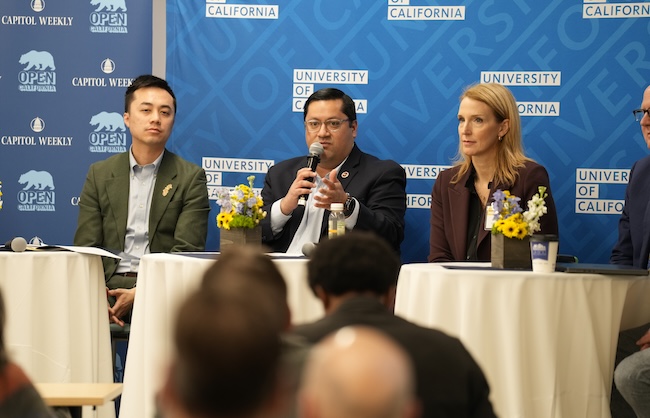
A Conference on Housing, Panel 1: Reforms: Permits, Building Code, CEQA. L-R: Asm. Alex Lee; Sen. Jesse Arreguín; Jennifer Barrera, California Chamber of Commerce; Dan Dunmoyer, California Building Industry Association. February 24, 2026. Photo by Joha Harrison, Capitol Weekly.
But there are other projects that are included in the initiative, [more] than just housing. And when we looked at housing, we kind of did an all of the above approach, as Assemblymember Wicks likes to say, it’s not one specific type of housing that was included in the initiative. It’s literally all different types of housing in California, affordable housing, mixed use housing, adaptive reuse housing, student housing, etc. and what the initiative does is put hard deadlines on agencies that are enforceable. That they have to follow.
We don’t tell the agencies what decision they have to make with regards to a project. We don’t tell the local jurisdictions how they have to decide what their land use decisions need to be. We don’t completely eliminate environmental review. We just say that there has to be enforceable deadlines within the approval process. So there is certainty for investors. So there is certainty with regards to how these projects are going to move through the approval process. And by shortening that and by providing kind of that time frame and that certainty with regards to when these decisions will be made, our hope is, of course, that some of these projects move faster, whether they get approved or not.Again, that’s to the agencies to decide. But time is money.
When the delays for years while these projects languish in kind of this in-between agencies and in-between decision makers, those costs continue to go up. The building material costs go up, the labor costs go up. And [those are] ultimately costs that are borne on to the consumers, the residents of California, when they go to purchase the home. Those are ultimately going to lead to higher costs for housing in California.
And so, again, what the initiative does is provide that certainty with regards to when decisions need to be made. Certainty with regards to when an environmental review needs to be completed, and then ultimately decisions on, or, certainty with regards to the timing of the ultimate approval of the project. And then when we talk about CEQA litigation, it also does say that a court has to make a decision about the litigation within a certain time frame as well. So again, there aren’t these extended time frames in which these projects are just awaiting a final determination by either the agency or the court.
LD: So am I summarizing correctly that the initiative does not make many or any underlying changes to CEQA itself? It simply speaks to how quickly or sort of [establishes] timelines, both from a regulatory and from a court perspective?
JB: It sets firm, enforceable timelines from a regulatory agency perspective and from a litigation perspective. It does limit in court the discretion upon which a court can evaluate a CEQA challenge to specify that they have to give deference to the agencies. If there’s been substantial evidence shown that the agency, when they were deliberating the approval of the project, and it also limits it to objective standards that were basically set forth. One of the challenges, again, with building here in California is the changing of kind of the requirements as it’s going through the process. As we just mentioned, the building code changes and to lock in kind of what those standards are so that a builder, a developer knows going in here are what your requirements are. Here’s what you’re expected to comply with as you’re building out this project. And we’re not going to change those at the last minute to kind of add a new burden on at the very end.
LD: Quickly, Chris, do you want to add?
CE: Yeah. I mean, as I, as I read it, it actually is a pretty substantive change through the subjective standards requirement. Because, CEQA as it operates now sort of presumes that we don’t know what the problems might be. And so, on a case by case basis, we’re going to look at what effects a project might have, and then we’ll figure out what we can do to limit those effects. And the approach of the CEQA ballot measure is instead to turn CEQA into kind of like a checklist for other existing environmental laws that have objective standards.
And if the project complies with those objective standards, then it’s good to go. If the project doesn’t comply with those objective standards, it can be challenged as a “CEQA” lawsuit. But at that point, CEQA isn’t adding anything other than a procedure for checking the boxes, because those standards exist in the other laws. The other thing the measure does is it creates a vesting process. Basically, the question is like, at what point can the rules no longer change for a project? And for housing, the legislature established the principle that the rules that apply to a project are the rules that are in place at the time the developer files what’s called a preliminary application. And this would basically take the same idea and extend it beyond housing to include almost any transportation project, energy project, water project, and a few other categories.
JB: That is all accurate with the exception of issues with regards to public health and safety, where changes can be addressed. And there aren’t necessarily vested at that point, if it’s going to impact public safety and health.
CE: And that also is the housing model, where the housing laws exempt public health or safety standards.
DD: Just to back up something, you may not be aware of this, but the average major land use project results in three bankruptcies before it’s built. So Jennifer talked about how time is money, when you can delay. It’s a great tool for NIMBYs and it destroys housing. The other irony, when we look at our projects when we started them, it is not uncommon, if we could have built it in the first tranche, we would build it for half of what we build it in the third or fourth tranche, after the third bankruptcy. So the impact to the consumer is profound, but the ability to actually attract capital and investors into California continues to diminish as CEQA continues to rule.
LD: Senator, I want to turn to you. Before you joined the legislature, came from a local government background, and I’m wondering if you could sort of explain how you’re thinking about some of these regulatory rules, CEQA processes for building code, permitting, how your understanding of these or mindset may have changed or how your view [on] these rules differ from local government, now [you’re] in the legislature.
JA: Well, it’s a great question. And it’s a bit awkward to be here because when I was the mayor of Berkeley, we sued the University of California, Berkeley under the California Environmental Quality Act over their growth plan in the city of Berkeley. Because under the state constitution, the University of California is statutorily exempt from any local taxes or land use regulations. So as mayor of a university, it’s very challenging to negotiate with the university over tax payments or other mitigations. But, that also is not necessarily the right approach to how we are addressing these issues in California.
I also look to other lawsuits that have happened in the city of Berkeley over building housing at People’s Park. I was a very strong supporter, remain a very strong supporter of the university’s plans to build student housing and permanent supportive housing at People’s Park. And if you visited Berkeley recently, you’ve seen the building is topped off and they’re almost done with the project, and we’ll be welcoming new students there very soon. It has been a battleground for building housing in the Berkeley community for 50 years, but we are moving forward. But neighbors who opposed that project sued the university under CEQA. And it resulted in some pretty absurd outcomes including one court decision by the Superior Court which froze enrollment at the University of California, Berkeley.
Thankfully to my predecessor, Senator Skinner, the legislature passed a special law to overturn that court decision so that we can actually welcome more students to the University of California, Berkeley. And then later, a court decision that resulted in the absurd conclusion that the noise that students and people that live in housing generate is an environmental impact that must be studied under the California Environmental Quality Act, i.e. people are pollution. Thankfully, my colleague in the other house, Assemblymember Wicks, introduced legislation to make a targeted change to CEQA to overturn that as well. But we shouldn’t have to pass special laws to fix absurd court decisions and legal precedents that stand in the way of doing things that are good for California. We know that building dense, infill housing is good for the environment. It’s good for the state’s efforts to combat climate change.
So I have, I think, a very unique perspective, having seen the impact of this at the local government level. And I think the legislation that we adopted last year, Senate Bill 130 and Senate Bill 131, is groundbreaking. I was an original co-author of what was AB 130, the infill housing reform bill. And these changes, these regulatory changes make a huge impact because now NIMBYs and local governments that don’t want to approve projects, now, they don’t have a choice.
And it’s setting a fair set of rules and standards to make sure that we are not standing in the way of building housing. And so you know, I’ve come to embrace as a local government official and as somebody who’s been personally impacted by the housing crisis as a renter and someone who can’t afford to buy a single family home in the city of Berkeley with the median price of $2 million a year, that we need to remove restrictions on environmental reviews.
We need to streamline the permitting process. There’s gonna be a lot of work that’s going to happen this year around how we can streamline condo development. How we can incentivize modular housing. Looking at financing tools to help developers get projects complete. Fee reform. Single stair reform. I think all these things have a huge impact in actually getting homes built. And we set ambitious goals as a state. We need, I think, estimated anywhere between 2.5 million to 3 million homes to address the existing housing shortage. We’re not going to get there if we don’t remove these barriers and make it easier for homes to get built. Recognizing the unique challenges that builders face right now in California.
LD: So I want to open this question to everybody. Hopefully [we] have a good discussion about it. So 8 to 10 years now of passing hundreds of bills that aimed at decreasing regulation, permitting, in some cases limiting local government power to deny projects, all these sorts of things. We spent a lot of time already talking about the major CEQA reform that happened last year. But it’s not like there was a surge of permits that happened immediately after this. So why, I mean, why’ve [the legislature] done all of this work on this point, talked about how groundbreaking or transformative CEQA changes or whatever, but why do we not see a surge in permits? What does this mean for whether all of these changes are sufficient or necessary to get building done?
DD: Well, I’ll jump in on that, Liam. So totally correct. The statistics for California, we have seen a slight uptick since Governor Newsom took over. But in the last two years, we’re starting to see a flattening. And actually last year, once those numbers come out, you’ll see a downturn for permits. So I mean, we had 71 bills signed into law last year on housing. I think it’s about 400 bills on housing.

A Conference on Housing, Panel 1: Reforms: Permits, Building Code, CEQA. L-R: Liam Dillon, POLITICO; Asm. Alex Lee. Photo by Joha Harrison, Capitol Weekly.
So here’s why it’s not happening. So you have a couple things that haven’t changed. You have the macro side. Our president, you know, puts tariffs in. That’s kind of a hidden tax that people don’t understand. It creates supply chain uncertainty, delays things, adds cost. You also have issues of interest rates. Again, a macro issue, twice as high as they were when I refinanced my home just a few years ago. But specific to California, you can still hug a project to death in California in any local jurisdiction. And you know, used to be you would just go out there and say, no, we’re not going to do this. But now you can just add a few zingers, as we call them, that make a housing project not work, like inclusionary zoning. Sounds great. Who would be opposed to inclusionary zoning? It just means you have to give 10, 20, 30% of the housing you built away for free or reduced cost. Sounds great, but the remaining homes go up in price to such a point that only the ultra rich can afford.
And we have to look at markets. So if you move into a community, you’re going to increase the cost. Every 10% of inclusionary is $100,000 in higher cost. So California has the least attainable housing purchasing. So if you look at the median price of housing in California, 904,000, [and] the median income in California, only 16% of Californians can afford to buy that home. When you add those extra $100,000 in, let’s say, inclusionary, oh, wait, there’s more. We’re going to put some other things. We’re just going to say, hey, you want to do infill?
Everybody wants to do infill. But the transit districts require us to build a certain type of housing that doesn’t pencil. So why in the world would a transit district put requirements and regulations on infill housing? So it can’t be built? It just seems, well, I’ll say contradictory. I’ll be a gentleman. So that’s our challenge [with] these different issues. Let’s go into the governor’s administration. The governor’s rhetoric on housing is unparalleled. I mean, he has really championed housing, but look at all the agencies he oversees. We’ve added this thing called Vehicle Miles Traveled. We’ve added this thing called Species. We have now insects that are labeled as fish in California. Go figure that one out. But now we have this bumblebee that’s everywhere in the state, but it’s endangered, so that adds delay and cost. But wait, wait, there’s more, there’s more, there’s more.
So hey, one of the big things is dirt has arsenic in it. So let’s have the safest dirt under every home. We had a vapor intrusion layer. It’s only 10 or 15,000. But wait, there’s more. We have mandatory solar. It’s great, but 14 million of our homes don’t have solar on. We should focus on retrofitting the 10 million homes built before 1980. That would reduce our GHG (greenhouse gas) to zero for housing. But we’re focused on building the perfect home for the few versus addressing the homes of the million. So those are just a few of them.
And obviously I get passionate about this. I’ll just say this one thing. My daughter lives in the great city of Berkeley with her husband. She has a great job with a household name company, as does her husband. They need $850,000 down payment as 30 year olds to buy the starter home in Berkeley. So to back up the chairman’s comments, that has to change. If we want our talent, our young people to view this as a state [as worthwhile to remain in]. Two of my sons moved to Texas. I lost that battle with them because they can buy a $300,000 home. So that’s the reality of this, is our young people don’t see a future in this great state unless we really tackle these issues. And although there’s been modest reforms, we really haven’t hit the crux of the issue, which is can we just build the damn home?
LD: The legislators, maybe you guys can both weigh in on this, but also I’d like to get your take. So Dan mentioned and sort of hammered the idea of inclusionary zoning, which is essentially a set aside when you build a new project, which happens in many cities across the state, set aside for a certain number of units that are restricted as affordable. Oftentimes developers get to build higher, denser, taller wave other restrictions, density bonus, it’s called, in exchange for reserving some of those units as affordable inclusionary. So could you sort of speak to maybe the original question, either or both of you about why these changes haven’t resulted in a ton more building, and also your perspective on inclusionary zoning.
JA: Sure. Well, as my colleague Senator Wicks says, we want to go to less bill signings and more ribbon cuttings. So we have passed hundreds of laws in California in the last decade to make process reform, to streamline the process of building housing in California, and those have been extremely important. But we’re not seeing the pace of housing construction that we need to address our shortage in our state. But I will look to ADUs as an example of how, through incremental progress, we have really made a huge impact.
1 in 5 homes built in California now are accessory dwelling units. Fast forward ten years ago, that wasn’t the case because through multiple rounds of legislative efforts and through the work of this administration to really prioritize building ADUs and holding cities accountable that are resisting state law, we are seeing a huge amount of construction of ADUs and small infill housing in neighborhoods throughout California. So it’s going to take time. It’s going to take time for these laws to have an impact. There’s no question the macroeconomic factors, tariffs lending and certainly regulatory approvals have a huge impact. We need to look at the things that we can do, the low hanging fruit, to help catalyze housing construction. So how do we look at fee reform, making sure we address impact fees so that they don’t create a huge barrier on building homes in California? Building codes ,and how that can incentivize modular housing. There are some things that we can do to help stimulate and catalyze housing production in California beyond the regulatory reforms that we’ve done.
I personally think that, in my opinion, Dan, I’m sorry, that inclusionary housing is a good thing. But we have to be mindful about what fees and requirements that we put on buildings to make them economically infeasible. And so there has to be a trade off. There has to be a trade off. Now, there are some jurisdictions that don’t see it that way. They put absurd requirements on projects as a way to intentionally stop things from being built. And that’s what we want to prevent here in Sacramento, to make sure that people are not using the law as a way to stifle production.
Dedicating whole cities as mountain lion preserves as a way to evade state housing law. That’s absurd. So that’s where we come in, is how do we look at what the obstacles are and clear the regulatory roadblocks? That’s where the AG and the administration come in, through their accountability units and through litigation to hold cities accountable. Huntington Beach just lost another lawsuit on their efforts to evade state housing law. That was just announced the other day. Because not every city is a good actor. And as a former mayor, I’m just being completely honest here. And so how do we reward and support those cities that are doing the right thing? And how do we hold those cities that are doing the wrong thing accountable?
AL: Yeah. And I think it’s a great point. I think back to some points of history for context, right. We passed a lot of good reforms in housing laws over the last decade or so, but we aren’t seeing prices plummet. We aren’t seeing a revolution in housing being built. And I think there’s… kind of think in the historical context, my district in Santa Clara County and southern Alameda County, in the Bay area, right, 50 years ago, was overwhelmingly farms and overwhelmingly white. Today, it is rapidly growing in housing and population and is overwhelmingly Asian.
The thing is, there’s a lot of state laws out there, CEQA included, that people weaponize to preserve California as a museum. And I am not interested in living in a museum [in] California as cities, as our state are evolving organisms with us. So we grow, we change, and it has real ramifications to our political power, social power, that we’re losing the population growth rates to Texas, to Florida. That has real consequences across the nation. And even ten years ago, when I was still a staffer, I would have these conversations with David Chiu, that a lot of people thought the housing crisis was just a San Francisco problem.
And then a couple of years after that, it was a Bay area problem. And then now it is a national, if not global problem of housing insecurity and housing affordability, that people have finally caught on. And even in that time, though, our politics moved so slowly in public wave. So we’re finally talking about common sense CEQA reform, common sense, getting people to stop weaponizing our laws. And I think we’re still in that era politically of legalizing the ability for housing to be built, allowing for housing to be built. But we have not moved into the period of financing housing itself. We’ve not moved into the construction architectural phase, but single-stair, even when I authored in 2023, was a super niche issue that most people didn’t even want to touch right now, given some political complexities of it. But we haven’t yet gotten to that realm. I think in 2018, Governor Newsom, of course, had the ambitious declaration that we would build a million new houses. We built a million new homes.
LD: 3.5 million.
AL: 3.5 million new homes. Something like that too, right? And I don’t think we’re anywhere close to it. And we stopped keeping track. Here’s also the reality in the American slash California context. When I go to study social housing and many other places like in Europe or in Asia, when the government says we will build a billion gajillion new affordable houses, they mean it. They put the entire muscle of the state apparatus to do it. We have, every now and then declared goals, but our goal right now, unfortunately, and this is why I love this panel up here, Our goal in the meantime has been so incremental. We said, let’s allow for more housing to be built. And that’s what we sell to voters, right? Because we’re so afraid of NIMBYism and all these, I can’t paint straight up as a pro housing person. We’d have social housing, we’d do all these things.
But we need to be coherent about saying, we will deliver you a million houses at this month, this monthly rent or this mortgage level or these things. And that is the objective goal of the federal or national or even state government. And I think right now, as you’re seeing this interesting synergy between Trump and Gavin and us on housing affordability and everything like that, there is appetite for the American electorate to want to deliver that. And I think we need to get to a level where, just like every consumer product, we will have a goal of delivering [a] gajillion houses that will be $3,000 a month rent if it’s three bedrooms or something like that, [where] we have a real goal and we have to use the entire state apparatus or federal apparatus to get to that point. And so right now, we’re only at the beginning. I think even though it’s frustrating and it’s slow and it’s frustrating our constituents, we’re only at the beginning of talking about housing and next will become the really, really hard stuff for the really impactful stuff.
LD: Chris.
CE: So two high level comments. One, I think it’s incredibly promising that the legislators on this panel are talking about building costs, as well as the building industry representatives on this panel talking about building costs. That’s a rare convergence. So that’s cause for optimism. On the less optimistic side, I think there’s still, like, pretty deep ambivalence within the legislature as a whole about whether they really want the housing laws to produce housing, or they’re willing to make the politically tough votes necessary to get the housing laws to produce housing. So let me give you two examples of this. Last year, California passed a bill that upzones land around transit stations to allow roughly 5 to 8 story buildings. This is a boulder that Senator Wiener has been pushing up the mountain since he got into the legislature in 2016, 2017.
And finally a version of it passed. But the version of it that passed last year requires local governments to set aside or requires developers to set aside at least 13% of the units in the projects as a deed restricted affordable housing and doesn’t compensate them for their losses on those units. The version that passed excludes any site that is subject to any kind of rent control, or that may have been occupied by a tenant any time in the last seven years. So you’ve got to have, like evidentiary battles over whether that house was rented or was it not rented, or can it be redeveloped. And certainly if there’s any kind of apartment building on the site it can’t be built on, and where most of our apartments, well, they’re near transit. Washington state, with less attention passed a version, less public attention, of the same law in the same year. What did Washington state do? They said, we’re going to require 20% of the units to be deed restricted, affordable housing. So like California, they want mixed income housing. And for good reason.
But, they said, we’re going to give the builder a 30 year property tax break to compensate them for their losses on those deed restricted units. And we’re going to cut impact fees by 50% on all of these projects. Just one time across the board, 50% reduction in impact fees. And there was a debate within the housing coalition, which included tenant advocacy organizations, about whether they should carve out existing apartment buildings. And the tenant advocacy group said no.
Ultimately, after some internal tussles, we don’t want to carve out those sites that have existing apartment buildings because it’s going to be good for tenants if we can tear down an old 4 unit apartment building and build 50 apartments on that site. California tenant organizations would, like, their heads would explode if someone tried to, within the movement, tried to make that argument. So I think that, you know, we’ll get some housing out of SB 79, but we’re not going to get nearly as much housing out of SB 79 as Washington State is going to get out of their version of the same bill.
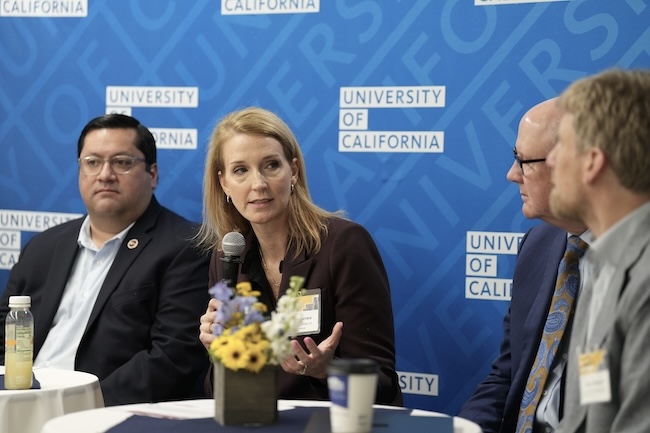
A Conference on Housing, Panel 1: Reforms: Permits, Building Code, CEQA. L-R: Sen. Jesse Arreguín; Jennifer Barrera, California Chamber of Commerce; Dan Dunmoyer, California Building Industry Association; Chris Elmendorf, UC Davis School of Law. February 24, 2026. Photo by Joha Harrison, Capitol Weekly.
Second example: accessory dwelling units have been a success story unambiguously in California. But what has the legislature done with accessory dwelling units? It’s required them to be approved ministerially. That means without any kind of discretionary condition of approval. Second, it has imposed no kind of labor standard on those accessory dwelling unit projects, which is usually the quid pro quo for ministerial approval for other kinds of housing. Third, the legislature has said there’s a minimum size that has to be allowed, any 800ft² for a backyard ADU, any local law, unless it’s a health or safety law that prevents you from building that 800ft² ADU, has to be waived.
So we’ve got a ministerial process, no impact fees, essentially no impact fees on ADUs up to 800ft² preempted by state law, no affordability requirements, no labor requirements, and ADUs go gangbusters. Senator Wiener last year introduced a bill that would do the same thing for duplexes and lot splits: to declare a minimum size that cities have to allow 1750ft² per unit.
Preempt local inclusionary requirements and impact fees and require approvals to be ministerial. Approvals are already required to be ministerial, so that wasn’t a change. That bill never made it out of its first committee. And if we were serious about density, even so-called gentle density in existing residential neighborhoods, that bill would have just soared through and been passed by overwhelming majorities in both houses.
LD: Two points I want to get to before we get to audience questions. So I want to move fairly, fairly quickly.
JA: I voted for that bill. Just want to be clear.
LD: So, Jennifer, tell us where your initiative is in the process. Is it going to qualify? As many folks in the room know, after an initiative qualifies, there’s an opportunity for the proponents to negotiate with the legislature about potential changes. Is the chamber assuming the initiative qualifies? Is the chamber open to negotiations about what it might like to see instead of having it on the ballot? And if so, what would you want?
JB: Yes, we are in the signature gathering phase right now. Just last week, we were able to announce that we had met or now exceeded the 25% threshold for signatures gathered to submit to the Secretary of State and to ultimately qualify for the November ballot. So we are very optimistic that we will get it qualified. Again, before we even filed this initiative, we did a ton of research and with the voters of California to see where they are at with regards to this issue. Our research was actually really favorable and optimistic, and it kind of goes to everything that’s being discussed up here with regards to where the voters are at.
Yes, they are concerned about the environment in California, but the top issue that they are concerned about is affordability and housing being that very top and tip of that discussion with regards to affordability. So when you talk to them about, hey, we need to expedite building here in California, they absolutely get it because they see the delays and they see the costs that ultimately they bear because of the delay that we have with regards to building and specifically housing in California.
So we’re very optimistic with regards to one that we will qualify it, and two, that we will be able to go before the voters in November to ultimately get it passed. The question on whether or not there’s a legislative deal: of course, I will never say never. You know, with regards to whether or not there can ultimately be a legislative deal.But I will also say that when we were putting this initiative together, again, this was a long, long process with regards to research and attentive land use attorneys, all discussing, you know what I mean, experts in land use, of how this should be crafted in order to meet that balance where we’re not completely disregarding the environment, but we’re also expediting the approval process and the decision making process in California to really reduce that delay and those costs ultimately borne by the builders and developers in California.
And so again, every piece of this is so intentional with regards to kind of crafting that balance where there is value for builders so that Dan’s members will go out and actually build the homes, they’ll build the infrastructure, they’ll build the transmission lines. But also so, you know, careful as to not completely eliminate any environmental review that we know is also important. Obviously, as we build here in California, that again, when you go through the legislature, as everybody has discussed, there is a tendency for things to get whittled down and for protections and different provisions to get removed. And so, again, in order to ultimately achieve the goal, which is to build these essential projects faster, I would just say I’m wary that we would be able to do that in the legislature and still produce the value that we believe this initiative will ultimately produce here in California.
LD: Okay. Good. Thanks. The last issue I want to raise before we get to the audience questions, is, there’s some reference earlier about this year, discussing about changes to condo defect laws. Not a lot of condos are built in California. Certainly a lot more apartments than condos are built. And a lot of folks will point to some of the legislature laws surrounding litigation that can happen after a condo is built. And so maybe we’ll start with either the legislators here who want to talk about why they think this is something that will be addressed this year and, and why it’s important.
AL: Well, I’m glad you have this panel here who are very optimistic about the legislature. So I’m really glad you’re all… so you can say the things that I think sometimes, it’s awesome. I think it is important that we have more condos. Obviously right now because most multifamily [developments] that are being built are apartments. There, of course, has been a lot of concerns about the conduct defect law. I don’t have any specific position on it right now, but I do think it’s important for us to have a deeper look at how we’re impeding condo development.
JA: I’ll just say that this is an issue we absolutely have to address. And it is going to require some negotiation between the consumer attorneys. Because that has been, I think, one of the biggest barriers to reforming the construction defect law. But Terner Center has done a couple of studies in the last year that have really pointed out how this one policy has hindered the construction of multi-family condominiums in the state of California. And while there’s been some work to… there was a bill several years ago to allow for ADUs to be separately sold as condominiums.
If we’re going to move the needle on expanding affordable home ownership in California, we need to streamline the production of condos and townhomes. Because that is going to make a huge impact in opening up opportunities for people to own property and to build equity and intergenerational wealth in the state. I want to just also [say that] former Senator Hertzberg has an initiative as well, which would create kind of a unique financing model, revenue bond model, to help finance affordable ownership housing in California. That’s also potentially going to be on the ballot as well.
LD: Dan, I want to hear your point on this.
DD: Yeah. No, thanks for asking this question. I just want to put an exclamation point on both what Chris and the senator said, in the context of ADUs. This is how you solve the housing crisis, is you do to housing what you did to ADUs. It’s the fees and it’s the delay. If you were to do to ADUs what you do to single family or condos, we would be able to build enormously quicker. We moved to construction defect. So this is an issue that California tackled. This goes back to Senator Isenberg and Senator Burton, for those of you in the history books, a while ago, this was, you know, the insurance industry and the building industry and the consumer attorneys of California sat down for about two years to try to create what’s known as SB 800.
That law went into effect. It did have a positive effect on minimizing the cost of construction defect. It’s relatively well for single family detached homes, but on the condo side it hasn’t. And so every single condominium project we build, and it is, as the senator said in the assembly member said, it is the most affordable, attainable for sale purchase price point in California. But 100% of the condos we build are sued for construction defect, no matter who builds them or how they’re built. It’s 100%. The average construction defect claim for a single family home in California is about 6800 to 8000.
The average claim on condos is whatever the value of all the homes are combined. Which means, in English, about $65 million claim. So the setup is there. Now let me step back, because I also know because we try to do this in other states. We’ve tried to reform some of the construction defect laws. We tried this in the great state of Nevada and it resulted in a housing moratorium. We didn’t build anything after the fix was done.
“We have a fundamentally broken Prop. 13, which forces our schools and special districts to rely on the fees. Right. And I get that. My fiance is a school board member, and they rely on a lot of fees and stuff to function at schools. But it also doesn’t help the schools if no new families move in and they have population declines, which is happening” – Asm Alex Lee
So this is… it’s sort of like nuclear power. It’s a beautiful thing when it’s done right. But if in the wrong hands, it could blow up in your face. Well, that’s kind of construction defect. So we are cautiously optimistic. But I have to say this publicly, the consumer attorneys of California are a force to be reckoned with. And so for us, it needs to be something that results in positive change and not what is viewed on a headline. We reform construction defect, like we said in Nevada, and then we stopped building for 18 months. Now they flipped it. So we’re building back again. But just 1 or 2 sentences could be the end of condo construction or the triple or quadrupling of condo construction. It’s that key and that complex.
LD: Okay. So we’re going to do audience questions. Rich you’re going to hand them okay. So I’m going to be very clear here. And I’m going to be mean because: questions not comments. Questions not comments. If you start commenting then I will cut you off. So please have a question. And you can direct it to the panel and I’ll go with this gentleman here. To start with.
RICH EHISEN: I cannot agree more, Liam.
AUDIENCE MEMBER: On the building codes: great that it’s frozen, but other than single stair reform, how do we do reform of the building code to have cost brought in? I just want to say our local elected official wanted to put our own single stair reform in and was stymied by the building code freeze.
AL: So in the building code freeze law, there were several small exemptions. Single stair is going to be one of those. So that’s when I bring my bill. Local jurisdiction. You’re right. Local jurisdictions would need a specific carve out again to do that. But that was the concern I raised about this. I really totally agree that there needs to be certainty in the process, needs to be certainty and simplification of the rules. But I’m like, as Dan pointed out, how long the code book is, I’m now not able to delete things, too. So that’s kind of the trade off with it. And I think it’s a further conversation this year. If we want to go back and amend things or to remove things, I think we should be able to do that.
DD: Yeah, we are open to that as well. The fear is, I mean, many cities, unlike the cities who are trying to pass the single staircase, are trying to claim, as recently, you know, that climate is a sufficient health risk that we should be able to expand codes even under this new pause. So if you want to reduce some of the members talking about, you know, we believe there would be a lot of unity in that concept. And just to the point that both Chris and Assemblymember Lee said, you know, the single staircase can reduce cost. Just think of two staircases. That’s a lot of square footage. So you can build more density and you can build at a lower cost. And, you know, for us that’s obviously a goal we’d like to share. So I think there’s something we can work on with the Assemblymember here.
RE: We have a question right here.
AUDIENCE MEMBER: So 483 cities, 58 counties, over 3000 special districts. You guys are talking about fee reform. True, there are many jurisdictions that have absurd fees, but there are also many that don’t. Now, my question is, if it can be argued that existing residents and businesses have funded the infrastructure of California, why should they subsidize the new infrastructure for new residences and new businesses? Shouldn’t those new homes and new businesses pay a reasonably fair share for new infrastructure?
DD: Yes they should. The key word there is reasonable. So you know, let’s go to faraway lands like Nevada, Oregon, Arizona. We do pay for infrastructure. It averages $15 to $20,000 a home. In the great community in which we sit, the average fee is $109,000. So the question is what’s reasonable? So right now, the joy of a local city planner and city council is when you add a fee to a new home, there’s no voter there yet. And so if you were to go to the rest of the community and say, hey, we need a new water treatment facility, not for the 100 new homes, but for the entire community, let’s just stick it to the new homes. Let’s charge a $60,000 hookup fee for water, which, ten years ago, that was 200 bucks. So the key word there is reasonable.
And so again, the other thing just really quickly on fees. It’s a triple zinger. It adds $109,000 to the home. You tax that $109,000. It’s in the property tax. And then you pay for it for 30 years. So think about that in the context of what fees do to attainability, affordability, and being able to stay in your home. So for us, it’s not the issue of paying fees. It’s just, why does every other state, forget about Texas and Florida because that causes Democrats to shimmy. Let’s go to Washington and Oregon. They don’t do that to us. So there’s fees, but they’re reasonable. So that’s the key phrase.
AL: I’ll just say quickly that the key is “reasonable”. But there’s also a key to why other states have reasonable fees is they have functioning property tax systems. We have a fundamentally broken Prop. 13, which forces our schools and special districts to rely on the fees. Right. And I get that. My fiance is a school board member, and they rely on a lot of fees and stuff to function at schools. But it also doesn’t help the schools if no new families move in and they have population declines, which is happening. So the balance of yes, it has to be reasonable fees, upkeep, the parks and schools. But it also doesn’t help if there are no new kids around and no new families. And that’s why we have to balance the interests of, yeah, there should be some impact fees, there should be some fees, but it shouldn’t be so prohibitive in a system that the schools, their survival is dependent on it. And that’s fundamentally broken. So we have to fix those too.
LD: Chris. And then we’ll get to a couple more questions.
CE: Totally agree on Prop. 13: [it] is the root of many, many, many problems in California, and I would love to see the Chamber of Commerce and others team up to run another ballot initiative tackling the fiscal constitution of California. But I think on the question of like, is new housing paying its own way? We’ve kind of approached this problem with blinders. Like, we look at the fact that new housing may create congestion costs or increase need for new sewer facilities or new transit opportunities. And that’s real. Like new housing can create congestion costs in existing communities.
But new housing also creates what economists call agglomeration benefits. Like it expands the labor market. People become more productive. New restaurants are able to open up because there’s got a bigger base of customers. And we don’t provide any kind of subsidy for the agglomeration of benefits of new housing. We just provide a tax to deal with the cost of new housing, and that means we have a fundamentally unbalanced structure, which results in too little housing being built in places where it’s highly valuable.
RE: All right. We got, I think, time for one more here.
AUDIENCE MEMBER: Good morning. Thanks for being here. I’m wondering, keeping in line with ballot initiatives, what is the accountability mechanism? If the initiative is to be passed, as the Assemblymember brought up, there’s an issue with the legislature keeping its own deadline. So how does instilling a hard deadline, like what’s the accountability there if it’s not met?
JB: The accountability measure is built into the initiative are basically if a local agency fails to meet the deadline required under the initiative for either a project approval permit, environmental review, then basically the applicant can demand or request a public hearing with the full governing body of that agency and require a hearing on the actual decision that is being required at that time. So that is the enforceability action of it. And there is also in some of the provisions, even litigation where an applicant can file to enforce that, again, that decision to be made. And it’s not specifying what that decision has to be. Again, it’s just saying that a decision has to be made.
LD: Can you have accountability on the courts though? I mean, you’re requiring a deadline for a lot more projects than are currently having the courts face deadlines. I know some of my prior reporting, the courts have blown some of those deadlines with many fewer projects than what you’re anticipating. So, how does the accountability aspect, as you say, address the courts?
JB: The courts are also accountable with regards to, it’s in the Constitution with regards to judicial accountability, if they fail to meet the statutory deadlines that we now have as a part of this initiative, it’s 270 days from the point of file to the point of complete resolution. There is discretion for the courts to add on another 90 days, but that’s it. There’s no further approval for them to kind of go beyond that. And again, there’s requirements within the Constitution to hold them accountable for meeting those deadlines.
RE: Actually, I think we have time for one more firsthand, I see. Okay. It’s a first come, first serve world, people.
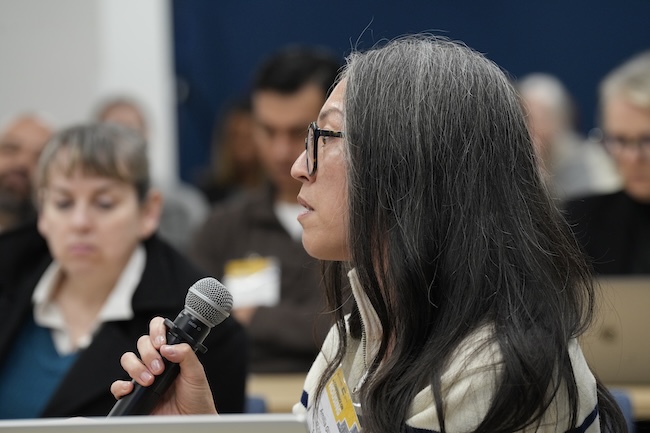
A member of the audience poses a question to the panel at A Conference on Housing, February 24, 2026. Photo by Joha Harrison, Capitol Weekly.
AUDIENCE MEMBER: Hi. Thank you so much for your comments today. I really appreciate it. I really like keeping an eye on the recent CEQA streamlining measures, which seem to shine a spotlight on infill redevelopment and representing developers who deal with the cleanup of contaminated sites and brownfield sites. I feel like that’s kind of, potentially the next frontier to make sure these bills get implemented. How do you make sure these cleanup oversight agencies are actually in the fold? And part of this conversation to, I guess, as part of the state apparatus to to mobilize housing construction, develop and make sure timelines are being followed. You know, the regulations aren’t overly burdensome and costs are reduced.
DD: So when you look at brownfield itself, I mean, both the state and federal statutes are in place to deal with those issues. But to your point, I mean, we don’t always fight regulation. We’re the only home building industry association in America that actually supported mandatory solar. It really comes down to cost effectiveness. And back to what Jennifer said on time and delay. So even on species issues, we’re not always, we don’t want to kill animals when we build homes. And by the way, we’ve never killed a mountain lion building a home. It’s just impossible, they run away when we see them. But the issue is time and delay. So one of the things a new governor could do, we’ve asked the current governor. He’s done this in the housing department. But if you look at all the DTSC that would look at this, if you go from two staff members to 20 staff members, we get our stuff approved. It just takes 2 years. Why could it maybe take 2 months? So if you want to enhance species, you want to enhance water quality. You want to enhance. We’ve actually worked on all those things. It just takes us 2, 3, 4 years.
So if you were to add 20 staff members in each of these bottlenecks you could build more quickly. Projects wouldn’t go bankrupt. So for us, all those issues are… we’re not trying to build crappy homes on dirty soil. We want to build great homes that aren’t effective and do it quickly. Because when we do that, we save millions of dollars. But when we remove delay, that’s the great part of the CEQA initiative. We don’t wipe out CEQA, we just make a decision. It could be a negative decision, but you make it in 270 days, versus Tejon Ranch, that since 1989 is trying to build a single home, and it hasn’t because of CEQA. So that’s the dynamic is, you know, staff, government to address our commitment to the environment, but also our commitment to housing. And that will change everything.
RE: And on that note, I think we give Liam and the panel a great round of applause.
Capitol Weekly Intern Aidan Wyrough contributed to this report.
Thanks to the sponsors of A Conference on Housing:
THE CALIFORNIA BUILDING INDUSTRY ASSOCIATION, THE TRIBAL ALLIANCE OF SOVEREIGN INDIAN NATIONS, WESTERN STATES PETROLEUM ASSOCIATION, KP PUBLIC AFFAIRS, PERRY COMMUNICATIONS GROUP, CAPITOL ADVOCACY, THE WEIDEMAN GROUP, CALKIN PUBLIC AFFAIRS, STUTZMAN PUBLIC AFFAIRS, RANDLE COMMUNICATIONS and CALIFORNIA PROFESSIONAL FIREFIGHTERS
Want to see more stories like this? Sign up for The Roundup, the free daily newsletter about California politics from the editors of Capitol Weekly. Stay up to date on the news you need to know.
Sign up below, then look for a confirmation email in your inbox.
Leave a Reply