
News
Old warriors gather and bury hatchets, not in one another
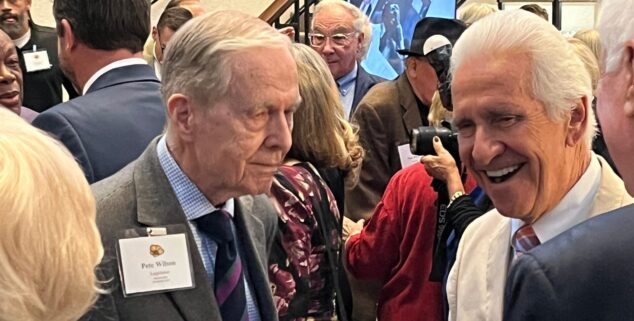 Pete Wilson and Jim Costa. Photo by Dan Morain.
 In the gauzy passage of years, politicians who once fought bitterly spoke of respect for the loyal opposition, and mostly meant it.
Jim Brulte is the Republican who came within a vote of becoming speaker of the California assembly in 1994. Willie Brown is the Democratic speaker who blocked Brulte’s ascent, having secured one Republican supporter and probably more who were willing to side with him.
Together, they co-hosted an extraordinary reunion of former legislators and current and past lobbyists last Friday. All living former legislators, roughly 175, were invited and at least 75 showed up, several of whom still hold elective positions as 70- and 80-something-year-old members of Congress.
Brown is the last surviving member of the class of 1964, his first of 30 years in the Assembly. Gov. Pete Wilson, who served two terms in the assembly, represented the class of 1966, the year Ronald Reagan was elected governor. Gov. Gray Davis, who served two terms in the assembly starting in 1982, was there too.
Davis and Wilson looked as trim as they were during their days in the corner office. Brulte, a bear of a man during his days in the assembly and senate, has slimmed down, noting that he had shed one full Gray Davis
Xavier Becerra, who almost certainly will be governor in 2027, showed up, and told a gaggle of reporters that housing affordability was an issue when he was elected to his single assembly term in 1990, as it is now. Becerra said he was pleased he was to see so many old colleagues.
“I’m just glad we’re all alive,” he said as he stepped inside the banquet hall at the Sheraton in downtown Sacramento.
Antonio Villaraigosa, Becerra’s one-time rival and one of three former speakers who showed up–Bob Hertzberg, who succeeded Villaraigosa as speaker, was there too–said several old Republican legislators confided that they voted for him in the June gubernatorial primary. How nice. If only a few Democrats voted for him as well, Villaraigosa would have gotten more than 1.1 percent, he said, flashing that big smile of his.
Of course, many weren’t there, among them such giants as Byron Sher, who died a month ago, and John Burton, Willie Brown’s friend and ally from the Class of ‘64 who died a year ago. The ones who came had greyer hair, though some had dye jobs, and many stepped a little more slowly.
Four surviving members of the Gang of Five shared a table off to the side. The gang of moderate Democrats–Steve Peace of San Diego, Gary Condit of Modesto, Rusty Areias of Los Banos, Chuck Calderon of Whittier, and the late Jerry Eaves–tried and failed to strike deals with Republicans to topple Brown in 1988. Areias became one of Brown’s good friends, though each buried their differences with the speaker years ago.
To jog my memory, I reread the L.A. Times story by Leo Wolinsky and Jerry Gillam about Brown’s reelection as speaker in 1988. It detailed how with only 79 seated members in the 80-seat house, Brown got the bare majority of 40 votes to 34 for Calderon and a smattering to the late Ross Johnson, a Republican partisan who later became one liberal John Burton’s closest friends:
Brown overcame a heavy lobbying campaign by GOP leader Ross Johnson of La Habra and dissident Democrats. The campaign, featuring mailers that asked voters to urge their lawmakers to “pull the plug” on Brown, focused on several Democrats in conservative districts and on three Republicans who were believed sympathetic to the Speaker.
That strategy clearly failed. In the case of the Democrats, all of those targeted by the campaign ended up casting their votes for Brown. Three Republicans who also were subjects of the campaign–Stan Statham of Oak Run, Gerald Felando of San Pedro and Sunny Mojonnier of Encinitas–cast protest votes for Johnson in a plan calculated to embarrass those Republicans who ultimately supported a Democrat–Calderon.
The effort to dislodge Brown continued in 1990 when Republicans led a campaign to pass Proposition 140, the initiative that imposed term limits on state elected officials. Brown referred to that initiative when he spoke to the gathering on Friday, noting that but for term limits, he might be the speaker to this day. He left in 1995 when he was elected San Francisco mayor.
The main backer of the term limits initiative was Pete Schabarum, who served two Assembly terms until 1972 when Gov. Ronald Reagan appointed him to the Los Angeles County Board of Supervisors–a position he held until 1991. No hypocrisy there.
Brown made a point of saying term limited legislators are an accomplished bunch. But the crowd applauded when Brown said term limits “never ever should have been inflicted on us.”
He elicited different reactions–uneasy laughs, maybe a few groans–when he added: “Let me assure you that if I had my way, I would have made sure Pete Schabarum would have died earlier.” It was a joke. Honest. Schabarum died five years ago.
In 1994 when Republicans gained a one-seat majority, Brown’s days as speaker were numbered–although the end did not come without a fight, one I helped cover.
Assemblyman Paul Horcher, a Republican, threw the house into chaos in December 1994 by slamming his hand on his desk and voting for Brown for speaker. With the house deadlocked at 40-40, the fight spilled into 1995.
Republicans mounted recalls of Horcher and later of Doris Allen, a Republican who became speaker with Democrats’ votes. The majority Republicans finally gained the speakership in 1996 when they elected Curt Pringle, though he would serve for only a year.
Democrats regained the Assembly majority in the November 1996 election. With partisan rancor persisting, Assemblywoman Sheila Kuehl provided a bit of comic relief by presiding over the house one day in September 1997 while wearing a combat helmet.
Legislators are unusual and accomplished people, Kuehl especially so. As an actress, she played Zelda Gilroy in the old television show, Many Loves of Dobie Gillis. She become a Harvard educated lawyer, and served as the first openly gay California legislator, and later was a Los Angeles County supervisor. On Friday, she told me about her autobiography, And Then What Happened?: My Life from Zelda to Politics. I will read it.
Some who showed up are little remembered, though each left a mark. Leona Egeland Rice, a Democrat who served three terms representing San Jose ending in 1980, was one of two women in the Assembly when she was first elected and was an early advocate of women’s right to control their bodies. Brown was one of the only legislators who endorsed Egeland Rice’s first candidacy. She served before more time but has a fascinating story, as I learned when I got to know her while worked on my new book. On Friday, I introduced her to Debra Bowen, who won her first election in 1992, the year of the woman when Dianne Feinstein and Barbara Boxer won U.S. senate seats.
During my years covering the Capitol, I found nearly all the elected officials got into politics because they wanted to make a difference. That didn’t stop me from writing pointed pieces about them if the facts warranted it, as Gov. Davis and Willie Brown could attest. Brown, Davis and other good ones understand that it’s part of the price they pay for the privilege of serving. It wasn’t personal. I would have knots in my stomach knowing a piece I had written would cause pain.
Brulte, Brown and their allies fought hard. They ran tough campaigns, sometimes underhanded. In the speakership fight of 1994-1995, there was shouting, some of it nose to nose.
In the heat of the moment, the assembly parliamentarian made a ruling that ran afoul of Brown’s wishes–and the parliamentarian took a few sick days. Transfers of power could be tumultuous but they took place without violence. Politics ain’t beanbags, not then.
Politics are different now—harder, more brutal—and politicians are more bitter. In Washington on Jan. 3, members of the new congress are scheduled to take their oaths. If polls hold up, Democrats will take control. I hope people in control follow the law. In the Trump era, no one can be fully certain of that.
Note: This story originally appeared in Dan Morain’s Substack newsletter. It is reprinted here with his permission.
Want to see more stories like this? Sign up for The Roundup, the free daily newsletter about California politics from the editors of Capitol Weekly. Stay up to date on the news you need to know.
Sign up below, then look for a confirmation email in your inbox.
Leave a Reply