
News
NIL: Will the feds finish what California started?
 Universty of Arkansas men's basketball coach John Calipari. Photo by ap.
 California helped open the door for college athletes to finally make money. Five years later, everyone is still fighting over the rules.
Since the NCAA allowed athletes nationwide to profit from their name, image and likeness (NIL) in 2021, booster collectives, multimillion-dollar player payments and a steady stream of lawsuits have transformed college sports. Now Congress is weighing whether to replace the patchwork of court settlements, state laws and college-sports rules with a national framework.
House Settlement
For the first several years of NIL, schools could not pay athletes directly. Instead, booster-backed collectives raised money and signed players to NIL deals that increasingly functioned as an unofficial payroll.
Enter the 2025 landmark House v. NCAA settlement. For the first time, schools could directly share revenue with athletes, resolving three antitrust lawsuits. It established an initial $20.5 million annual cap on those payments and created a new system to oversee compensation.
Athletes can still sign NIL deals with outside companies and other third parties, but the settlement sought to prevent those deals from becoming a way to circumvent the revenue-sharing cap. The College Sports Commission (CSC) was created to oversee the new system, including reviewing certain third-party NIL deals to determine whether they have a legitimate business purpose and fall within market value set by the CSC.
But schools and boosters have continued looking for ways to spend beyond the revenue-sharing cap. Disputes over which NIL deals are legitimate, along with ongoing litigation over eligibility and other NCAA rules, have exposed the limits of governing a rapidly changing industry through a court settlement rather than federal law or a collectively bargained agreement.
ESPN’s Dan Murphy reported that roughly 30 football programs are spending $30 million or more on their rosters, with about half exceeding $40 million.
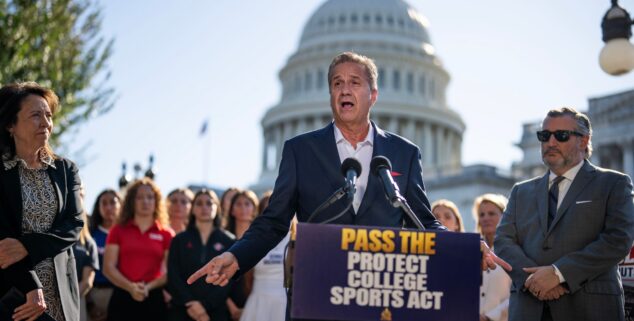
Now making its way through Congress, the Protect College Sports Act (PCSA) would strengthen enforcement of compensation limits by giving certain college-sports rules federal antitrust protection and tightening oversight of third-party NIL deals used to circumvent them.
Congress Steps In
To a host of boos, Texas Sen. Ted Cruz said during an appearance on ESPN’s College GameDay on Sept. 12 that the PCSA is intended to end the “chaos” and put “reasonable rules” in place.
The bipartisan legislation would establish federal rules governing athlete compensation, NIL, eligibility, transfers and other aspects of college sports while preempting conflicting state laws. It would also provide limited antitrust protection for certain rules established under the new system – a significant shift in an industry transformed through athletes’ successful antitrust challenges.
The PCSA has drawn support from the NCAA and a broad coalition of college athletic conferences and universities, including the Big Ten, SEC, ACC and Big 12. Professional sports organizations, including the NFL, NBA and MLB, as well as the NFL and NBA players’ associations and U.S. Olympic and Paralympic organizations, have also backed the legislation. Supporters argue a federal framework is needed to provide more certainty around compensation, eligibility and other college-sports rules.
Eligibility and the Courts
The NCAA is also facing lawsuits from athletes challenging the rules governing who can compete and for how long, including athletes seeking to return to college competition after playing professionally. Players have challenged rules that count time spent in professional leagues against their college eligibility or bar them from returning altogether, arguing in some cases that the restrictions violate federal antitrust law.
The PCSA would address eligibility by creating a five-year window for athletes to compete, beginning the year they turn 19 or graduate from high school, with certain exceptions. It would also establish federal rules governing transfers.
Transfer restrictions have already become another antitrust battleground. NCAA rules once generally required Division I athletes transferring between schools to sit out a season before competing again. A coalition of state attorneys general successfully challenged later NCAA restrictions on multiple transfers, arguing that they illegally restrained athletes’ ability to move between schools.
Employee status
Not everyone believes greater protection for college-sports regulators is the answer.
Derrick Johnson, president and CEO of the NAACP, appeared on ESPN’s SportsCenter three days after Cruz and argued that athletes could lose leverage if rules governing their compensation and movement are protected from legal challenges without giving players the ability to negotiate those rules collectively.
The current legislation does not settle one of the most consequential questions hanging over college sports: whether athletes should be classified as employees and have the ability to unionize and collectively bargain.
Olivia Nuss, a sports attorney and assistant attorney general with the Louisiana Department of Justice who has worked on NIL policy, discussed the unresolved question during “Chaos in College Sports,” a webinar hosted by the Institute for State Policy Leaders for state lawmakers and policymakers.
“I think the other interesting issue that is still an open issue is employee classification. So whether student athletes have the legal right to unionize remains completely unresolved,” Nuss said.
Women, Olympic sports and roster spots
Proponents of the PCSA argue that without federal intervention, athletic programs will continue to face expensive litigation and rising player-compensation costs that could threaten roster spots, non-revenue sports, Olympic programs and women’s sports.
So far, however, NCAA historical participation data do not show the widespread disappearance of athletic opportunities some policymakers have warned could occur. Through 2024-25, both Division I participation and the number of sponsored teams had increased.
Division I participation in championship sports reached 202,353 athletes in 2024-25, up from 184,222 in 2020-21, while the number of Division I teams increased by 151 over the same period, according to NCAA sport sponsorship and participation data.
“As we are having discussions about NIL, state policy, federal policy, it really needs to be rooted in what is best for student-athletes. And I think sometimes I think that that is lost a little bit in some of our conversations,” said Edgar Birch, a principal at the Rabin Group who advises clients on public policy strategy and stakeholder engagement.
Title IX
Another unresolved question is how Title IX, the 1972 law prohibiting sex-based discrimination in federally funded education programs, applies to the new era of direct athlete compensation.
The House settlement did not decide whether or how Title IX requires schools to distribute revenue-sharing payments between male and female athletes. The PCSA would not settle that debate either. The bill says it does not alter schools’ existing obligations under Title IX, leaving schools without a definitive answer from Congress about how the law applies to revenue-sharing payments.
Gov. Gavin Newsom raised Title IX when he signed California’s Fair Pay to Play Act alongside LeBron James in 2019, dismissing concerns that allowing athletes to profit from their own NIL would undermine protections for women. Nancy Skinner now says the rise of direct payments from schools has raised a different, unresolved question.
“The thing I regret, and I hope it gets fixed, is that the colleges’ paying of the athletes somehow has not fallen under Title IX, so they have not had the obligation that it ensures that the women athletes, the women students, get paid at least as much as the men, and that needs to be fixed,” Skinner told Capitol Weekly on its podcast.
The money behind college sports
The fight over college sports isn’t limited to athlete pay. Athletic conferences have a major financial stake in what Congress does next.
Conferences like the Big Ten and SEC negotiate lucrative TV contracts on behalf of their member schools and distribute that revenue back to them, giving the wealthiest leagues an enormous financial advantage over smaller conferences. They also help establish and enforce rules governing competition, scheduling and championships.
As NIL, revenue sharing and conference realignment have transformed the industry, the power conferences have pushed Congress for a national framework that would provide greater certainty around compensation rules and protection from some antitrust lawsuits. At the same time, proposals that could change how TV rights are sold or revenue is distributed carry significant consequences for conferences whose existing media deals are worth billions of dollars.
The PCSA would allow top-tier football programs to pool and sell their TV rights if at least 75% agree. The bill also seeks to curb conference consolidation and includes provisions to preserve free, over-the-air access to some games.
What’s next
The PCSA is now closer to passage than previous congressional attempts to establish national rules for college sports.
On Sept. 28, the Senate passed the PCSA in a bipartisan 77-22 vote, sending the legislation to the House of Representatives. The vote came four days after senators adopted a revised Cruz-Cantwell version of the bill.
The House would need to pass the Senate legislation before the end of the current Congress for it to reach the president’s desk.
“They’re going to try to put some controls, but I don’t think they’re ever going to be able to remove those athletes’ right to their name, image, and likeness,” Skinner said.
Note: This is the second of a two-part story.
Want to see more stories like this? Sign up for The Roundup, the free daily newsletter about California politics from the editors of Capitol Weekly. Stay up to date on the news you need to know.
Sign up below, then look for a confirmation email in your inbox.
Leave a Reply