
News
NIL: Beyond here there be dragons
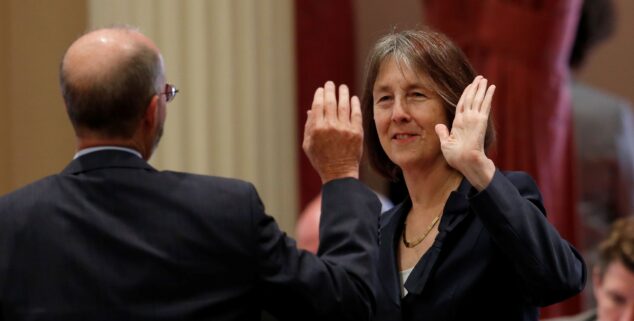 Nancy Skinner. Photo by AP.
 For decades, there was plenty of money to be made off college athletes — just not by the athletes themselves.
Universities sold tickets. Television networks paid billions for broadcast rights. Coaches became some of the highest-paid public employees in the country. An athlete, meanwhile, could put their eligibility at risk by accepting money for an autograph, an endorsement or the use of their own name, image and likeness (NIL).
That contradiction increasingly became difficult to defend.
“Our college coaches were the highest-paid public employees across California and across the U.S., and I’m like, ‘what is wrong with this picture?’” former state Sen. Nancy Skinner (D-Concord) told Capitol Weekly on its June 8th podcast. “This is a multi-billion-dollar industry that makes money for everyone involved, except the very talent and labor that produces that wealth.”
In 2019, Skinner set out to change that equation. Her Fair Pay to Play Act challenged one of the National Collegiate Athletic Association’s (NCAA) most entrenched rules and helped set off a chain reaction that would transform college sports nationwide.
History of NCAA & NIL
What started as an effort to protect college athletes – the year 1905 alone saw 18 deaths and 149 serious injuries attributed to college football – would eventually grow into the organization that enforced some of the biggest barriers to athletes profiting from their NIL.
Born out of President Theodore Roosevelt’s call to reform the increasingly dangerous sport, the Intercollegiate Athletic Association of the United States, the precursor to the NCAA, was established in 1906 to help standardize play. It adopted the name National Collegiate Athletic Association in 1910.
From the 1920s to the 1950s, the NCAA’s scope of responsibilities widened to include the creation and enforcement of eligibility rules, the regulation of recruitment, the establishment of academic standards, and the organization of championships, among other responsibilities. During this period, the concept of amateurism also became central to the NCAA’s governance of college sports.
Amateurism was rooted in the idea that college athletes were students, not professionals, and the NCAA believed maintaining that distinction was necessary for college sports. By the 1950s, the system had evolved to permit athletic scholarships, allowing colleges to provide financial aid to athletes they recruited.
It would be nearly 30 years before the NCAA found itself in a major legal battle to challenge its economic authority and control. In the 1984 case, NCAA v. Board of Regents of the University of Oklahoma, the U.S. Supreme Court found that the NCAA’s television plan, which restricted the number of college football games that could be televised and controlled the terms of those broadcasts, violated federal antitrust law. The decision gave schools and conferences greater freedom to negotiate TV rights, helping pave the way for the massive media deals that now fuel college sports.
Think of the SEC and Big Ten; the amount of money that rolls in through college athletics has exploded, as have the salaries of coaches and administrators. University of Georgia football coach Kirby Smart, for example, earned more than $13 million in 2025.
The transformation of college sports and the policy questions it has created were the focus of “Chaos in College Sports,” a webinar hosted by the Institute for State Policy Leaders that brought together state lawmakers, policy experts and others involved in college athletics to discuss the evolution of NIL and related state policy.
“It increased the number of eyes directed at college sports, and it raised a number of questions and increased scrutiny as well, which led to questions around whether or not student-athletes were getting a fair shake,” said Edgar Birch, a principal at the Rabin Group, during the webinar.
While the landmark California NIL legislation paved the way for unprecedented efforts to allow college athletes to profit from their NIL, the legal fight over NCAA pay restrictions began years earlier.
“I was really proud to carry it. I knew that it would have a huge impact. I mostly just wanted some fairness to athletes and some ability for them to make money – especially women.”
In 2009, Ed O’Bannon, a former UCLA basketball player, sued the NCAA after learning his likeness was being used in an EA Sports college basketball video game without compensation. U.S. District Judge Claudia Wilken found that the NCAA’s restrictions violated federal antitrust law. Her ruling would have allowed schools to provide scholarships covering the full cost of attendance and place up to $5,000 per year in deferred compensation into trust for athletes.
The Ninth Circuit Court of Appeals later upheld the finding that the NCAA’s rules violated antitrust law and affirmed the cost-of-attendance remedy, but struck down the portion allowing the $5,000 deferred cash payments. The decision did not legalize NIL, but it represented a major crack in the NCAA’s amateurism defense by establishing that its compensation rules were subject to scrutiny under federal antitrust law.
Olivia Nuss, a sports attorney and assistant attorney general with the Louisiana Department of Justice who has worked on NIL policy, also participated in the Institute for State Policy Leaders discussion.
“That justification rooted in amateurism became harder and harder to apply the rule of reason test in a way that would allow the NCAA deference to continue to have that restriction in place, and so when you talk about how this all began, you have to remember that even the cases that we’re dealing with today are still centered around that Sherman Antitrust Act,” Nuss said.
Running parallel to California’s push for NIL rights was another challenge to the NCAA’s limits on athlete compensation. In NCAA v. Alston, a lawsuit first brought in 2014, college athletes challenged restrictions on the education-related benefits they could receive from their schools. In June 2021, the U.S. Supreme Court unanimously ruled against the NCAA, finding that those restrictions violated federal antitrust law.
While the ruling did not directly concern NIL, it dealt another blow to the NCAA’s longstanding argument that its amateurism model justified restrictions on athlete compensation. The decision came at a pivotal moment: states were preparing to implement new NIL laws, and just nine days after the Alston ruling, the NCAA adopted an interim policy allowing college athletes nationwide to profit from their name, image and likeness.
California changes the game
Enter Skinner’s 2019 Fair Pay to Play Act. The bill would prevent colleges and athletic associations from revoking a student-athlete’s eligibility for receiving compensation for the use of their NIL. Importantly, this was not a way for players to be paid by their colleges; rather, they could earn money through deals with brands, businesses and advertisers.
Formal opponents of the bill included the NCAA and Pac-12 Conference, along with universities and higher-education organizations. Opponents raised concerns that the legislation conflicted with NCAA rules and could jeopardize athletes’ eligibility and schools’ ability to compete. Some also argued that NIL reform should happen nationally rather than state by state.
The bill analysis from the Assembly Committee on Arts, Entertainment, Sports, Tourism, and Internet Media recognized that Skinner’s bill would send all those involved into “uncharted waters” – something Skinner was ready to try and navigate.
“I was really proud to carry it. I knew that it would have a huge impact. I mostly just wanted some fairness to athletes and some ability for them to make money – especially women,” Skinner said.
Now, 34 other states have NIL legislation following that day Gov. Gavin Newsom sat down on LeBron James’ HBO show “The Shop: Uninterrupted” in 2019 and signed the bill into law.
This is part one of a two-part story.
Want to see more stories like this? Sign up for The Roundup, the free daily newsletter about California politics from the editors of Capitol Weekly. Stay up to date on the news you need to know.
Sign up below, then look for a confirmation email in your inbox.
great headline. dragons indeed.