
News
Is expansion the key to saving rural hospitals?
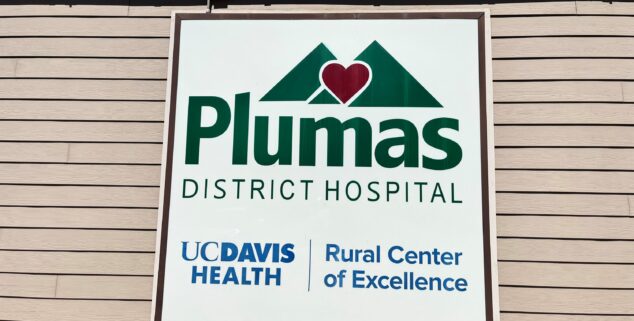 Plumas District Hospital, Quincy California. Photo by Rich Ehisen, Capitol Weekly
Nearly 500 miles north of Ridgecrest, another small hospital has confronted many of the same questions.
Plumas District Hospital (PDH) sits in Quincy, a mountain community in the northern Sierra Nevada. The publicly governed Critical Access Hospital has 16 licensed beds and an average daily census of just over five patients, according to the California Department of Health Care Access and Information (HCAI). It operates rural health clinics in Quincy and Greenville and provides emergency care, surgery, imaging, laboratory services, ambulance service and a recently opened long-term care facility.
Plumas offers an important counterpoint to Ridgecrest because it is not currently in the same financial position.
About a decade ago, it nearly was.
“When I first came on, we were sitting right around six days cash on hand, two days cash on hand,” said Caleb Johnson, the CFO of Plumas District Hospital. Administrators met weekly to decide “who’s not going to get paid.”
“It was pretty touch and go, without a doubt,” he said.
Today, hospital leaders said Plumas generally carries more than 60 days cash on hand, sometimes reaching around 120, and has reported a positive bottom line for more than a decade.
Its experience illustrates another side of the rural health equation, which is that survival may require expanding.
Hospital leaders described their services almost like an investment portfolio. An ambulance service, rural clinic or long-term care program may have good years and bad years, but having multiple lines of business spreads the financial risk.
“If you have all of these different service lines that are all having their own experienced risk in different ways, it’s very unlikely that all of them are going to be experiencing the same risk at the same time,” Johnson said.
Plumas recently expanded ambulance operations into neighboring Lassen County after another operator struggled to remain financially viable.
Chief operating officer at Plumas Darren Beatty called rural emergency medical services a “quiet brewing crisis,” warning of a future in which someone calls 911 but “the nearest ambulance is two hours away.”
The strategy has also meant spending money on things that do not necessarily make money by themselves. The hospital built a daycare serving employees and other local families.
“It will never make money,” Beatty said. But without it, the hospital would struggle to staff other positions.
“If you have all of these different service lines that are all having their own experienced risk in different ways, it’s very unlikely that all of them are going to be experiencing the same risk at the same time.”
Hospital leaders said a rural hospital’s value cannot always be separated from housing, childcare, schools, ambulance service, local employment and whether young families can build a life in the community.
Hospitals themselves have increasingly become part of the economic base in some rural towns.
“What’s left are some of these anchor institutions,” Beatty said. If the hospital failed, he said, “it collapses the community in general.”
Plumas and Ridgecrest also show how hospitals can reach different conclusions about the same service.
While Ridgecrest chose to restore traditional labor and delivery, Plumas stopped providing traditional obstetric deliveries in 2022 after years of declining volume and mounting staffing problems.
“If you just aren’t having a lot of deliveries, then skills can atrophy,” Johnson said. “It might actually not be safe, even if you have people with the right letters behind their name and the right training.”
The hospital faced the same standby problem Ridgecrest describes. OB nurses had to be available even during stretches with no deliveries. But eliminating traditional labor and delivery did not eliminate pregnancy in Plumas County.
Hospital leaders said two local women recently planned to deliver in Truckee but failed to make it there in time. One, pregnant with her fifth child, ended up giving birth at a fire station.
Plumas is now pursuing a midwife-led alternative birth center paired with prenatal care through its rural clinic and a standby perinatal unit for emergencies.
In 2025, the idea grew into Senate Bill 669 authored by then-Senate leader Mike McGuire, hospital officials said, with the goal of creating a model that could potentially be used elsewhere.
The contrast between Ridgecrest and Plumas underscores a point Glenn Melnick, USC health economist, raised that preserving rural health care does not necessarily mean preserving the same services in the same form everywhere.
“You want this anchor,” Melnick said. “But rural hospitals don’t necessarily have to do all these inpatient services.”
For more specialized care, he said, a stronger system could ensure patients are transferred efficiently to larger facilities, while also recognizing that transportation itself can become a barrier.
“A lot of these folks in the rural areas are lower income; they can’t afford to travel,” Melnick said. “So, you know, we got to think about all that stuff.”
California is now trying to rethink parts of that system through the California Rural Health Transformation program, administered by the Department of Health Care Access and Information. California received about $233.6 million in federal funding for the program’s first budget period.
The program emphasizes regional partnerships, workforce development, technology and changes in how care is delivered rather than simply replacing lost hospital revenue. HCAI’s first round of recommended awards includes about $6.9 million for Ridgecrest Regional Hospital and more than $3.2 million for Plumas District Hospital across separate initiatives.
The new funding could help rural hospitals change how they deliver care, but it does not necessarily solve the more basic problem Ridgecrest officials have raised for years: how to pay for services that must remain available even when patient volume is low.
“When a person shows up at the hospital, chances are they’re having the worst day of their lives….They’re not thinking about the funding model, the reimbursement. We have to make this invisible, so that when people come in, we take care of them.”
That question has also reached the Legislature this past session.
Assembly Bill 1882, authored by then-Assemblymember Stan Ellis, would have created a pilot program to compensate certain geographically isolated hospitals for maintaining services, including labor and delivery, inpatient pediatrics and surgery, even when patient volume was low.
Ellis told Capitol Weekly the bill grew directly out of conversations with Ridgecrest Regional Hospital, which was in his district.
After both houses passed it, Gov. Gavin Newsom vetoed AB 1882. Newsom said he shared the goal of preserving access in geographically isolated communities but objected to creating what he called a “new, complex, and unfunded hospital reimbursement program.” He instead pointed to existing state investments for financially distressed hospitals, public hospitals and a new health care stability unit.
Ellis viewed the decision differently.
“Ridgecrest is a little community,” Ellis said. “It’s forgotten.”
The veto exposed a distinction that runs through the broader rural hospital debate. While one approach is to step in when a hospital becomes financially distressed, another is to compensate a remote hospital for maintaining a service before the institution reaches crisis, as AB 1882 intended.
The harder question is how the state decides what a remote community must have close to home, what can reasonably be regionalized and how to finance the difference.
At Plumas, hospital leaders say years of financial improvement have put them in a much stronger position to face the coming uncertainty than they were a decade ago.
Johnson compared it to two houses facing the same storm, one a shack and the other reinforced over time.
“The strength of the wind,” he said, “is the same.”
Ridgecrest enters that storm from a different financial position. But for the people who depend on the hospital, the complicated funding questions are largely invisible.
“When a person shows up at the hospital, chances are they’re having the worst day of their lives,” said Rebecca Neipp. “They’re not thinking about the funding model, the reimbursement. We have to make this invisible, so that when people come in, we take care of them.”
Want to see more stories like this? Sign up for The Roundup, the free daily newsletter about California politics from the editors of Capitol Weekly. Stay up to date on the news you need to know.
Sign up below, then look for a confirmation email in your inbox.
Leave a Reply