
News
Grizzly reintroduction effort may only be hibernating
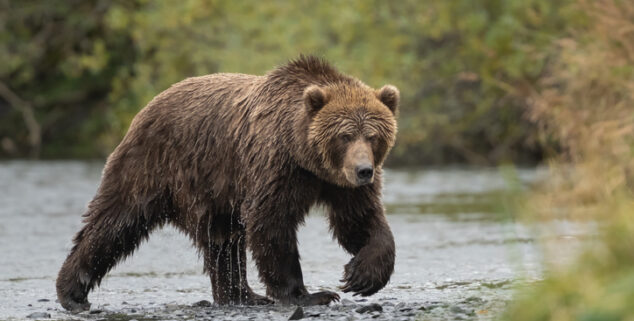 A wet Kodiak bear walking out of a river. Image by GoDogPhoto via iStock
The iconic grizzly bear image can be seen across California, from the state flag and seal to souvenirs, college mascots and even theme parks, but the state hasn’t seen an actual grizzly bear in the wild since 1924, when one was reportedly sighted in Sequoia National Park.
A proposal to consider changing that failed this year, but supporters say the idea is not yet extinct.
The measure, SB 1305, authored by Senator Laura Richardson (D-Inglewood), would have directed the California Department of Fish and Wildlife (CDFW) to establish a roadmap to determine the feasibility of reintroducing Ursus arctos horribilis to California. The bill was co-sponsored by the Tejon Indian Tribe and Yurok Tribe, with supporters of the bill including the California Grizzly Alliance, which published its own feasibility study last year.
The bill cleared the Senate on May 27th on a straight party line vote but later died in the Assembly Appropriations Committee.
Tiana Williams-Claussen, director of the Yurok Tribe Wildlife Department and member of the California Grizzly Alliance, was approached to join the alliance after her work to reintroduce the California Condor to the state. Her involvement led to raising the issue of reintroducing grizzly bears to the Yurok Tribal Council.
“Part of what we consider to be our foundational reason for being is, as we say, world renewal or fix the earth people,” Williams-Claussen said. “So our elders were very behind this idea of bringing a species that we consider to be a relative back into our ecological and human communities as well.”
She said since joining, she has “grown in my understanding of grizzlies to be confident in their capacity to not only thrive in an ecological context, but to be a benefit to the ecology.”
That, she says, was the driver behind the proposed study, “from ecology to socioeconomics to cultural factors. Not only potential for human-wildlife conflict, but also human-wildlife coexistence and how might that be brought to happen.”
But the possibility of human conflict with grizzly bears kept the bill from making it to the Assembly floor. Assemblymember Heather Hadwick (R-Alturas) was one of several legislators who opposed the bill, saying her rural constituents already deal with predators as a daily occurrence.
“When this bill came up, people immediately were afraid, and they often already feel like rural California has been forgotten and is a dumping ground, and doesn’t have a voice,” Hadwick said. “We’re out of whack in our wildlife management right now and unbalanced, so adding another one would cripple us in rural California.”
Peter Alagona, professor of environmental studies at UC Santa Barbara and founder of the California Grizzly Research Network, helped lead the California Grizzly Alliance’s feasibility study. He said it would have taken years of planning after the bill’s study to start introducing a small number of bears, “the last thing you want to do is put people and these amazing animals in a place where they’re set up for failure,” adding that “all this bill would really have done is tell us more about how we might eventually plan for this.”
Hadwick, however, said the state shouldn’t be spending money on such a study when CDFW is already underfunded and running at 30% of its law enforcement staffing needs.
“To spend millions of dollars on a study, it seems irresponsible,” she said, adding that many of her rural constituents view approving the study as a green light to reintroducing grizzly bears.
To that end, the Assembly Appropriations Committee analysis notes some of the funds were earmarked for reintroducing grizzly bears into the wild even though the bill wouldn’t authorize doing so.
Notably, the bill would not directly allocate the CDFW’s requested funds, leaving a future legislature or other source to do so.
Hadwick says the threat of predators is unique to her district, with many of her colleagues not facing daily issues with wolves, bears and mountain lions.
“When you have to listen to a mom talk about how she can’t let her kids play outside because of these predators, because they’re afraid, whether they attack humans or not, it is irrelevant at that point, because that fear is real,” she said. “We need to solve the problems we have that we currently have before Sacramento starts studying how to create another one or bring another predator into this.”
Hadwick says she supports the tribes’ efforts to restore a part of their culture, but that California’s massive growth over the last century makes bringing the grizzly back untenable.
“We have 37 million more people here in our state than we did when grizzly bears walked free, and we are definitely a different California,” Hadwick said.
Devlin Gandy, a member of the California Grizzly Alliance, said their feasibility study found most of Hadwick’s district to not be an ideal area for reintroduction, instead focusing on forests in the Northwest, the southern Sierra Nevada and the Transverse Ranges.
“We have 37 million more people here in our state than we did when grizzly bears walked free, and we are definitely a different California.”
“Any bears that are released would be so monitored, even if there weren’t hypothetically fences in place, the tracking system on these bears would be so extensive that they are functionally in an open-air zoo,” Gandy said.
Alagona said that while many historical accounts noted grizzly bears as eating livestock, his research found that before European settlement their diet consisted of 80-85% plant matter, similar to brown bears in the Mediterranean.
“If you think of a true omnivore, grizzly bears have the broadest diet of any large animal except for people,” Alagona said. “They’ll eat basically anything people eat; they’ll eat basically anything almost any other animal will eat.”
Alagona said that while protein from land animals did increase from 15% to 30% after European settlement, he believes tools that have been developed can lead to a peaceful coexistence.
“Well-managed livestock can coexist with a healthy ecosystem in places where people invest in them,” Alagona said. “I think that we should be investing more in enabling people in rural communities to be able to live those lifestyles and do that work, but not at the expense of a healthy ecosystem.”
Gandy said that historically grizzly bears provided ecological benefits to California, from creating pathways through chaparral and creating natural fire breaks to redistributing nutrients via their droppings.
“We know that they also distribute a lot of marine nutrients to the forest in a way that gives the trees a really unique opportunity, one, to thrive, but also to respond to climatic stress,” Gandy said. “There’s a term that’s actually been coined recently called salmon trees, and these are trees that basically grizzly bears are feeding by moving salmon out of the river up into the slopes of the forest,”
Siskiyou County Sheriff Jeremiah LaRue was one of the rural sheriffs who testified against the bill. He said sheriffs already have to step in to deal with predators because the Department of Fish and Wildlife doesn’t have enough funding.
“If the state regulatory agencies or the state enforcement agencies are underfunded, they don’t have the resources; it winds up falling on the local government to carry the burden,” LaRue said. “We already have current conflict with bears, and because of regulations and politics, it makes it very hard and is growing ever increasingly challenging for fish and wildlife to perform their mandated function.”
Gandy said that argument convinced Richardson and the co-sponsors to strike language that would have required the state to recover grizzly bears and instead focused fully on the study.
“They really heard the concern about the role of law enforcement and really tried to include folks that are left behind in the conversations,” Gandy said. “Individuals that explicitly needed to be consulted with, engaged with, and have state frameworks to help manage human-wildlife conflict.”
LaRue says the legislature would need to carve out an appropriate pathway on how to deal with an animal that is a public safety risk, saying that as of now “we just don’t have the right policies and laws on the books” to manage such situations.
“For me, the question of grizzly recovery in California, it’s more broadly a question of values and integrity for our state….It’s a question of what we want to stand behind as a state, as a community, as people.”
“People feel very vulnerable, local government feels vulnerable, but yet we’re carrying the burden of having to work through these very challenging situations,” LaRue said.
Williams-Claussen says part of the feasibility study would be how to avoid and respond to human-wildlife conflict, with that being needed before any final decision is made.
“Everybody, probably CDFW included, would say they are underfunded for the tasks that they’ve been allocated,” Williams-Claussen said. “Which is something I think we need to change as Californians in general if we want to really be leaders in wildlife management.”
Alagona says the issue of reintroducing grizzly bears isn’t just a two-sided issue.
“These animals are just so fascinating,” Alagona said. “Every time you think you’ve learned all there is to know about them, they surprise you with something else.”
Gandy says the issue of reintroducing grizzly bears is about who we are as a state.
“For me, the question of grizzly recovery in California, it’s more broadly a question of values and integrity for our state,” Gandy said. “It’s a question of what we want to stand behind as a state, as a community, as people.”
Hadwick says her opposition isn’t about being “anti-wildlife.”
Williams-Claussen says that whether the efforts lead to the reintroduction of grizzly bears, she looks forward to the conversation bringing people together.
“I feel regardless of how it comes out we’re gonna come out better friends,” Williams-Claussen said. “We’re gonna be able to move forward towards a beautiful and healthy California in a good way.”
She said discussions over next steps are ongoing and the decision whether or not to reintroduce the bill next year has yet to be made.
Want to see more stories like this? Sign up for The Roundup, the free daily newsletter about California politics from the editors of Capitol Weekly. Stay up to date on the news you need to know.
Sign up below, then look for a confirmation email in your inbox.
Leave a Reply