
Q&A
CW Q&A: CHA’s Carmela Coyle
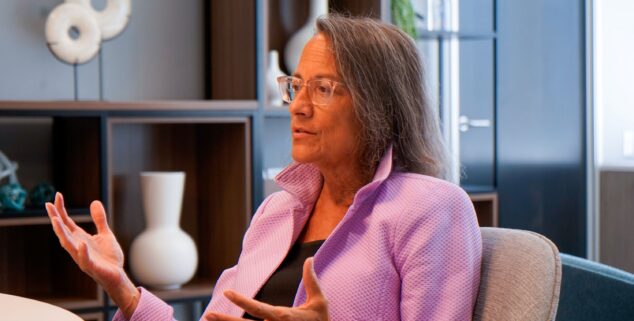 Carmela Coyle. Photo by Joha Harrison, Capitol Weekly.
 Longtime California Hospital Association President and CEO Carmela Coyle is retiring at the end of this year. We sat down with her recently to discuss challenges hospitals are facing in light of massive federal funding cuts over the next two years.
CW: Hospitals, in particular rural hospitals in California, have been struggling for a very long time. Give me your bottom line assessment on the health of California’s hospital systems.
Coyle: This is really a difficult moment against a 40-year backdrop for California’s hospitals. Today, 44 percent of California’s hospitals operate in the red. They lose money every single day, and that is unusual not only in California’s history but nationally. A couple of things drive that. California is a state that is very focused on managed care, which means the opportunities to make up shortfalls are fewer and fewer. If you go east, hospitals may be able to encourage more insured patients and fee-for-service patients, where there is a higher reimbursement amount to come into their organization. That’s just not the case in California. Rural hospitals are particularly distressed, but a number of our inner-city urban hospitals have the same set of challenges that our rural hospitals have: difficulty recruiting physicians, difficulty finding staff and financial challenges because of the makeup of the population they serve. Large numbers of Medi-Cal patients, where the reimbursement is low; large numbers of Medicare patients, where the reimbursement is low. So while there’s a focus right now on rural, we really have a broader set of financially distressed hospitals than we’ve seen in a very, very long time.
CW: I imagine that’s only going to get worse as we look ahead to 2027, when the impact of the Big Beautiful Bill really hits. How are hospitals preparing for this?
Coyle: The One Big Beautiful Bill Act pulls about a trillion dollars out of Medicaid, including some $100 billion from the state of California and California’s hospitals. And you’re right, it’s a bigger impact in 2027 and an even bigger impact in 2028. So hospitals are trying to plan and make operational changes now to try to avoid falling off a financial cliff, taking a look at how to lower their expenses because there is very little revenue relief that’s coming. What’s difficult for hospitals, unlike other types of providers, is we are open 24/7, and we are required by federal law to treat and stabilize every patient who comes to the emergency department. Others can lock the door and say, ‘I’m so sorry, we don’t accept Medi-Cal, or we’re not accepting Medicare patients today.’ And hospitals just don’t have that option. So it’s immediate short-term actions, combined with long-term planning. And that planning now has to have everything on the table. Can a hospital continue to provide all the services to the community it’s currently providing? That’s been challenging. We’ve seen across the state cutbacks in labor and maternity care. We’ve seen cutbacks in behavioral health services. But that means people have to drive further to get that care. And then, the planning for the longer-term, bigger changes. There will be hospitals that close, there will be service lines that are discontinued, there will be more combining of resources and services. It’s going to be very, very challenging over the next two years.
CW: What role is AI going to play in how you mitigate these worst-case possible scenarios?
Coyle: Hospital leaders are also looking at how they can take better advantage of technology moving ahead. But artificial intelligence requires investment before you can see the savings that may occur. I think as we look at AI in healthcare, the application is different than in other kinds of businesses. What we’re looking for is the opportunity to supercharge our nurses and our physicians and how can we take limited personnel and enable them to spend more time at the bedside and less time with the paperwork; more time with the patient, less time on insurance coverage-related issues. So I think it’s about amplifying that clinical knowledge. And the more we can use technology, and AI in particular, to deal with the administrative side, the more time our incredibly well-trained clinical folks have to be with patients.
“What’s difficult for hospitals, unlike other types of providers, is we are open 24/7, and we are required by federal law to treat and stabilize every patient who comes to the emergency department. Others can lock the door and say, ‘I’m so sorry, we don’t accept Medi-Cal, or we’re not accepting Medicare patients today.’ And hospitals just don’t have that option.”
CW: We see workforce shortages across every aspect of healthcare, whether it’s nursing, X-ray technicians or doctors. What are you seeing in terms of overall staffing shortages and efforts to try to mitigate those problems?
Coyle: My greatest concern has nothing to do with the current pipeline of clinical professionals that we’re developing. My greatest concern is about demographics, and it is the number one problem as it relates to workforce right now. And there’s nothing that we can do about it. The age 65 and over population in California is going to increase 59 percent by 2040. That’s just the aging of the population. We are going to be losing more people in the health professions than we possibly have the opportunity to train just because it is a longer-term pipeline. So yes, we’ve got to keep that pipeline going. But all the retiring baby boomers is going to give us a short-term crunch. And I think we’re going to have to think differently. People often talk about making certain that healthcare professionals can work at the top of their license and be able to do everything they’re capable of and trained to do. I think we need to get even more creative with new roles for community health workers, new roles for behavioral health technicians. We’re going to have to take advantage of folks who may not have the completion of a full degree. How can we use them in the healthcare delivery setting as wisely as possible?
CW: You’re touching on scope of practice, which is always one of the most intense battles in all of healthcare.
Coyle: In an ideal world, in every circumstance, we want the best, most highly trained individual capable of delivering that care. But in times of dramatic change – and I think that’s what this demographic cliff is going to deliver to us – we have to do whatever we can to continue to be able to provide care. And we need to do that thoughtfully and in combination with physicians and nurses. But we’re going to have more people who need to be cared for, right? Those baby boomers are also going to continue to get sick, and they will continue to have cancer, and they’ll continue to be in car accidents. We’re going to have more people who we’re caring for, with fewer people available to care for them. And we can’t simply let that pass.
CW: Gov. Newsom has implemented several policies and programs designed to address the state’s mental health challenges. Where are we in terms of the hospitals’ roles in trying to deal with some of the mandates that have come down on hospitals in this regard?
Coyle: Gov. Newsom has been a champion of behavioral health issues, and I think the investments California has made in behavioral health have been some of the most state’s most important over the last five to eight years. But we are also dealing with significant challenges in that we simply don’t have the infrastructure, both in places and the people, to provide the behavioral health care that we need. And unfortunately, hospitals have and will continue to be the catcher’s mitt for all of society’s challenges. Because when there’s not a place for appropriate care, the emergency department is the next best thing. And we’ve seen a huge increase in emergency department visits for behavioral health patients, which is often the least good place for them to be. So we’ve been working to see what we can do to increase the infrastructure.
CW: And the people aspect?
Coyle: We’ve been challenged as the state legislature has driven to implement new nurse staffing ratios in acute psychiatric hospitals. And unfortunately, it’s backfired. What has happened is in putting these ratios in place, we’ve actually seen hospitals who have had to close their psychiatric beds. So despite all of the investments over the last decade to do the right thing in California, we now have places where we’ve lost 10-15 percent of the acute psychiatric beds. Some hospitals have had to close all of their adolescent psychiatric care services. And so, we continue to work with the state to see if there’s more we can do. The whole idea was to expand, not to contract. And I think it’s an example of being well-intentioned, but in making one policy move to put billions more into behavioral health, it has actually contradicted that objective.
CW: As you noted, under federal law the ER is the one place you cannot get rejected for any reason. Given how many people we think are probably going to lose their healthcare coverage, what can hospitals do to help manage or mitigate a big influx of patients into the emergency room?
Coyle: This is the bigger conversation about the complexity of the healthcare delivery system. As more people are without health insurance coverage and the emergency department is the only place they can go, that creates backup in the EDs. It creates boarding and patients who are not just there for 12 hours but sometimes for days in what’s called ‘on the wall’ waiting for a room to open up. But rooms can’t open up upstairs unless we have a place to put patients who no longer need acute hospital care but need some level of nursing home care or home health service. But if that’s insufficient, which ever since COVID it has been, we have people who are stuck in the hospital. We did a study on the millions and millions of wasted hours and days patients spend in the hospital. Wasted, in the sense that these patients no longer need acute hospital care, but there’s nowhere else to put them. And it’s just creating this blockage within the hospital. We’ve got to work with our post-acute care partners to continue that flow, but they’re also suffering as a result of reimbursement cutbacks. And because of the lack of obligation there to be open and remain open, hospitals end up with a patient complement because we have to care for everybody.
CW: What can be done?
Coyle: There is what I’ll call a grassroots movement that’s happening organically in communities across California. We know we will have people who will lose their coverage because they are undocumented. They will lose their coverage because they’re not meeting work requirements. They will lose their coverage because their patients can’t navigate the application process in a way that others might be able to. So what do we do? How do we work with our local health plans to flag some of these individuals? How do we catch them before they fall off the rolls? This is where we have people in hospital admitting departments, who are helping people fill out that paperwork. How can we work with the health plans? It’s in their best interest to have full coverage for these folks, not just partial coverage. So we’re seeing more and more of that. There is a project in San Diego, where there is a large philanthropy that’s looking to try to plug that gap, and I think we’ll see more community-level efforts to try to keep people covered and get them the care that they need. But it simply won’t be enough to cover just the huge shift in who’s going pay for healthcare in the United States. We’re going to have to move that back to the states.
:We know we will have people who will lose their coverage because they are undocumented. They will lose their coverage because they’re not meeting work requirements. They will lose their coverage because their patients can’t navigate the application process in a way that others might be able to. So what do we do?”
CW: CHA is opposed to Prop 39, the so-called ‘billionaire tax.’ But give me a thought on efforts to try to counter things that are coming down from the federal government with ballot measures.
Coyle: I’ll share a personal thought, which is I always think policy is better done through a legislative process, where folks from different parties are informed by our state financial and budget experts, where they’re working collaboratively with the governor. I think it’s a process that can lead to better, longer-term, more sustainable solutions from a public policy perspective. I think in general, the ballot is a very difficult tool for that. Ballots tend to be ham-fisted. They are not particularly elegant policy solutions. They’re catering to how voters view certain issues. Healthcare, in particular, is so complicated in that moving one rock you typically have to move three or four other rocks with that. That makes it a difficult place to create a thoughtful policy. That’s one of the challenges with the billionaires’ tax. Is more revenue a good thing? Yes. But that revenue needs to be sustainable. We need to make certain it’s going in the right places. We shouldn’t jeopardize a longer-term flow of revenue for the short-term instant result that might be there and might be available.
CW: It seems like the public sometimes has unrealistic expectations of the healthcare system, given the resources at hand. Does that surprise you?
Coyle: If there’s a part that might be surprising, it’s from more of an academic policy perspective. It’s easy to come up with elegant policy solutions that all fit together but sometimes aren’t politically realistic. I think we have to constantly balance the policy objective with what our elected officials can and should do. I have a ton of respect for our elected officials. I know sometimes the voting population raises questions about it, but I think they have very difficult jobs and they’re managing a very challenging set of activities. I actually think the public largely has it right. And that is: it’s one thing to make policy decisions and budget decisions, and it’s another thing when it’s your loved one who has just been in an accident or been diagnosed with cancer and is in need of care. The public is never of two minds at that point – they want a loved one to get whatever they need. We as a nation have one of the best healthcare delivery systems. I truly believe that. I don’t agree with those who compare mortality rates in one country versus another country. It’s a very insensitive measure. We have a challenge, and that is how much do we, as a nation, or how much do we, as a state in California, want to spend on healthcare? That’s very different when it’s a theoretical policy issue, than when it is a member of your family in need of care.
Want to see more stories like this? Sign up for The Roundup, the free daily newsletter about California politics from the editors of Capitol Weekly. Stay up to date on the news you need to know.
Sign up below, then look for a confirmation email in your inbox.
Leave a Reply