
Capitol Briefs
Capitol Briefs: The Capitol Weekly Conference on Affordability
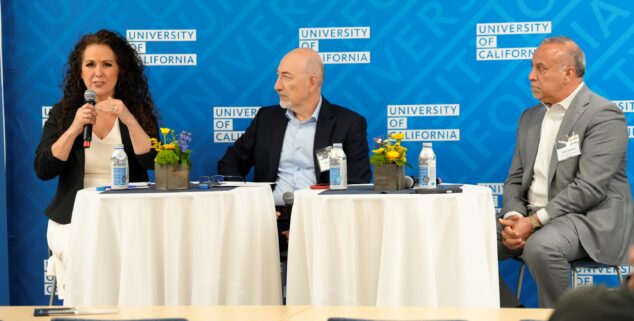 Lorena Gonzalez, Rich Ehisen and Mike Madrid. Photo by Joha Harrison, Capitol Weekly.
 Speakers lamented the high cost of living in California on Thursday at Capitol Weekly’s second conference of 2026, offering a sobering assessment of the gap between the haves and the have nots in the Golden State.
“We can’t even conceive of the income inequality,” said one of the keynote speakers, California Federation of Labor Unions president Lorena Gonzalez. “I’m sorry, most of us can’t actually conceive of what a billion dollars is. There’s all these memes and stuff you can go look at like, ‘Wait, I have to go work 11,000 years to get to a billion dollars?’ What are we talking about?
Panels scrutinized the cost of energy and food as well as who should be held accountable while Gonzalez and her fellow keynote speaker, the political consultant Mike Madrid, engaged in a lively conversation about the politics of affordability.
Panel 1: Energy Costs
The first panel of the day focused on the rising cost of energy in California, with panelists focusing on differing diagnoses and highlighting the difficulty of balancing affordability, climate goals and system reliability. The discussion reflected a mix of perspectives from academia, utilities and the petroleum industry.
Andrew Campbell, Executive Director of the Energy Institute at Haas, UC Berkeley, pointed to global conflict as a primary driver of fuel costs and cautioned against expecting state policy to offset global forces.
“The biggest driver is really just a big global supply situation,” Campbell said.
Tara Porter, Director of Customer Operations at SMUD, emphasized wildfire mitigation as a major contributor to rising electricity costs, noting the growing expense of reducing fire risk.
From the petroleum industry’s perspective, Zach Leary, Senior Director and California chief lobbyist of the Western States Petroleum Association, highlighted how California’s policy environment has contributed to a decline in in-state fuel production and an increased reliance on imports.
“We’ve gone from 30 plus refineries down to now six,” Leary said. “The long-term solution is to protect what’s left, because if there’s another global event and you don’t have refineries, then the California consumer is going to be worse off in the short term.”
Leary further explained that state climate policies are intentionally designed to influence consumer behavior away from fossil fuels.
“In California, the design of California’s energy system, its climate programs, is to send consumers a price signal not to use fossil fuel products anymore,” Leary said.
Returning to consumer-focused solutions, Porter highlighted energy efficiency as an underutilized means to reduce long-term costs for consumers.
“Making the older homes more energy efficient, along with weatherization, those are the more affordable ways to reduce a customer’s energy use,” Porter said.
Campbell emphasized that policymakers must carefully balance tradeoffs between environmental goals and affordability, noting that both priorities often compete in shaping energy policy.
Campbell also warned that structural weaknesses in California’s fuel system leave the state vulnerable during global disruptions.
“We just don’t have a very resilient environment,” Campbell said.
Overall, panelists agreed there is no single solution. They stressed that policymakers must take coordinated approaches that meet climate goals while also reducing the financial burden on consumers.
Panel 2: Food Costs
Speakers on the second panel discussed the food insecurity thousands of Californians and various challenges facing agriculture.
“Before people used to choose between things that they wanted and things that they needed,” said Assemblymember Rhodesia Ransom (D-Stockton). “Now what we’re hearing from constituents is they are prioritizing their needs differently.”
The assemblymember said her constituents are struggling to choose between basic commodities such as gas and food. Similarly, Steven Fenaroli, Director of Political affairs at the California Farm Bureau, said a survey found that 66% of farmers in the West are unable to afford fertilizer.
“Everyone always likes to say farmers are so resilient and they are,” he said. “But gosh, there’s only so much people can take before they just throw in the towel and say, ‘Hey, enough’s enough. I’m not going to do this.”
Indeed, James Sayre, a UC Davis agricultural economist specializing in international trade and food supply chains, said agriculture is inherently risky, calling it “basically an open-air casino.” He said trade policies, particularly tariffs, have a huge impact on the sector.
Leticia Garcia, Director of Government Relations at the California Relations Association, said local grocers are likewise struggling because it costs them so much to compete with larger national brands.
“At the end of the day, they don’t have the same buying power that these larger brands have.”
Luncheon Keynote
In an unusual format for a Capitol Weekly keynote, Gonzalez and Madrid discussed how California politicians address affordability—with the pair agreeing that, essentially, they don’t.
“I think unfortunately the only thing we’ve heard of substance about affordability is whether or not you keep the gas tax, right?” said Gonzalez, president of the California Federation of Labor. “So, it hasn’t been, I think, largely addressed and let’s be honest, the gas tax — although substantial and we can talk about why it would be foolish to get rid of the gas tax — even if you reduced it, we’d still have higher gas prices than most of the nation.
“So, there are a lot of issues that are going on and yet we’re not seeing deep dives into issues around affordability.”
Madrid, the political consultant and Latino voter expert who is a senior fellow at UC Irvine School of Social Ecology, attributed this lack of leadership to a fundamental breakdown by California politicians to rise to the thorny challenges before them and respond to the needs of struggling residents.
“We can’t even get to solutions anymore because we don’t even address the problems,” he said excitedly. “We’re not even asking the right questions in this state. And so how are we going to solve things for real people? And by the way the voters know this overwhelmingly.”
Gonzalez, a former state lawmaker, said she believes there are several things the Legislature could do if it was serious about pursuing “an affordability agenda,” citing a ban on surveillance pricing to prevent online retailers from jacking up the cost of goods, a revision of the gas tax to make it more progressive and broad, robust right-to-repair laws that make it easier for families to fix expensive electronic products instead of having to replace them when they break.
“I think there are a lot things that could be outlawed, that could be looked at in California and could be addressed that sometimes just are a little hard for people to get at, that could help,” she said. “And you know that’s not even getting to the big ones like rent and food and electricity.”
Madrid said he’d like to see something that would allow Californians to leverage their most valuable asset in the digital age: their data.
“The seven biggest companies in America are tech companies that get data on us for free,” he said. “By simply walking in here and liking something and posting something, you’re providing an asset to these firms and you are being monetized and receiving no benefit. In a previous time, we would have called that feudalism or slavery. OK?
“So we are giving away ourselves a monetized asset and these companies are making money off of us. Why can’t we create a technological and legal framework that guarantees not just a right to privacy … but the technological solution to control our own data and monetize it?”
About the only topic Gonzalez and Madrid differed on was taxes. Gonzalez said she believes the solution to affordability is taxation and “a little redistribution of wealth.”
“There’s no other way around it,” she said. “On this road you have 900 billionaires in this country that are going to continue to horde wealth to expand their wealth — and that wealth comes from somebody. It comes from working people. Right? So how else do you recalibrate our society?”
Madrid agreed that taxing the wealthy would generate some revenue for programs, but he said a more effective strategy would be breaking up corporate monopolies.
“Redistributing cash is different than redistributing wealth. If we had taxed andrew Carnegie and Vanderbilt and Getty a one-time tax, maybe that would have gotten us two or three years of funding whatever we did. Thank God the people of that era went in and busted up those monopolies. That’s what the wealth is! OK? Get the cash, I guess. But that is, I think, a very limited understanding of the problem here…
“The moment is so much bigger than what we were dealing with in the Gilded Age.”
Panel 3: Accountability
Capitol Weekly’s third panel of the day highlighted California’s inability to hold its programs accountable for their desired outcomes, resulting in what panelists described as bloated government spending.
In the Legislature, former state Sen. Steve Glazer said lawmakers are afraid to exercise their authority to oversee government spending for fears of angering a governor who could veto their bills.
“You’re putting yourself at risk and all the bills that you’re authoring that year,” Glazer said, noting that in nine years on the Senate Education Committee it never once held oversight hearings on K-12 education, the state’s largest expenditure. “You’re putting them at risk because you have a governor now that’s going to be mad at you for doing oversight.”
Lindsay Maple, Deputy Director of Possibility Lab, a community-driven policy team at the University of California, Berkeley, said lawmakers often become so preoccupied with process that they overlook outcomes. She said that’s due to a mismatch between the data that’s often collected on programs and the data needed to measure its effectiveness.
In a similar vein, former State Auditor Elaine Howle said the State Auditor should conduct incremental reviews on programs instead of retroactive ones.
“We come in and we bayonet the wounded,” Howle said. “That’s not what we want the State Auditor’s office to be doing.”
The panelists, however, weren’t entirely pessimistic. Howle applauded Gov. Gavin Newsom’s administration for its response to more $30 billion lost to fraudulent pandemic unemployment claims. The state is set to invest more than a billion dollars into modernizing the department’s infrastructure and be better prepared to combat fraud.
Nick Maduros, Gavin Newsom’s Secretary of Government Operations, also highlighted the California Health Benefits Review Program, designed to guide the Legislature in lawmaking related to health insurance benefits. Through the program, UC Berkeley is required within 60 days to submit a report that details proposed legislation’s impact and costs.
“That’s an example of an oversight and an accountability element of a policy program that’s ongoing in the state,” Maduros said. “And it’s positive.”
Capitol Weekly reporters Brian Joseph and Leah O’Tarrow were joined by interns Jasleen Kaur and Chris Ramirez in producing this story.
Want to see more stories like this? Sign up for The Roundup, the free daily newsletter about California politics from the editors of Capitol Weekly. Stay up to date on the news you need to know.
Sign up below, then look for a confirmation email in your inbox.
Leave a Reply