
Capitol Briefs
Capitol Briefs: On your mark, get set….
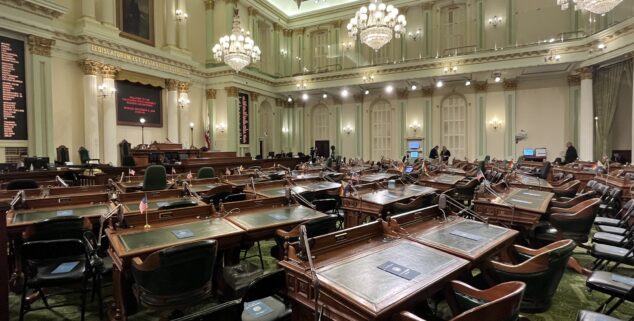 Assembly Chambers. Photo by Capitol Weekly
Lawmakers come back next week for the annual sprint to the legislative finish line. Today we look at a handful of bills and issues on the August docket.
The fire down below: Things kick off fast starting on Monday when the Senate Appropriations Committee is set to hear AB 28, a bill from Assemblymember Pilar Schiavo (D-Chatsworth) that would require landfill operators to monitor underground landfill gas temperatures and report to regulators when those temperatures reach certain levels.
The bill is aimed directly at trying to prevent a replication of the Chiquita Canyon landfill fire in Los Angeles County that has been burning since May 2022.
 The now-infamous landfill north of Los Angeles stopped accepting trash nearly a year and half ago after a hot chemical fire deep underground scorched garbage and sent noxious fumes wafting over the nearby communities of Castaic and Val Verde.
Nearby residents complain of burning eyes, nosebleeds, headaches, vomiting and difficulty breathing due to the foul-smelling orders emanating from the 639-acre facility owned and operated by the Texas-based Waste Connections.
Under the proposal, landfills would have to inform the Department of Resources Recycling and Recovery whenever “a subsurface elevated temperature event occurs,” defined as “an event where subsurface gas or waste temperatures at a solid waste landfill persistently exceed 131 degrees Fahrenheit over a substantial area, as determined by the department.” The measure would also require landfill operators in such situations to develop and implement a correction action plan or face fines of up to $100,000 per day. Fines would go into a special fund to “mitigate harm to a person or community affected by a subsurface elevated temperature event.”
Schiavo says this would create a critical safeguard to prevent future landfill disasters like Chiquita Canyon.
“AB 28 is about putting people first,” Schiavo said at a July 1 press conference after the bill passed the Senate Environmental Quality Committee on a 6-0 vote. “It’s about ensuring that residents have the support and resources and protections that they deserve when their health and quality of life is threatened.”
But despite Chiquita Canyon’s infamy today as a toxic site, there’s actually a fair amount of disagreement over what is going on there.
Waste Connections insists independent toxicologists have concluded repeatedly that the site poses no expected short- or long-term effect on people’s health, and the company even disputes the characterization that Chiquita Canyon is “burning,” which is how the landfill is commonly described.
A representative of the site told Capitol Weekly last fall that the landfill is “responding to a rare chemical reaction called an Elevated Temperature Landfill,” which “causes increased production of heat and liquids, and can change the composition of the landfill gas and liquids. There is no fire at the landfill.”
That might seem as a difference without a distinction to some, but experts we spoke with say there is more to being able to predict another Chiquita Canyon than just temperature readings.
Tung Le, executive director of the California Air Pollution Control Officers Association, told Capitol Weekly that oxygen and moisture content of landfill wells and the amount of waste held at each landfill must also be considered when assessing potential for a fire…or an elevated temperature event.
But that was not all. Le said that even if you had all four data points for several years it would still be questionable whether you could actually identify problem landfills like Chiquita Canyon. To do so, he said, would require insight into how a landfill is operated, not just its temperature readings, because landfills don’t just tip over into toxicity as those temperatures rise. Events like what happened at Chiquita Canyon are the result of a confluence of conditions and oversight practices, Le said, not just worsening temperature numbers.
We took these concerns to Assemblymember Schiavo, who directed us to speak to a scientist at the California Environmental Protection Agency they were working with. The agency at first agreed to an interview, then abruptly changed course and offered only a brief statement instead. Another advocate in Schiavo’s office directed us to also declined to be interviewed on the record, but told us on background that her assessment was in line with what Le of the CAPCOA had told us.
The Senate Appropriations Committee is set to hear the bill on Monday, August 3rd.
A matter of (anti)trust: Last week, the California Chamber of Commerce launched a multimillion-dollar statewide campaign in opposition to AB 1776, or the COMPETE Act. The campaign’s initial ad, a 30-second clip urging Californians to “tell Sacramento we can’t afford AB1776,” is the latest in CalChamber’s ongoing opposition to the bill since it was first introduced by Majority Leader Cecilia Aguiar-Curry (D-Winters) in February.
AB1776 looks to significantly expand the Cartwright Act, California’s primary antitrust law, to include anticompetitive conduct by a single company. Currently, the Cartwright Act only addresses anticompetitive conduct by two or more companies, which proponents of the bill argue has allowed for single-firm monopolization and monopsonization, resulting in higher prices and fewer options for consumers.
Conversely, in a July 21 press release announcing their opposition campaign, CalChamber stated that AB1776 would “raise prices, kill customer discounts and price matching programs, and create substantial compliance burdens that could bankrupt small business owners and wipe out jobs in communities across the state.”
The release cited an April 6 analysis by the CCIA Research Center, which estimated that AB1776 could result in a loss of approximately $1 trillion GDP and 1.6 million jobs after the first decade, and a May 11 advocacy article by CalChamber highlighting an opposition letter to the bill signed by 25 California university professors.
In response, Aguiar-Curry wrote that the press release “[makes] claims about this bill that just don’t match the facts.” Aguiar-Curry pointed toward CalChamber’s cited materials being reflective of earlier versions of the bill, and clarified that the bill has since been amended in collaboration with antitrust experts, businesses and opponents.
Aguiar-Curry also disputed the claim that AB1776 removes consumer discounts or exposes businesses to frivolous lawsuits, writing that the bill “is, and has always been, about making sure businesses succeed because they offer a better product or service—not because they’re using their size and market power to squeeze out everyone else.”
“I wish the Chamber would come to the table and help us make this bill even better instead of spending millions trying to scare people with outdated, inaccurate claims,” Aguiar-Curry wrote. “At the end of the day, the question is whether we’re going to stand up for the thousands of California businesses trying to compete fairly or continue protecting the handful of corporations that have the resources to squash competition instead of actually competing based on the merits.”
CalChamber’s opposition campaign will continue throughout the remainder of this year’s legislative session. AB1776, which passed through the Senate Judiciary Committee on June 30, is set to be heard by the Senate Appropriations Committee when the legislature returns from recess.
Social media and kids: What started as California’s attempt at a teen social media ban has transformed into something much more targeted. AB 1709 from Assemblymember Josh Lowenthal (D-Long Beach) would originally have prohibited children under 16 from holding social media accounts, but after months of pushback over privacy, free speech and access to online communities, the measure shifted its focus to the products. Under the latest version, platforms would have to strip out addictive features such as infinite scroll, autoplay and recommendation algorithms for younger users – or stop offering them accounts altogether. Big Tech still isn’t sold, warning the proposal gives regulators broad discretion to define future “addictive” features and leaves companies guessing where the line will ultimately be drawn.
Data centers and CEQA: SB 887, authored by Senator Steve Padilla (D-San Diego), would allow qualifying data center projects to move through an expedited CEQA process through the state’s Environmental Leadership Development Project program instead of creating a broad exemption from environmental review. To qualify, projects would have to meet the environmental and clean-energy standards established in the bill. Supporters say the measure provides a predictable path for developing AI infrastructure. Critics question whether the streamlined process gives large data center developers preferential treatment.
Groundwater recharge: Assemblymember Cecilia Aguiar-Curry’s (D-Winters) AB 2026 would streamline permitting for groundwater recharge projects by expanding opportunities to divert flood flows into underground aquifers. It will also limit CEQA exemptions for certain recharge activities that don’t involve new construction. Supporters say the bill removes bureaucratic hurdles that can cause California to miss opportunities to store water that would otherwise flow out to sea. Critics, however, warn that speeding projects through environmental review could come at the expense of adequate oversight and protections for waterways and nearby communities.
This story was compiled by Capitol Weekly reporters Brian Joseph and Leah O’Tarrow along with CW editor Rich Ehisen and intern Olivia Bye.
Want to see more stories like this? Sign up for The Roundup, the free daily newsletter about California politics from the editors of Capitol Weekly. Stay up to date on the news you need to know.
Sign up below, then look for a confirmation email in your inbox.
Leave a Reply