
Opinion
California can’t afford to weaken ocean protections in a warming world
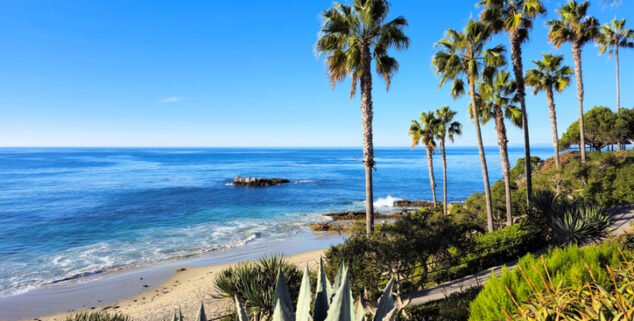 Laguna Beach ocean shoreline with palm trees at Heisler Park, California, USA
Capitol Weekly welcomes Opinions on California public policy or politics. Please read our guidelines for opinion pieces before submitting an Op-Ed. Submissions that do not adhere to our guidelines will not be considered for publication.
OPINION — At a time when California needs stronger ocean protections, the status quo is a step back.
The California Department of Fish and Wildlife recently considered a set of proposals to strengthen or expand Marine Protected Areas (MPAs)—and recommended denying nearly all of them. This comes as California has committed to protecting at least 30 percent of its lands and coastal waters by 2030. Our research shows that well-designed, strongly protected MPAs are among the most effective tools the state has to help kelp forests survive a rapidly warming ocean.
For over a decade, Pacific Ocean waters have experienced an unprecedented series of marine heatwaves, including a particularly severe event from 2014 to 2016, referred to as “the Blob”. Another is now underway, with ocean warming intensifying off the California coast, threatening to become yet another severe event. These events are transforming marine ecosystems—disrupting food webs, harming fisheries, and causing cascading ecological effects.
The consequences are already visible. Marine heatwaves have caused widespread seabird die-offs, declines in forage fish, and starvation among marine mammals. Harmful algal blooms and marine mammal entanglement in fishing gear have forced the closure of California’s valuable Dungeness crab fishery. Scientists describe this as a “massive reorganization” of ocean life.
Few ecosystems exemplify this disruption more clearly than kelp forests. These underwater habitats support more than a thousand species and rank among the most productive ecosystems on Earth. Yet in recent years, California has experienced widespread declines along its coast—with Northern California losing up to 90 percent of its kelp—transforming lush underwater forests into barren seafloors.
Marine heatwaves are a major driver, but not the only factor. Kelp forest collapse results from multiple stressors working in tandem: ocean warming and acidification, pollution, ocean and coastal development, and fishing. Fishing removes key predators. Fewer predators mean more urchins—and as their numbers surge unchecked, they devour what remains of the kelp, transforming entire ecosystems into “urchin barrens” that stall recovery.
Kelp forests are naturally resilient and can often recover from disturbances. But when these pressures combine, that resilience breaks down and recovery becomes far less likely.
This is where marine protected areas can make a decisive difference.
Our research shows that MPAs can help restore the ecological balance that kelp forests need to recover. By limiting fishing, strongly protected MPAs allow key predators—such as lobster and sheephead—to rebound. These species play a critical role in controlling urchin populations, reducing grazing pressure, and giving kelp a chance to regrow.
In one study, we analyzed decades of satellite data to compare kelp abundance inside and outside California’s MPAs. We found that kelp forests in Southern California MPAs rebounded more quickly from the 2014–2016 heatwave than those in unprotected areas. A second study found that where predators were protected, urchin populations remained in check, and kelp proved more resilient. Where predators were not protected, this advantage disappeared.
These findings reinforce a broader point: MPAs do more than rebuild fish populations. By protecting biodiversity and restoring key ecological relationships, they make marine ecosystems more stable and better able to withstand change—much like a diversified investment portfolio reduces risk.
California’s MPA network was designed to protect a wide range of marine habitats. But as climate impacts intensify, the state must keep pace. Expanding protections to include more climate-resilient areas, such as California’s most persistent kelp forests, would be a practical, science-based step toward safeguarding these ecosystems.
MPAs alone are not a silver bullet. They cannot stop ocean warming or prevent marine heatwaves. But they can improve the conditions that allow ecosystems to recover. Without that support, recovery becomes far less likely—and losses may become permanent. The stakes extend far beyond kelp. These ecosystems support fisheries, tourism, coastal economies, Tribal communities, and countless species that depend on healthy ocean habitats. Their decline is not just an environmental issue—it is an economic and cultural one as well.
California has positioned itself as a global leader in ocean conservation. It has the science, the tools, and the policy framework to meet its 30×30 goals. But leadership requires action that matches ambition. At a time when climate change and ocean industrialization are accelerating, and marine ecosystems are under increasing stress, maintaining the status quo is a risk California should not take.
The science is clear. Strong, well-designed marine protected areas can help kelp forests—and the communities that depend on them—endure a warming ocean. The question is whether California will act on that science before more of these ecosystems disappear.
Fiorenza Micheli is a marine ecologist and conservation biologist at the Hopkins Marine Station at Stanford University, Professor in the Oceans Department and co-director of Stanford Center for Ocean Solutions. Nur Arafeh Dalmau is a marine ecologist and climate adaptation researcher at Hopkins Marine Station at Stanford University and the co-chair of the IUCN Seaweed Specialist Group.
Want to see more stories like this? Sign up for The Roundup, the free daily newsletter about California politics from the editors of Capitol Weekly. Stay up to date on the news you need to know.
Sign up below, then look for a confirmation email in your inbox.
Leave a Reply