
CA120
CA120: California voters souring on Top Two
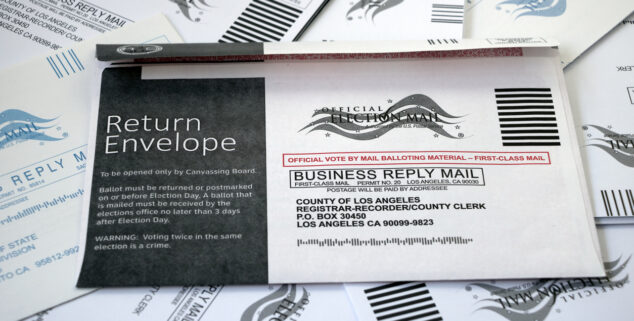 Ballot envelope, Los Angeles County. Image by Darylann Elmi.
 Back in February when I launched the top two primary simulator (TWINS – https://toptwoca.com/) it was because reporters and insiders were in this extremely polarized and nonsensical disagreement – one camp was saying it was a guarantee that two Republicans would make the runoff, because Steve Hilton and Chad Bianco were leading most polls, while the other camp was saying there was no chance, largely because it had never happened before.
Anytime one camp is at 100%, and the other is at 0%, that situation begs for some nuance and better understanding of the actual probabilities.
 When it was launched, the probability of a Democratic lockout was around 15%, but then, when John Slavet dropped out of the race, leaving only two top-ranked Republicans, the probabilities shot up to 25% or more.
Since then, the risk of a top two lockout by either party has significantly abated. The most significant factor was the Trump endorsement for Hilton, which consolidated the Republican field. And the Democratic field has mostly consolidated as well. No longer are we seeing poll after poll with two Republicans on top, and five Democrats all within a couple percentage points of each other.
While the actual risk has abated, it fear among voters is still palpable.
In a new Capitol Weekly survey of likely June primary voters fielded May 6-14 (N=1,549), we asked voters about the Top Two system and the Governor’s race. The headline number is striking: 69% of voters say they are concerned that the November General Election could feature no candidate from the party they prefer. Democrats register at 76% concerned. Republicans, 66%.
To understand their decision making, we asked people how the Top Two implications impacted their vote, and these were some of the typical responses from Democrats:
- “I voted not for the best candidate my party offered but for the candidate that had the best chance of blocking the Republicans from getting 2 candidates on the ballot in November.”
- “I voted for the person I thought had the best chance of winning not necessarily the person I liked best.”
- “If it was just the party I typically vote for, I probably would have looked more closely at the candidates to determine which I liked the most. But because it is possible that someone from my party wouldn’t be in the top two, I voted for the person who had pulled ahead in the polls.”
- “I’d walk on hot coals to keep a Republican from being on the ticket”
Among Republicans, we actually saw two competing versions of the Top Two implications, most were trying to ensure that at least one Republican made the runoff:
- “I like Bianco more but Hilton was leading, I would rather have any republican in the top two than my preferred republican.”
- “I prefer Bianco but voted for Hilton.”
- “I voted for the Republican polling the highest on the day I voted.”
- “I like two candidates and voted for the one that was poling better.”
And then another set that were trying to get two Republicans in the runoff:
- “I had to do my part to hope that the Top Two primary system yields 2 Republicans so Democrats are locked out. It’s a long shot at this point, but I’m still hoping it can happen.”
- “I assumed Hilton would have the most votes and I voted Bianco in hopes of him coming in second to shut the democrats out of the race.”
- “I voted for Bianco because I want the top two choices to be Republican. Democratic leadership has failed.”
This Republican behavior shows the failure of trying to achieve a gaming of the outcome. Voters in this case are running cross-purposes with each other in their strategic objectives.
The second impact of this primary is a massive erosion in voter support for the Top Two Primary. We asked voters what they liked and didn’t like about the system, and if they preferred to get rid of it, or modify it.
Asked what they like about the Top Two Open Primary, the runaway winner, picked by 69%, was that “non partisan voters can vote in the primary for candidates from any party.” The runner-up, at 59%, was the related feature that “Democratic and Republican voters can cross over and vote for candidates of the other parties, not just their own.”
Those numbers are even larger among nonpartisan voters, with 79% of them supporting the open nature of the system.
Which among these do you think make the Top Two Open Primary
system better than a traditional primary system?
(Select as many as you want)
| Response | N | Total | Dem | Rep | NPP | Other |
|
Non partisan (independent) voters can vote in the primary for candidates from any party.
|
895 | 66% | 69% | 51% | 78% | 73% |
|
Democratic and Republican voters can cross over and vote for candidates of the other parties, not just their own.
|
797 | 59% | 60% | 58% | 54% | 59% |
|
The top two candidates, regardless of party go to the General Election
|
484 | 36% | 31% | 38% | 42% | 40% |
|
When two candidates from the same party go to a General Election, it is argued that the more moderate candidate can win.
|
217 | 16% | 17% | 16% | 19% | 4% |
What is shocking is that the central argument for the Top Two, that when two candidates from the same party go to a General Election, “the more moderate candidate can win” is endorsed by just 16% of voters. This was the entire intellectual scaffolding behind passing Prop 14 back in 2010, but it is now a minority viewpoint, even among independents at just 19% and just 4% among voters in minor parties, like Green, Libertarian and others. After 15 years, the public is not buying that the mechanism produces more moderate elected officials, or that this should be a goal.
Testing the arguments against the Top Two, there is a strong belief that voters will not vote, or skip a contest when there isn’t a candidate of their party on the ballot. They also find having no candidate to vote for in the General as a negative. There is less concern about minority party candidates, but that does reach over 50%.
Which among these do you think make this less appealing
than a traditional primary system?
(Select as many as you want)
| Response | N | Total | Dem | Rep | NPP | Other |
|
When there are two candidates from the same party, turnout declines as many voters will skip voting when there is not a candidate of their party on the ballot.
|
870 | 66% | 68% | 64% | 65% | 64% |
|
When two Democratic or two Republican candidates make it to the November General, the voters of the opposite party often do not have someone they want to support.
|
825 | 63% | 64% | 62% | 62% | 54% |
|
Minor parties, like Green or Libertarian, rarely if ever get a candidate into the top two positions, so they are not in the November General, although they would be in the traditional system.
|
537 | 41% | 40% | 33% | 49% | 60% |
Here’s where the poll becomes useful for the conversation that is clearly coming. We gave voters three options, in their full, fairly detailed wording:
- “Modify the primary system so that all voters can vote for any party, but that the top candidate from each party makes it to the General Election.”
- “Eliminate the Top Two open primary, going back to traditional primary elections where voters from each party select their nominee for the General Election, like Presidential primaries.”
- “Keep the Top Two primary system, allowing for a runoff with two candidates from the same party.”
The result: 50% want to Modify, 29% say eliminate and only 21% want to keep the current Top Two primary system.
Some have suggested modifying or eliminating the Top Two open
primary system. Which of the following options is closest to your viewpoint?
| Response | N | Total | Dem | Rep | Other | |
|
Modify the primary system so that all voters can vote for any party, but that the top candidate from each party makes it to the General Election.
|
711 | 49% | 54% | 39% | 56% | 53% |
|
Eliminate the Top Two open primary, going back to traditional primary elections where voters from each party select their nominee for the General Election.
|
420 | 29% | 26% | 42% | 14% | 22% |
| Keep the Top Two primary system, allowing for a runoff with two candidates from the same party. | 308 | 21% | 20% | 19% | 30% | 25% |
Republicans and Democrats both want to get rid of the Top Two system, although a majority of Democrats support keeping it “open” with voters being able to select among candidates from all parties, while a plurality of Republicans want to scrap the entire system altogether.
NPPs are the system’s strongest supporters. Only 14% want to eliminate it. 30% want to keep it as is, while only 22% of minor party voters want to eliminate it, and one-quarter want to keep it as it is. The majority of each group want it modified into an open, but not top-two system.
The change most supported by voters would eliminate the very scenarios animating this primary election cycle. A “top from each party” reform would, by construction, eliminate the same-party runoff. It would also eliminate the down-ballot turnout collapse and would do so without taking the open-primary feature with independents voting and voters being able to cross over.
Want to see more stories like this? Sign up for The Roundup, the free daily newsletter about California politics from the editors of Capitol Weekly. Stay up to date on the news you need to know.
Sign up below, then look for a confirmation email in your inbox.
Voters should have been given more choices, such as saving taxpayers millions of dollars by eliminating the primary, and using either Ranked Choice Voting or Proportional Representation.
Eliminates the primary, and use RCV for election of statewide candidates. Eliminate the primary thereby saving taxpaying voters millions of dollars by using proportional Representation to elect Assembly Members, State Senators, or Members of the U.s. House, or any combination of them.