
Reporter's Notebook
Ancient redwoods, junk bonds and why salmon need a shady place
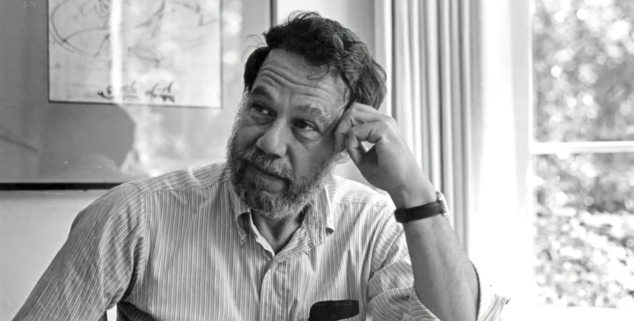 Sen. Byron Sher. Screencapture from video posted by the Loma Prieta Sierra Club: 2020 Guardians of Nature Benefit honoring Byron Sher
In the park on the south side of California’s Capitol Park, a small plaque names a huge redwood for Byron Sher, appropriate given that as a state senator, he led the fight in Sacramento to protect the last large untouched privately owned redwood forest left in California—and world.
At the California Environmental Protection Agency building, the public hearing room is called the Byron Sher auditorium. That makes sense, given far-reaching legislation he authored during his 18 years in the assembly and eight in the senate protecting California’s air, drinking water and remaining wild rivers.
Now, there’s a notion to name something far more grand after him. More about that in a minute.
Sher died on Saturday at age 98. Journalist Paul Rogers wrote an obituary about him in the San Jose Mercury, and I wrote one for my former employer, The Los Angeles Times. Combined, they give a sense of the man and his accomplishments.
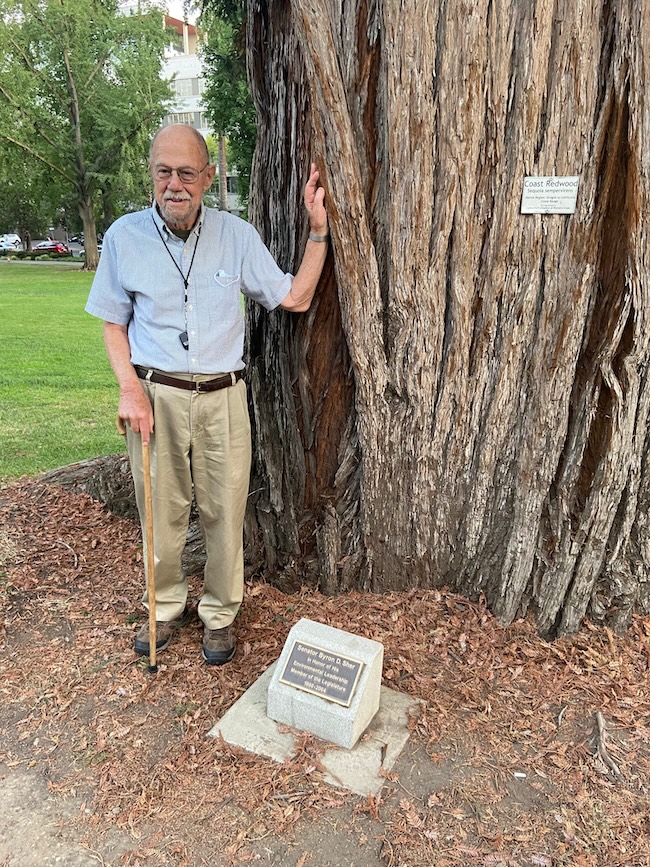
Byron Sher by the redwood named for him in Capitol Park. Photo courtesy of Ben Sher.
—
Sher has been out of the public eye for two decades. But tributes from Democratic and Republican legislators who knew him, and environmental advocates and lobbyists who dealt with him are a testament to how deeply he was respected.
“He wasn’t a comfortable politician,” San Mateo County Supervisor Jackie Speier, a Democrat who served with him in the legislature and later was a member of Congress.
“He saw problems we were facing as a planet, and recognized that things had to change,” said Democrat Tom Bates, another former legislator who often collaborated with Sher to kill—or at least flag—legislation that was larded with odious provisions reflecting the undue influence of special interests.
Republican Jim Brulte, who served with Sher in both houses, called him a “wonderful man.” Steve Merksamer, who was Republican Gov. George Deukmejian’s chief of staff, cited his “integrity,” and said he “did the right thing,” on whatever the topic happened to be.
Perhaps Sher’s greatest achievement occurred three decades ago as Gov. Pete Wilson was leaving office and Gray Davis was entering office–the deal to save Headwaters Forest in remote southern Humboldt County.
Texas financier Charles Hurwitz had used high-interest bonds to purchase Pacific Lumber Co. To pay off the debt, he and his Houston-based Maxxam Inc. planned to log the giant trees, some of which had stood since Jesus Christ lived.
To prevent that catastrophe, the state and federal governments, Republicans and Democrats, needed to collaborate. Bill Clinton, a Democrat, was president. Wilson, a Republican, was governor.
In Washington, U.S. Sen. Dianne Feinstein led the fight. Her fellow San Franciscan, John Burton, led the California Senate as its president pro tem. My former L.A. Times colleague Frank Clifford summed up the epic battle:
“The siege of Headwaters has been marked by massive civil disobedience, thousands of arrests of people protesting the logging of 1,000-year-old trees and the death of a protester killed by a tree that was being cut down by a logger last fall.”
Julia “Butterfly” Hill, an Earth First activist, celebrated her 24th birthday 180 high in a redwood tree. She had spent months perched in the redwood to protest Maxxam and Hurwitz’s plan to clear-cut the forest, telling an L.A. Times reporter: “When it’s only 30 degrees outside, it makes for a very quick sponge bath.”
Hurwitz hired some of the most accomplished lobbyists in Washington, the legendary Tommy Boggs, and, shrewdly, Dawson Mathis, a friend of Burton’s from their days in Congress.
Burton and Mathis were so close that when then Congressman Burton hit rock bottom in 1982 and decided to begin his recovery from cocaine addiction and alcoholism, he called Mathis, then a lobbyist, to drive him to a Washington airport where he boarded a jet bound for a clinic in Phoenix.
Burton understood politics better than any of them. But for policy and details, he turned to Sher, the Harvard Law School graduate, class of 1952, who became a Stanford law school professor in 1957, and Sher’s chief aide, Kip Lipper, a Stanford law school graduate.
At one minute, Burton might be using a clunky old-style cell phone to call Julia Butterfly to test her support for an idea. At another time, he might call the head of the Sierra Club, Carl Pope. Pope was confident that Sher would ensure the deal was solid. Still another time, Burton called Vice President Al Gore to make sure the White House was on board.
Always, he returned to Sher for counsel.
Sher told me when I worked for the L.A. Times that questions about Hurwitz’s high-interest bond debt were not his concern: “The state needs to insist on what makes this a good deal for the state.”
At Sher’s urging, the state insisted that Maxxam could not log within 100 feet of streams. Maxxam, of course, wanted the buffers to be less than 100 feet.
It took Burton time to understand Sher’s reasons for the 100-foot buffer. But he caught on. Wider buffers limited erosion that would fill streams with sediment, and tall trees provided the shade that kept the water cool so that the salmon could, as the famously profane Burton said, “fuck.”
No matter that salmon don’t copulate–they spawn–Burton got the gist right.
“Burton was yelling. Byron would translate John,” Lipper said, recalling the process of writing the final legislative products.
The law professor-senator authored legislation that essentially was a contract, one that would levy what’s known as liquidated damages on Hurwitz’s company. If Maxxam violated proper forest practices, Lipper said, it would owe the state potentially hundreds of millions in fines and penalties.
A deadline to strike the deal fell on the last night of the legislative session in 1998. The Legislature needed to pass legislation earmarking the state’s share of the purchase price, $230 million of what became a $480 million purchase.
“Getting the fucking thing done,” Lipper remembers Burton telling him.
Sher and Lipper penciled changes into what became the final bill, and Lipper walked it from the Senate chambers, across a hall to the legislative counsel’s office, where a secretary quickly typed it.
After checking to make sure there were no errors, he walked the freshly typed paper back to the Senate floor, and handed it to Burton. Burton raised his microphone, uttered a few words of support, and urged an aye vote. Lipper doesn’t recall that Sher spoke. If he didn’t need to give a speech, Sher stayed quiet, an unusual trait for most politicians but not Sher. The measure passed, and the senate adjourned for the year.
As a backdrop for the bill signing, Wilson chose a stand of redwoods at the California state fair grounds a few miles from the Capitol. Feinstein and her husband, Dick Blum, arrived by helicopter, landing at the fairgrounds parking lot.
“I am convinced that what we are doing will stand the test of time and nature, knock on wood,” Wilson said, in a corny joke, as he signed the bill.
The deal wasn’t final. The feds had to come through with their money. Hurwitz held out. But the brinkmanship concluded shortly before midnight on March 1, 1999.
Hurwitz’s Pacific Lumber transferred about 10,000 acres to the state and federal governor, and agreed to protect habitat on more than 200,000 acres surrounding Headwaters. A decade later, Maxxam lost control of Pacific Lumber as a result of a bankruptcy,
Back to names. Kip Lipper, Sher’s chief of staff and friend who remains a most influential legislative aide, has an idea, one that is more than fitting. Congress should change the name of Headwaters to honor the senators–Byron Sher and Dianne Feinstein. They had the foresight and skill to make sure redwoods would stand in perpetuity.
One of the creeks in Headwaters is known as Salmon Creek. I think it ought to be renamed John Burton Creek, because as Burton explained, in chilly pools shaded by giant redwoods, we know what salmon do.
Dan Morain has been a journalist in California for more than 40 years, focusing on state policy, politics and justice-related issues for publications including the Los Angeles Times, Sacramento Bee and CalMatters. He is the author of “Kamala’s Way, An American Life,” published by Simon & Schuster in 2021. This piece also appears on his substack.
Want to see more stories like this? Sign up for The Roundup, the free daily newsletter about California politics from the editors of Capitol Weekly. Stay up to date on the news you need to know.
Sign up below, then look for a confirmation email in your inbox.
Leave a Reply