
News
Big Cities, Big Challenges: Capitol Weekly’s Big City Mayors Forum
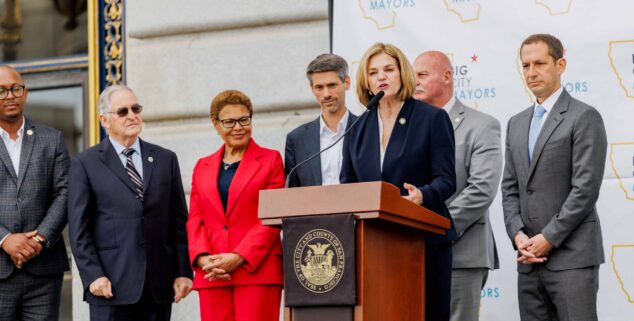 Big City Mayors Mayor Patricia Lock Dawson, Matt Mahan, Karen Bass, Larry Agran, Daniel Lurie, Jerry Dyer, Rex Richardson. Photo courtesy of Big City Mayors coalition.
 Mayors from several of California’s largest cities gathered on Wednesday for the Capitol Weekly Big City Mayors Forum to discuss some of the state’s most pressing challenges, including homelessness, housing affordability, economic development, regulatory reform and the evolving relationship between local governments and Sacramento.
The discussion featured Riverside Mayor Patricia Lock Dawson, chair of California Big City Mayors; Bakersfield Mayor Karen Goh; San Jose Mayor Matt Mahan; Irvine Mayor Larry Agran; San Francisco Mayor Daniel Lurie; Sacramento Mayor Kevin McCarty; and Oakland Mayor Barbara Lee.
Throughout the forum, mayors stressed the need for stronger state-local partnerships, greater flexibility for cities and more predictable funding to address the issues residents encounter most directly in their communities.
“When homelessness remains visible, when housing is too expensive, or when economic development is slowed down, residents don’t turn to the state; they turn to us,” Lock Dawson said. “They want us to fix it.”
Measuring Progress
Several mayors pointed to declining numbers of unsheltered homeless people as evidence that local strategies are producing results.
Lock Dawson noted that unsheltered homelessness statewide dropped 9% in the past year. Bakersfield Mayor Karen Goh reported a 16.3% reduction in unsheltered homelessness over the past two years and said 92% of people moved from city shelters into permanent housing have remained housed.
Mahan said his city has reduced the number of people living outdoors by roughly one-third over the last five years through a combination of homelessness prevention, interim housing, affordable housing investments and case management.
In Irvine, Agran highlighted a partnership with the Irvine Company that uses vacant apartment units to house families identified through school homelessness programs. Starting with 88 students experiencing housing instability, Irvine reduced that number to zero within a year.
Homelessness Requires More Than Housing
While mayors discussed housing and shelter investments, several stressed that homelessness is closely tied to mental health and substance abuse challenges.
Mahan argued that there is no “silver bullet” and called for stronger behavioral health systems, recovery housing and treatment options.
Lurie reported that tent encampments have fallen 53% since he took office and described the city’s new Reset Center, where police can transport individuals openly using drugs or experiencing severe impairment to receive evaluation and care.
“We’re not going to arrest our way out of this problem, we’re not going to build our way out of this problem,” Lurie said. “It’s going to take all of these factors.”
“When homelessness remains visible, when housing is too expensive, or when economic development is slowed down, residents don’t turn to the state; they turn to us….They want us to fix it.”
The Fight Over HHAP Funding
Despite highlighting local successes, the mayors repeatedly returned to concerns about the state’s Homeless Housing, Assistance and Prevention (HHAP) program.
Mahan called HHAP funding “transformative” but said uncertainty over annual allocations makes long-term planning difficult. Goh echoed the need for consistency, while Lock Dawson said mayors have spent the past year aggressively advocating for the restoration of funds.
The consensus was clear. While cities are demonstrating results, maintaining momentum will require Sacramento legislators to provide predictable, long-term support.
Economic Development
According to Mahan, the most effective avenue for encouraging economic development is to address California’s overall cost structure.
“Our cost to do things is so high that we often get less impact per dollar deployed in the economy, and that hits both the public and private sectors,” he said.
Mahan also recognized that economic development is not always viewed in a positive light among Californians, especially with recent concerns that rising tech companies and an increasingly AI-fueled economy are exacerbating living costs.
He cited the need to “demonstrate to Californians that growth can ensure broad-based prosperity, which has not been people’s experience in recent decades, because more growth has just meant higher housing costs. That’s a fundamental public policy failure that we cannot afford to repeat.”
Another frequently cited public policy failure concerned the need to reform state laws such as CEQA, which can slow down housing development and increase costs. Lock Dawson referenced recent updates to CEQA, such as the Vehicle Miles Traveled law, as an impediment to housing development in Riverside.
“Things that are really well-intentioned can have a chilling effect,” she said.
“[We need to] demonstrate to Californians that growth can ensure broad-based prosperity, which has not been people’s experience in recent decades, because more growth has just meant higher housing costs. That’s a fundamental public policy failure that we cannot afford to repeat.”
For Goh, navigating state regulations can be especially difficult in a city like Bakersfield, an industrial and agricultural hub. “The state’s policies [can be] in conflict with Central Valley’s realities,” Goh said.
Rather than viewing economic development as a key concern, Agran cited economic justice as the pressing issue that state legislation must address. He referenced the significant economic gap in California, stating that the “top 20%” are in “great shape” while the majority are left to struggle amidst high inflation and housing costs. For Agran, redesigning the tax code to increase income taxes on multi-millionaires and billionaires is “imperative” to achieving economic justice within the state.
Housing and Local Control
Both Lee and Mahan highlighted the importance of reducing building costs. Lee spoke of issuing tax credits and identifying more Opportunity Zones as part of her strategy to increase Oakland housing.
Meanwhile, Mahan focused on capping fees and adjusting regulatory requirements, as seen in recent policy changes such as easing San Jose’s Inclusionary House Ordinance and approving a streamlined ministerial approval process for infill housing projects.
The effort to build more housing has moved towards what Mahan called an “all-of-the-above” approach to the housing crisis, which invests in both temporary and permanent housing. Mahan’s goals include building multifamily and high-rise residences near urban centers and transit hubs, as well as focusing on alternative forms of housing such as ADUs, prefabricated homes and tiny homes.
To address the challenge of creating and implementing cohesive housing solutions amid a wide range of local rules and regulations, McCarty proposed a statewide permitting process to reduce costs per housing unit and streamline the building process.
However, Goh stated a strong belief in reducing state regulations and emphasizing local control, especially considering California’s broad range of cities and communities with varying needs.
According to Lee, the true issue lies within state unfunded mandates, especially when trying to balance these with generating investments for local unfunded mandates. Lee stressed the need for both support at the state level and the freedom to prioritize local communities. “It’s kind of a balancing act,” she said.
Despite their differing perspectives on economic development, housing and regulation, the mayors largely agreed that California’s biggest challenges will require closer collaboration between state and local leaders. As cities continue to serve on the front lines of those issues, they said, Sacramento must view local governments as partners rather than simply implementers of state policy.
Want to see more stories like this? Sign up for The Roundup, the free daily newsletter about California politics from the editors of Capitol Weekly. Stay up to date on the news you need to know.
Sign up below, then look for a confirmation email in your inbox.
It is simply not true that homelessness is caused by largely due to mental illness. This is a current trumped up mantra being used across the United States and, unfortunately, in cities across California where there has been a total lack of leadership in addressing the affordable housing crisis. Affordable housing-rising rents, inequality, lack of rental assistance programs, inadequate safety net are the essential elements. These issues lead individuals and families to be one job loss, physical or mental health crisis, accident away from being on the streets. https://endhomelessness.org/state-of-homelessness/. Regardless of what takes people to the streets, they need affordable housing to stabilize and rebuild their lives.
Let us take the City of Riverside, where the Chair of the Big City Mayors, Patricia Lock Dawson is Mayor. The City of Riverside has had an appalling record in achieving the Regional Housing Needs Assessment Housing Goals established by the State of California from January 1, 2021 to January 1, 2029 under Mayor Dawson’s tenure. The City has only achieved less than 1 percent of the permitted units (47) and recently the City Council turned down a State HomeKey+ Grant of $20.1 Million that would have led to 94 permanent supportive housing units for the most vulnerable, disabled senior and veteran homeless with mental health and/or substance abuse. Further, in the very low, low and moderate income categories, the City has achieved less than 5% of the permitted units goal. At the same time, the City of Riverside has permitted 41% of the goal for Above Moderate Income ($88,000 in Riverside).
Further, the City of Riverside has failed to follow nearby communities like Redlands and Palm Springs who have successfully passed and implemented inclusionary housing ordinances. These ordinances mandate either the inclusion of affordable housing in every market rate development and/or payment in lieu of that. These payments then can be invested in affordable housing projects. Thus, the City of Riverside invests no dollars in creating affordable housing as it has not created a mechanism to generate funds. This despite the City’s own Housing staff leadership stating they need $3 to $5 million a year to invest in affordable housing developments to make progress. There is also a failure of City leadership to allocate staff resources to the creation of affordable housing. Not one of 10 economic and community development staff at the City are focused on creating workforce (affordable) housing for our growing employment base. Thus, the college graduates from University of California-Riverside, California Baptist University, La Sierra University and other local higher education institutions can find housing in Riverside. The same goes for much of the workforce at our City. Most jobs in our City do not pay over $88,000 a year. In addition, the lack of affordable housing means that downsizing seniors have limited options to move to and free up their larger homes for families. It is a vicious cycle.
What is needed is for the Mayor’s to understand to create inclusive, prosperous communities that must understand that affordable housing contributes to a thriving city and is, indeed, an economic and community development tool as people can then live, work, play and spend their resources in the City they work in. In addition, affordable housing reduces the need for long commutes and the resulting air pollution, need for parking space, and competing demands on family time.
I call on the Big City Mayors to devote as much of their energy and staff to affordable housing as they do to “economic development.” Get out and support the proposed Affordable Housing Bond Referendum that likely be on the ballot. And, please, take responsibility and stop the finger pointing.