
Micheli Files
More observations on California bill drafting
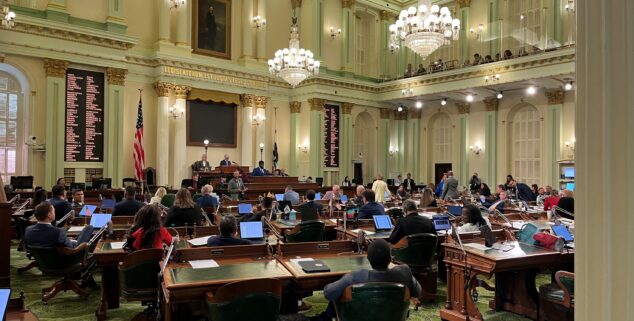 California Assembly. Photo by Capitol Weekly.
 In my continuing review of 2026 legislation in the California Legislature, I offer some additional observations from a drafting perspective, as set forth below:
We don’t see this statement of retroactivity very often:
It is the intent of the Legislature that the amendments made by this act shall operate retroactively to any pending action or proceeding.
 This is a good explanatory statement of legislative intent, including specific reference to statute:
It is the intent of the Legislature in adding paragraph (3) to subdivision (b) of Section 66300 of the Government Code to clarify that the protections of the Housing Accountability Act continue to apply in areas that have already been identified through adopted planning processes for future residential growth, but distinguish between unplanned conversion of agricultural, open space, or rural lands and areas that local and regional agencies have long designated for coordinated urban development through general plans, specific plans, or other areas planned or designated for future residential, mixed-use, or urban development. By doing so, the amendment supports orderly, infrastructure-efficient, and environmentally responsible growth while preserving the state’s commitment to addressing the housing crisis.
The following should be written in the active voice:
In no event shall the package or its contents be taken from the custody of the elections official. Instead, it should be rewritten as follows:
The package or its contents shall not be taken from the custody of the elections official.
SB 599 and AB 1881 have 18 legislative findings and declarations. That is a lot of them! SB 1181 has 16 legislative findings and declarations. But there are 35 findings and declarations in AB 2115 (Ramos)!!
A bond act bill this year has quite a few plus sections (uncodified sections at the end of the bill):
- Severability clause
- Effective date upon voter approval
- Submittal of the measure to voters
- Act is to be broadly construed
- Act is to be liberally construed
- Conflicting measures and this measure is self-executing
- Finding and declaration for public right of access to meetings of public bodies and writings
These are good statements to include in findings and declarations when appropriate:
(h) Courts are essential to a republican form of government and to the functioning of California’s government. California has the reserved power under the Tenth Amendment to the United States Constitution to protect their proceedings.
(i) The provisions of this act are necessary to protect and preserve the integrity of the proceedings of the judicial branch of California government.
This is a different way of granting rulemaking authority:
The interpretation of Section 1777.5 and the substantive requirements of this section applicable to contractors or subcontractors shall be in accordance with the regulations of the California Apprenticeship Council.
An example of applying a statute to specified actions prospectively:
This section does not apply to any fee adopted or amended prior to the effective date of the act that added this section
These are two possible, additional provisions to include after findings and declarations:
The purpose of this division is to ….
It is not the intent of the Legislation to ….
Should we include this or a different term (we usually see “policy of the state”)?
It is in the interest of the state to ….
These are two good statements that could be in other statutes (where appropriate):
This chapter establishes minimum safety and governance standards of ….
This chapter does not limit, waive, or alter any rights, remedies, or obligations under state or federal laws….
SB 1025 is a good example of creating a new state department or office:
Section 1 properly contains uncodified legislative findings and declarations in the first subdivision, followed by a statement of legislative intent in the second subdivision.
Section 2 contains the codified provisions in the proper order using all the proper language:
- Sets forth the Definitions
- Establishes the Office
- Establishes the Director
- Specifies the duties and responsibilities of the Office
- Specifies the duties and responsibilities of the Director
- Creates a Fund for the office
- Authorizes the office to adopt regulations under the APA
- Contains a sunset clause
What else could be added? The act could be named. There could be a purpose statement after the findings and declarations. There could be enforcement authority granted. There could be fees to fund the program. Nonetheless, the language in this bill is a good model to follow
Which is the better approach (the second one reflects modern drafting rules)?
Should we write: “trafficking” shall have the same meaning as in…
Or should we write: “trafficking” has the same meaning as in
Which is the better language to use?
There are California statutes that use the standard of being “liberally construed.” However, there are also many state statutes that use the less common “liberally interpreted.”
This raises the question for me: What about the other 150,000 statutes in California Codes that do not use either phrase? How should they be construed or interpreted by the courts?
Which is the better approach (I prefer to list them as subparagraphs instead, just like we do findings and declarations)?
Should we write: (a) It is the intent of the Legislature that… (b) It is the intent of the Legislature that…
Or should we write: (a) It is the intent of the Legislature that… (b) It is also the intent of the Legislature that…
Or should we write: (a) It is the intent of the Legislature that… (b) It is further the intent of the Legislature that…
I like this addition following Section 1 of a bill:
Consistent with the findings and declarations and statements of legislative intent in subdivision (a),
Although there are many instances in existing statutes where the Legislature “reaffirms” something, I do not recall ever seeing one after a finding and declaration:
The Legislature finds and declares all of the following:
(a) The Legislature reaffirms the findings and declarations set forth in Section 1597.30 of the Health and Safety Code:
This is an example of an excellent explanation (with a specified rationale) for applying a statute to charter cities:
The Legislature finds and declares that laws that establish, require, impose, limit, or otherwise relate to wages, salary, or compensation affect access to the provision of safe, consistent, and reliable security services to private and public entities, as well as to their employees, customers, and visitors. The Legislature further finds and declares that access to safe, consistent, and reliable security services for private and public entities is a matter of statewide concern and is not a municipal affair as that term is used in Section 5 of Article XI of the California Constitution. Therefore, this section occupies the whole field of wages, salary, or compensation for covered security officers, and applies to all cities and counties, including charter cities, charter counties, and charter cities and counties.
I’ve seen the first clause many times, but not often with the second clause:
This section does not require, and shall not be interpreted to require, …
We rarely see this: many more intent statements than findings and declarations:
The Legislature finds and declares that birth defects, conditions, stillbirths, and miscarriages represent problems of public health importance about which too little is known, that birth defects, conditions, stillbirths, and miscarriages lead to severe mental anguish on the part of parents and relatives and frequently to high medical care costs, and that a system to obtain more information about birth defects, conditions, stillbirths, and miscarriages could result in development of preventive measures to decrease their incidence in the future. Therefore, it is the intent of the Legislature in amending this chapter to accomplish all of the following:
(a) To enable and maintain an ongoing program to monitor birth defects and conditions statewide.
(b) To provide information on the incidence, prevalence, and trends of birth defects, conditions, stillbirths, and miscarriages.
(c) To provide information to determine whether environmental hazards are associated with birth defects, conditions, stillbirths, and miscarriages.
(d) To provide information as to other possible causes of birth defects, conditions, stillbirths, and miscarriages.
(e) To develop prevention strategies for reducing the incidence of birth defects, conditions, stillbirths, and miscarriages.
(f) To conduct interview studies about the causes of birth defects and conditions.
(g) To affirm the authority of the state department to contract with a qualified entity to operate the program to monitor birth defects and conditions statewide.
(h) To affirm the authority of local health officers to monitor the prevalence and incidence of birth defects and conditions in their local health jurisdictions in order to supplement state efforts or in the absence of state efforts in their jurisdiction.
This would be a good provision to add to all grants of rulemaking authority:
The department shall adopt regulations necessary to implement this chapter. During the rulemaking process, the department shall include opportunities for stakeholder comment and cooperative workgroups aimed at ….
I think these legislative intent statements are good as they specifically refer to statutes:
In enacting this measure, it is the intent of the Legislature to do the following:
(a) Provide specific terms supporting implementation of existing law in Section 10737.2 of the Water Code to ensure that a comprehensive adjudication of groundwater rights in a basin does not interfere with the timely completion and implementation of a groundwater sustainability plan.
(b) Provide specific terms supporting implementation of existing law in Section 10737.2 of the Water Code to ensure that a comprehensive adjudication of groundwater rights in a basin avoids redundancy and unnecessary costs in the development of technical information and a physical solution.
(c) Provide specific terms supporting implementation of existing law in Section 10737.2 of the Water Code to ensure that a comprehensive adjudication of groundwater rights in a basin is consistent with the attainment of sustainable groundwater management within the timeframes established by the Sustainable Groundwater Management Act.
This statute has an explanatory statement just as I have advocated for many times (there should be more of these types of statements in bills):
This section is intended to inform owners about the possible existence of unclaimed property identified pursuant to this chapter.
This absolutely should not be in intent language, which has no force of law:
….it is the intent of the Legislature that the Office of the Inspector General, High-Speed Rail has the ability to operate independently of other state agencies when publishing reports, making hiring decisions, and entering into contracts with a value of up to $1,000,000.
Interesting(?) introductory statements to legislative findings and declarations:
In enacting the amendments made to this section by the act adding this paragraph, the Legislature further finds and declares the following:
We should try and use consistent statements, but here is another example of a different term being used:
The Legislature also recognizes that…
I don’t recall ever seeing this type of language in a bill (although it is in intent language):
This act does not place a finger on the scale of those negotiations or change the…
I like this for the legislative intent statement following the findings and declarations:
For the reasons described in subdivision (a), it is the intent of the Legislature in enacting this act to ….
Interesting finding and declaration:
Due to the unique circumstances pertaining to the State Water Project, this act does not set a precedent for any other permit issued by the State Water Resources Control Board.
This is more extensive guidance to the courts than we see in most statutes:
(e) This article shall not be interpreted to:
(1) Prevent the home community college district, or an eligible institution associated with the home community college district, from continuing to offer its own courses.
(2) Grant exclusive instructional rights to a non-home community college district or an eligible institution associated with the non-home community college district.
(3) Eliminate requirements to comply with applicable instructional services agreement, apportionment, academic, or reporting requirements.
(f) This article shall only be interpreted to expand access to postsecondary education for justice-involved youth when existing delivery mechanisms fail to meet documented needs. This article shall not be construed to restructure community college governance, modify community college district service areas, or alter statewide apportionment policy.
This is one of the best special statute statements that I have seen (because of its detailed justification):
The Legislature finds and declares that a special statute is necessary and that a general statute cannot be made applicable within the meaning of Section 16 of Article IV of the California Constitution because of all of the following:
(a) Residents, workers, and visitors in Del Puerto Health Care District in the County of Stanislaus face comparable—and considerable—and in many cases more burdensome—access conditions to emergency medical services when compared to other designated underserved areas.
(b) Average travel distances in the City of Patterson located in Del Puerto Health Care District to the nearest full-service acute care hospital or trauma center are approximately 21 miles, with average drive times of 36 minutes or more.
(c) These access delays are driven by persistent geographic isolation, limited roadway options, agricultural and freight traffic, rail crossings, State Highway 33 congestion, and weather-related disruptions, including fog and flooding.
(d) The access challenges in Del Puerto Health District reflect structural constraints and ongoing gaps in timely emergency medical services in a rural, medically underserved community, rather than temporary emergencies such as wildfires.
This is my preferred approach found in a current bill (separate bill sections for findings and declarations, followed by intent statements):
SECTION 1.
The Legislature finds and declares all of the following:
(a) The Legislature has delegated to the State Lands Commission the state’s ongoing oversight of public trust lands to ensure that they are managed consistent with the granting statutes and the public trust doctrine.
(b) The City of Martinez is seeking to promote the further development, improvement, and economic revitalization of granted lands within its jurisdiction.
(c) The Martinez Marina is a valuable asset of the state that provides special maritime, navigational, recreational, cultural, and historical benefits to the people of the region and the state.
(d) The unique circumstances facing the Martinez Marina create challenges to public enjoyment of the public trust resources. Constructed in the 1960s, the marina has far exceeded its useful life. Decades of deferred maintenance and limited reinvestment have accelerated its decline, resulting in critical maintenance needs that far exceed the city’s budgetary capacity, and rendering repair and restoration of the existing infrastructure infeasible.
SEC. 2.
It is the intent of the Legislature that the State Lands Commission, the City of Martinez, and the parties to the exclusive negotiating agreement for the revitalization of the Martinez waterfront and marina, approved at the December 17, 2025, Martinez City Council meeting, maintain dialogue and continue to work together to determine the appropriate lease term to spur the revitalization of some or all of the city’s public trust lands to address the unique circumstances the marina is facing while maintaining the public trust.
Support for The Micheli Files is provided by The McGeorge School of Law Capital Center for Law & Policy.
Want to see more stories like this? Sign up for The Roundup, the free daily newsletter about California politics from the editors of Capitol Weekly. Stay up to date on the news you need to know.
Sign up below, then look for a confirmation email in your inbox.
Leave a Reply