
Opinion
Help communities understand the water impacts of data centers
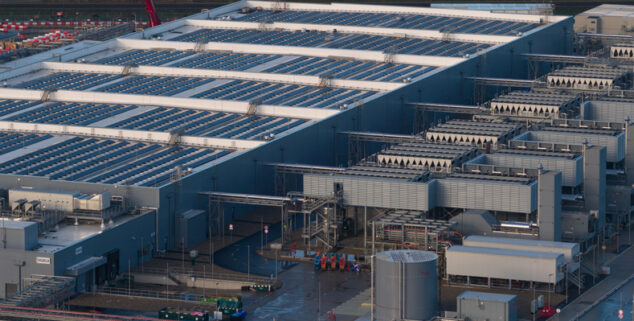 Aerial drone video of a large data center building exterior, representing the massive technological infrastructure required for storing, processing data, and delivering global digital services.
Capitol Weekly welcomes Opinions on California public policy or politics. Please read our guidelines for opinion pieces before submitting an Op-Ed. Submissions that do not adhere to our guidelines will not be considered for publication.
OPINION— California’s boom in data centers places growing demands on stressed water resources.
Everyone who uses the internet benefits from data centers. Yet the impacts of data centers are felt most by the communities where these facilities are built and there is no state law controlling their spread.
The nightmare: a community greenlights a data center, only to later learn that it’s on the hook for providing cooling water it doesn’t have.
We believe that communities should be able to understand what these facilities mean for their future, before they decide whether to allow construction. Details matter. A small data center using recycled water in a city with sufficient supply may cause no issues.
But a hyperscale facility in a small community with limited resources could have a crushing long-term effect.
Communities need information and support to make good decisions. Without a coordinated state effort to provide both, communities are flying blind, unable to assess or manage potential impacts.
Cautionary tales are already surfacing: A hyperscale project in Imperial would use 750,000 gallons of water a day. The developer says it will use recycled water, but local utilities have denied that an agreement exists.
Confusion and crossed signals are the least of the problems. Without clarity on where that water will come from, the county risks committing to a project its water system can’t support.
Larger cities across Los Angeles County are also grappling with complex trade-offs. Communities of all sizes may need state support. The alternative is rolling the dice on whether there’s enough water, or blunt instruments like moratoriums that avoid real decisions.
Pending bills head in the right direction and align with findings from our recent UC Berkeley report. But these bills must go farther to protect communities.
First, AB2619 (Papan) needs to do more to support informed local decision making. The bill’s provision of “guidance” should be strengthened to include technical assistance where communities need it.
Decision-makers in small communities are often stretched thin. They may need help understanding what a data center’s water use will mean for their supply.
A mayor in a small town might want to compare a data center’s water demands to a new mall or shipping facility–and how many jobs each would bring.
Right now, there’s no state resource to help. Local officials shouldn’t have to shoulder the oversight of data centers alone. The state could assemble a data center “response team,” ready to jump in and support the mayor tasked with making sense of a data center proposal.
Second, new legislation needs to enable the state to actually get a handle on data centers’ water use. More data alone does not enable good decisions.
We support transparency, but not a recipe that could increase costs without increasing usable information. AB2619 would require data centers to disclose anticipated and actual water use data.
AB2469 (Papan) would require data center developers to submit water use, scarcity and supply assessments–including important data like peak operation scenarios. The bill would also ensure large consumptive users, like data centers, can be tracked separately from other industry water users.
But data alone is not enough. Without coordination, this essential new data will simply join the pile of fragmented data already scattered across agencies–with no way to make sense of it. The state needs to collect and analyze water use data to develop the community guidance AB2619 promises, to learn when a data center’s water use is efficient, and to track long-term impacts.
In spite of how dedicated state agency staff are, without coordinating glue they cannot understand impacts or help communities face their challenges.
The stakes are high because once data centers are in place, their water use will be effectively permanent.
We applaud legislators for their efforts to respond to data center water use.
And we hope that Gov. Newsom will rise to the moment. Last year, he vetoed a bill requiring data centers to disclose their water use, concerned about impacts to the “global epicenter of the technology sector.”
We think it’s just as important to protect local water supplies.
California can recognize data centers’ central role in modern life. It can also safeguard local community water resources.
Marie Grimm, Ph.D. is an environmental policy research fellow and Michael Kiparsky, Ph.D. is the director of the Wheeler Water Institute at UC Berkeley Law’s Center for Law, Energy & the Environment.
Want to see more stories like this? Sign up for The Roundup, the free daily newsletter about California politics from the editors of Capitol Weekly. Stay up to date on the news you need to know.
Sign up below, then look for a confirmation email in your inbox.
State law requires all agencies and cities to measure water use. In order to do that, they must install meters. In order to do that they must know what size meter to install. In order to do that, they must know how much water water is to be used and they can compare that to the water they have available that is published every 5 years in their Urban Water Management Plan. So this is a pretend issue in urban areas. In rural areas, they now have to go through either the same process for an agency or get a well and work through the GSA. So what is the problem we are trying to solve here?