
Capitol Spotlight
Capitol Spotlight: Assemblymember Anamarie Ávila Farías
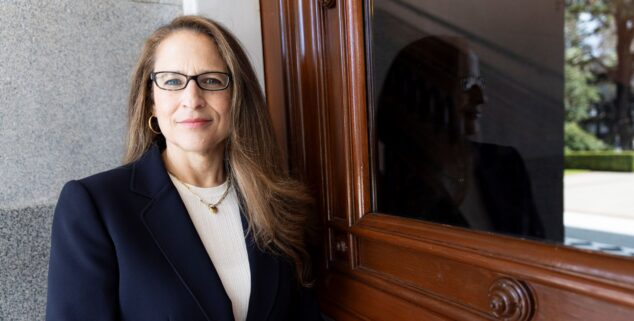 Assemblymember Anamarie Avila Farias. Image by Ellie Appleby, Capitol Weekly
Before she was old enough to vote, Assemblymember Anamarie Ávila Farías (D-Martinez) was already learning how government worked.
After her father died when she was just 3 years old, Ávila Farías was raised in Martinez by her single mother. As she grew older, she became her family’s translator and advocate. Along the way, she learned how language, education and poverty could become barriers – and how meaningful it could be when someone helped navigate them.
Her family, she said, often felt invisible.
“I would say my family was the unseen family, mainly because Latinos traditionally don’t go into politics,” Ávila Farías said. “It really is a fluke that I’m here because I had none of that to experience.”
Long before she held elected office, Ávila Farías built a career in housing and public service.
“I firmly believe that politics found me,” Ávila Farías said. “I did not pursue politics, and so I have a different outlook on why I’m here.”
The granddaughter of Mexican immigrants who came to California through the Bracero Program, Ávila Farías spent decades working in housing and community development, serving on the Martinez City Council, the Contra Costa County Board of Education and the California Housing Finance Agency (CalHFA) board before arriving in Sacramento.
Growing up, affordable housing provided stability for her family during a time of financial insecurity. Without it, Ávila Farías said, homelessness was a real possibility.
Ávila Farías said her mother’s limited education became one of her earliest motivations.
“My mom’s in this situation because she does not have an education to advance and pull herself out of poverty,” she said. “So that inspired me to figure out how to get to college.”
She became the first in her family to graduate, earning degrees in business administration and information technology from the University of San Francisco.
Education gave Ávila Farías the opportunity to pursue the kind of work that had shaped her childhood. At 18, she landed an internship at the Martinez Housing Authority, where she saw widespread poverty and its impact up close.
As Contra Costa County began responding to a growing homelessness crisis, Ávila Farías found herself helping build the systems her own family had once relied on. As federal McKinney Act funding began flowing to Contra Costa County, she helped launch some of the county’s first homeless shelters.
“My family wasn’t as different as I thought it was… my life is very much mirrored by so many people in society,” she said.
That experience opened the door to a broader career in housing policy across the Bay Area.
Ávila Farías joined then-Mayor Willie Brown’s Housing and Community Development Department in San Francisco, where she learned the financing and development side of affordable housing. She later continued that work under then-Mayor Gavin Newsom.
In 2015, Gov. Jerry Brown appointed her to the CalHFA board. Reappointed by Gov. Gavin Newsom in 2021, she helped shape statewide housing finance and homeownership initiatives.
In San Francisco, she found a different political culture.
“She’s willing to always, on her own bills, not look at, ‘What’s my pathway to 41?’ but, ‘What’s my pathway to 80?’”
“It was like a country by itself,” she said. “Everybody, like even their grandma was an activist.”
After serving on the Martinez Planning Commission for roughly a decade, she stepped away, thinking her public service had run its course. Six months later, members of the local Latino community encouraged her to run for the Martinez City Council.
She entered the 2012 race with no major endorsements, little funding and as the only Latina candidate. She won, becoming the first Latina elected to the Martinez City Council.
The path wasn’t always smooth. A 2016 bid for the Contra Costa County Board of Supervisors ended in defeat.
“They weaponized my housing career,” Ávila Farías said, recalling campaign attacks that portrayed her advocacy for affordable housing as a liability. “It was very difficult.”
The loss proved to be a turning point rather than an ending.
Instead of stepping away from public life, Ávila Farías threw herself into community advocacy. She worked to bring local governments into compliance with the California Voting Rights Act, helping several cities throughout Contra Costa County transition from at-large to district-based elections to expand representation.
“That’s my why,” she said. “Showing up and representing when people want us to shrink in spaces… I think I broke through a lot of those glass ceilings.”
Although Ávila Farías is new to the Legislature, colleagues say she arrived with an uncommon depth of experience.
Assemblymember Lori Wilson (D-Suisun City), who sits next to Ávila Farías on the Assembly floor and serves alongside her on the Housing and Community Development Committee, said what immediately stood out was that she wasn’t learning government from scratch.
“She is someone who has experience not just as a local government leader but also in state government,” Wilson said. “She came to the Legislature with a full career.”
That background, Wilson said, is reflected in how Ávila Farías approaches legislation, engaging colleagues broadly rather than focusing only on the votes needed to pass a bill.
“She’s willing to always have a conversation about a bill,” Wilson said. “She’s willing to always, on her own bills, not look at, ‘What’s my pathway to 41?’ but, ‘What’s my pathway to 80?’”
Assemblymember Patrick Ahrens (D-Sunnyvale), who serves with Ávila Farías in the bipartisan Problem Solvers Caucus, said that the collaborative approach has made her a trusted colleague during their freshman term.
“She’s been a really dependable colleague,” Ahrens said. “She’s really trying to focus on solutions instead of partisanship.”
For Ahrens, that’s especially important at a time when affordability remains one of California’s defining challenges.
“Problem solving to her always comes before politics,” he said. “She’s committed to listening and collaborating with anyone who’s willing to deliver results for working families”
For Ávila Farías, those priorities remain rooted in the experiences that first introduced her to public service decades ago.
“I think it’s making sure that Sacramento does not change who I am,” she said, “and to have the political courage to speak in spaces that make people uncomfortable.”
She still thinks about her grandfather, who crossed the border through the Bracero Program with little formal education, and about her mother, who worked to raise four children on her own.
“When I step into the chamber, it’s not Anamarie Ávila Farías,” she said. “I’m really stepping in with ancestral energy.”
Want to see more stories like this? Sign up for The Roundup, the free daily newsletter about California politics from the editors of Capitol Weekly. Stay up to date on the news you need to know.
Sign up below, then look for a confirmation email in your inbox.
Leave a Reply