
Opinion
In California, we need more outrage about inequality
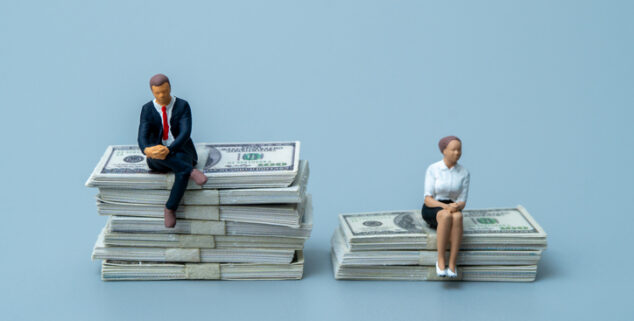 Man and woman figures sitting on unequal stacks of dollar bills. Gender pay gap, income inequality, financial disparity, and salary discrimination concept.
Capitol Weekly welcomes Opinions on California public policy or politics. Please read our guidelines for opinion pieces before submitting an Op-Ed. Submissions that do not adhere to our guidelines will not be considered for publication.
OPINION — Inequality in the United States is out of control. And this is particularly true in California, which, despite being the wealthiest state of the wealthiest nation in the world, many people are simply not making it.
This fact sits in direct contradiction to the idea of this place as the land of plenty. The state produces more billionaires than any other state in the nation, but one in three families lives below the poverty line, and the unhoused build makeshift settlements mere blocks away from multimillion-dollar housing units.
Even among the middle class, the California Dream seems to be further away than ever. On average, Californians spend nearly half (46%) of their paychecks on housing.
That is compared to about 25-30% nationwide. Social workers, teachers, small-business owners, and middle managers work full-time but often cannot afford to feel middle-class. Many have college degrees but take on gigs and side hustles to make it to the next payday, and a mortgage remains out of the question.
In our new book, Normalizing Inequality: How Californians Make Sense of the Growing Divide, we examine how everyday people live with and understand this reality. Drawing on in-depth interviews and survey data collected from middle- and working-class folks across the state, we found that they were clear-eyed about the difficulties besetting their towns and cities.
In their interviews, they told us that the rich were getting richer, a college degree no longer delivers what it once promised, and that homeownership was increasingly reserved for the wealthy, in expected places like Los Angeles and the Bay Area, but also throughout the Central Valley.
They were fed up, and they wished things were different. And at the same time, they found ways to minimize it, push it to the background, and lean on optimistic ideas of California as a place where one can work hard and reach the middle class.
And this was the central crux of our findings. Californians were skilled at naming and identifying inequality, and then, almost in the same breath, they also downplayed it.
When it came to economic inequality, for instance, Californians acknowledged the brutal housing market and were upset that single-family home prices had skyrocketed. And then they would quickly shift to tell us that they themselves could be an exception because they knew how to save, work hard, and seize the right opportunities.
Californians had a knack for identifying the structural roots of inequality and then brushing these ideas aside to foreground individualist, bootstrapping stories of individual success.
This is not necessarily denial, but rather a more complex contradiction at the heart of a troubling conclusion. People have developed a remarkable ability to both acknowledge and minimize the very conditions that they claim to deplore.
And in doing so, they come to tolerate and passively reproduce the inequalities around us.
It is important to make these strategies visible, to show how strange it is that we have all come to accept inequality. It is only by realizing that all of us, in our everyday lives in the Golden State, have come to somehow accept the inequalities that we deplore, that we can begin to imagine new forms of society-building.
It is when we can understand our own everyday roles in all of this that we are more bothered, more unsettled, maybe even more upset about the state of inequality in the Golden State.
As we decide who our next governor is and the future of this state, we need to treat this moment like a state of emergency around inequality, rather than a creeping inconvenience. We need to think more creatively and try more experimental, more far-reaching, and innovative policies.
Proposals to tax the rich, are simply a starting point. We also hope that everyday discussions on the issue will create opportunities to see how our own sensemaking around inequality also helps to reproduce it.
It is only by understanding our role in all of this that we can become more alarmed and more proactive about the state of inequality around us.
California, which markets itself as the land of dreams, desperately needs not simply concerned politicians, but also critically engaged everyday residents to fight against the status quo.
And as we head toward November, let’s start the conversations needed to reflect on our sensemaking and disrupt the world that we often take for granted. Only then will we be able to transform it.
Cristina Mora is Chancellor’s Professor of Sociology and co-director of the Institute of Governmental Studies, University of California, Berkeley. Tianna S. Paschel is an associate professor, Department of African American Studies and Sociology and faculty director of the Center for Latin American and Caribbean, UC Berkeley.
Want to see more stories like this? Sign up for The Roundup, the free daily newsletter about California politics from the editors of Capitol Weekly. Stay up to date on the news you need to know.
Sign up below, then look for a confirmation email in your inbox.
Leave a Reply