
Podcast
Special Episode: Housing – Innovations and New Ideas
 L-R: Jenny Huh, ABC10; Asm. Jeff Gonzalez; Roger Krulak, Fullstack Modular; Ben Metcalf, Terner Center for Housing Innovation; Jim Wunderman, California Forever. Panel 3 at A Conference on Housing, Feb. 24, 2026 in Sacramento. Photo by Joha Harrison
CAPITOL WEEKLY PODCAST: This Special Episode of the Capitol Weekly Podcast was recorded live at A Conference on Housing, which was held in Sacramento on Tuesday, February 24, 2026.
This is Panel 3: Innovations and New Ideas
Asm. Jeff Gonzalez; Ben Metcalf, Terner Center for Housing Innovation; Jim Wunderman, California Forever; Roger Krulak, Fullstack Modular
Moderated by Jenny Huh, ABC10
This transcript has been edited for clarity.
JENNY HUH: Well, hello, everyone. Good afternoon. Thank you so much for having me and our panelists here. Our theme is “Innovations and New Ideas.” So really, the future of housing and affordability. I guess we dive right into it for the sake of time. In terms of the Legislature — 2026, we view it as the year of affordability, the year of housing. But perhaps it could be the year of factory housing, is what I am hearing. So let’s just start with the concept of that: modular housing. Instead of on-site, traditional construction — very simply put — you build homes in factories, drop them off at the destination and finish the work. So, Roger, let’s start with you. You’re kind of known as the O.G. in the modular space. So tell us a little bit more about how the idea came to be, and what you envision the future of it.
ROGER KRULAK: I’m Roger Krulak and the founder of Fullstack Modular. We were really born for a denser, urban environment space. So we build fully volumetric modules in a factory — fully structurally, mechanically, electrically and plumbing distributed. And we stack it up, fold it together and do roughly 85% of the actual work in the factory. So that’s where we were born. We are generally focused on mid- to high-rise, multifamily housing. Be that student housing or affordable housing, workforce housing, sometimes hotels, etc..
JH: And I think the big question is the cost effectiveness. I think it was noted that it’s not necessarily cheaper, but it’s more cost effective.
RK: Great question, Assemblyperson Wicks talked about it earlier. Factories need to be busy, and if factories are busy, they can be cost effective. What they’re building matters. Economies of scale require some level of repetitiveness, and no matter what business you’re in, you have to cover your overhead. And if you have a factory that’s busy the whole time, the overhead gets distributed very evenly over 12 months. If you have a factory that’s not busy, as she talked about specifically, then the cost of the overhead to do that goes up. If everything is different the economies of scale go down. So to answer your question, there’s an opportunity for it to be very cost effective. But it doesn’t happen automatically. There is a process by which you embrace industrialized construction that requires the creation of an economy of scale.
JH: Ben, can you weigh in on this? Because this is something you actually testified to the Assembly member directly on the housing committee
BEN METCALF: Yeah. Thanks, Jenny. Good afternoon, everybody. Ben Metcalf, I’m with the Terner Center for Housing Innovation in Berkeley. We’re a think tank that focuses on trying to do policy-relevant, policy-forward research and bring more evidence and data into these kinds of timely conversations. This has been an area of focus for us. We’ve been trying to put out some research and bring together data to support the work that, hopefully, will flow legislatively this year. But it’s been a challenging space. So we’ve done work over the last couple of years. We have surveyed many of the developers in California who have been trying to work in the modular space, trying to figure out how to make it all together. In an effort to really put a pin in this question of, “How much savings do you really get from going down this trajectory?”
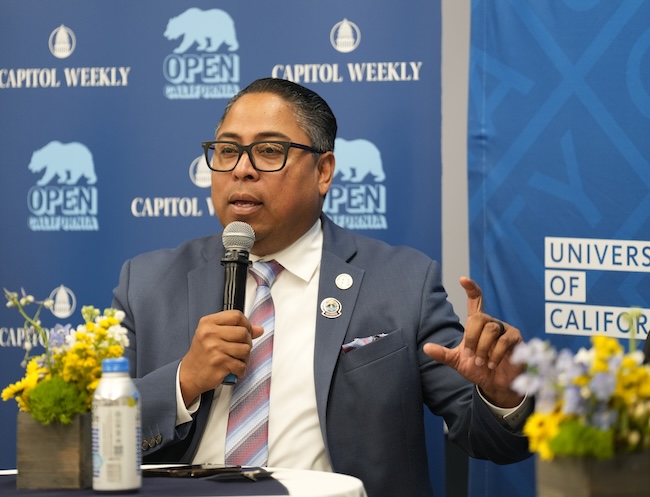
Asm. Jeff Gonzalez speaks on Panel 3 at A Conference on Housing, Feb. 24, 2026 in Sacramento. Photo by Joha Harrison
I would say, from our broad surveys, we actually were a little surprised to find how little savings developers are collectively getting from going to a modular solution in California. They were often reporting either very modest gains or incomparable benefits to just traditional stick built. They were seeing certain time savings — don’t get me wrong, time is money. If you cut six months off of your development timeframe, you’re saving on construction and interest costs, and you’re getting housing faster to the people who need it. But it was a little disparaging, actually, to see this data and see that we aren’t consistently getting the savings. However, when we sort of went back at that, and then tried to ask the question in a different way, which was really like, “Well, when we are seeing savings, what are the characteristics of those kinds of projects like?” It really spotlighted the opportunity because there actually are a group of developers, builders who are consistently able to get savings.
They’re not the majority of the space right now, but they are folks who are experienced, who are often fully vertically integrated — they run their own development company; they have their own contractor; maybe they have an in-house architect; they’re not doing it for the first time, they’re doing it for the second time; they understand the fact they have a strong working relationship with the factory, so they know what they’re going to get; they know how to operationalize it — it seems like there’s this really significant potential. In fact, for those folks who are effectively doing it, it feels like you can get on the order of 20% savings on your hard costs, if you can get into that.
It’s not just that you need to have a smart team of people who understand how to work in this space. It’s also that for everybody else, the regulatory environment is really conspiring to make this much more hard and riskier than it needs to be, and more uncertain. You’re less guaranteed to get the success and savings that you see with the folks who sort of figured out how to operate in this complicated space.
JH: And we’re already seeing this concept throughout California, nationwide as well. In the Bay Area, Jim, I know in some of California’s major urban areas, like San Francisco, we see some of this mechanism being used when it comes to housing. I just want to ask, for you, being familiar with that space, what is it like? And what do you envision in terms of modular housing fitting into the bigger picture of housing there?
JIM WUNDERMAN: Yeah. Well, thank you. Jim Wunderman from California Forever and, for almost 22 years, the CEO of the Bay Area Council — and worked on a lot of the housing legislation and was very close to the early creation of manufactured housing. Especially at Mare Island and what was Factory OS and now Harbinger, which I guess put out its warn notices yesterday. I have a bunch of friends who lost a lot of money, a couple of times, on that particular project.
“I believe that the Legislature is the problem — look at those smiles on their faces. Everyone’s like, ‘Yes, it’s true.’ We are the problem” – Asm. Jeff Gonzalez
Clearly, if you can get it done right and you can keep the factory busy, there’s an economy of scale to be had here, and a predictability to the way it’s done. Time is money when you’re building. So it makes sense that it should work. And I think when you achieve it at scale, you’re going to be able to not only get savings, but you create a greater predictability in housing construction. So I think it’s something that absolutely should be pursued, I think for our project, which I hope we’ll get into at California Forever, when we’re planning to build almost 200,000 units, it would make a lot of sense to have major factory producing as much of that housing close to where houses are being built, and then moving on and moving on.
Having that kind of predictability would then enable other housing and other parts of the region to benefit from that. If you do it in a spotty kind of way, it’s not going to work as well. If you do it at scale, I think it’s going to work really great. How we manufacture stuff well is at scale. And so we should concentrate on how to make it work. To Ben’s point, when we make it hard from a legislative standpoint or from a regulatory perspective, legal — that’s not the way to go about creating success.
JH: Now to bring the Assembly member into the conversation. Again, we’re talking about factories. Factories are expensive. And like you said, factories need constant work to operate, and generate revenue. In that space, where can you guys see the Legislature kind of coming in to help out; and Assembly member, for you as well, serving in the Legislature, where do you see partnerships — increased partnerships — on this front to really make it work?
ASM. JEFF GONZALEZ: The lens in which I look at things is through my time in the Marine Corps, 21 years in the Marine Corps, right. One of the things that we talked about was to adapt and overcome. So whatever the situation might be, we adapt and we overcome that situation. Which means that we have to think about it. We have to quickly analyze and make pathways that might not be there. So because of that, I look at the housing challenge as to adapt, innovate and overcome. We have to adapt to the current season that we’re in, so that way, the smart folks can innovate and figure out ways to put this problem to rest, and then we overcome the challenge. It sounds really easy, right? But actually, it’s already being done throughout the world in many places. So why is California taking so long? If we go to Japan, if we go to all these places throughout the world, they’re doing amazing things. Why is it taking California so long to answer the need, with respect to housing?
I believe that the Legislature is the problem — look at those smiles on their faces. Everyone’s like, “Yes, it’s true.” We are the problem. And the reason why we’re the problem is because we’re looking at things so much from the lens of emotion, and sometimes lack of experience, that when we try to do something, it actually counters what should be done. So as a business owner, when I approach things, I look at it from the place of, “I sign the front of the check, so I know the impact that that has.” So time is money. But if I’m going to use 100 sticks on something versus 10 sticks, I know with 10 sticks, I’m going to spend less. But why does it cost the same? Why does it cost the same? That little puzzle piece is California’s rules and regulations that have created that. So if it can create that, it can remove it.
Now, yes, we need some bumpers on it, but it’s gotten to the point where we can’t solve the problem because we keep on chopping off our nose to spite our face. Are you with me? There’s nobody that agrees with that. Alright, the Legislator is right — no, the Legislature is wrong! We’re doing this wrong. That’s the reality. And I think we need to step back. We need to adapt to the situation. We need to look at the different ways, whether it’s modular or container or whatever that might look like, as long as it’s safe within specs, and then move forward. But we also need to take that financial piece out, all the regulations. We need to look at those and say, “Alright.”
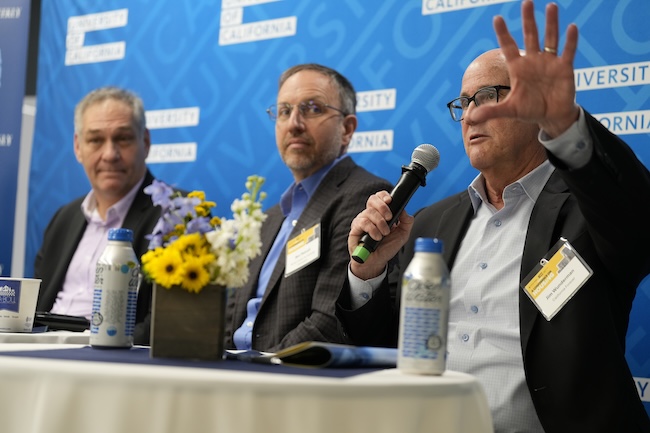
L-R: Roger Krulak, Fullstack Modular; Ben Metcalf, Terner Center for Housing Innovation; Jim Wunderman, California Forever. Panel 3 at A Conference on Housing, Feb. 24, 2026 in Sacramento. Photo by Joha Harrison
We’ve kind of put them like apps on your phone. Everyone has a phone, and sometimes you get 300 apps and you’re like, “Man, I don’t even remember downloading this app. What is this?” That’s regulations in California. We’ve added so many different apps to everything, that it’s just become so burdensome, that it’s slowed down the phone. And that’s where we’re at. We can solve this problem. We have innovation. We have the right people. We have the right location. What we don’t have is the right regulation to help innovate. That’s where we’re at. I don’t know if you’re expecting a legislator to tell you that we are wrong, but I try not to B.S. anybody.
JH: Transparency is always great, right? Last year was so focused, though, on eliminating some of that red tape to really expedite the process of constructing housing, whether it’s local or state regulations and reforms. I know there was a panel discussion on that earlier. This year really was supposed to be focused on the construction of housing, but then comes the question of cost: the high cost with inflation and tariffs, etcetera, etcetera. Do you think there’s a chance for the Legislature to really focus on that topic of construction? And again, with the high cost of material, now that we have eliminated some of that red tape and the regulations you mentioned, Assembly member, focusing on housing construction: do you think that is a reality for the 2026 year by you and your colleagues?
JG: Do you want the truth?
JH: What do we want? The truth!
JG: No — not a reality. If you expected me to give you the smoke-and-mirrors treatment, I’m not going to do that. I’m going to tell you exactly what I think it is. We haven’t gotten to that pain point yet. There’s a book by Malcolm Gladwell. It’s called “The Tipping Point” And we haven’t reached that point — that pain point, that tipping point — to be able to say, “We’ve got to throw this stuff out because it’s just not working.” Now, we’re hurting in California. Absolutely, when it comes to the housing market. But do I think we’ve reached the point? I think we’re getting there. Do I think that we’ve reached that tipping point? Nope. Do I think it’s within reach? I think we’re within three years, three to five years, of being at that point. The only reason why I think three to five years is because the pain has placed us in this position today, of CEQA and so on and so forth.
Unfortunately, there needs to be more pain for legislators to act. But we can stop that. That can actually be fast-forwarded if Californians rise up and force the legislators to move faster. You can do it. But it’s in your hands, it’s not in my hands. It’s in the hands of the voters.
JH: So we have three experts on the panel that can really push legislators to move quicker in certain directions. So I’m going to go down the line here. Roger, starting with you: what is your reaction to what the Assembly members just said?
RK: I mean, I think that’s true. I think structurally it would be helpful to move CEQA and anything you can on permitting, etc. One of the things that’s worth noting is that, as Ben mentioned earlier, the development process also needs to change structurally. So along with the legislative problems, what you just described as a development process — is antithetical to the value that industrialization causes — you need to streamline that process along with the legislative process associated with it. And you see a lot of cities now, in California, finding alternative ways of financing things that speed up that process.
So rather than sort of a standard LIHTC process, there’s a process where they’re doing public-private partnerships by providing land or providing incentives for creating housing. And those things are attempting to accelerate the process. But the structure of the development needs to change because sitting around with a bunch of people, that you sort of work with, or don’t work with, does not really make a factory work. So we also have to think about how to shift our focus in that fashion where it works.
BM: Yeah. I mean, it’s hard to imagine anything the Legislature does in 2026 beating the cost curve. But that’s not to say you don’t want to do stuff now, anticipating 2027, 2028 and beyond. A lot of the cost challenges that California faces are not going away. The tariffs, apparently, are not going away. And certainly labor issues aren’t going away. I mean, I think we’re really staring down the barrel of a gun here in terms of labor availability to work on these construction job sites. We have a workforce that’s aging, a workforce, by the way, that has historically in California been very immigrant-driven, and a very large portion of those are undocumented. So we’re seeing a lot of losses there in terms of people who can step into the working jobs that we need.
“I have a bunch of kids. They’re all going to leave, sooner or later, when they confront the fact that they can never own a home” – Jim Wunderman
A focus on factories has a crazy logic to it, right. It turns out that factories are a place where people are willing to work later into their professional lives. They retire later when they’re in a factory: they start at a factory early, it attracts much higher shares of women; attracts much higher; more diverse workers as well. Factories have their air controlled, they’re safe, they’re easy to access. They can be a few blocks from where you live. You don’t have to do a crazy commute. This is the kind of thing that won’t turn up costs overnight. But you know, by golly, you got to start with something. And this is an obvious place to start, if you’re looking at the demographics here on California’s labor force going forward.
And lastly, I think it’s important not to be too skeptical, with all respect. We shouldn’t be too cynical here. I mean, I think there are some examples of legislative changes over the last few years that have been really successful. Give credit to Jim’s team at the Bay Area Council. Accessory dwelling units is one I think many of us in the housing space keep coming back to again and again and again, because it’s one that actually is compelling. Twenty-fifteen, basically nobody was building or permitting ADUs in the entire state of California. There were maybe a thousand of them statewide.
Now, it looks like in this most recent year, maybe 30% of all California homes — new permits —will be free to use. Why is that? A series of legislative changes over the course of the 2010s that consistently cut away that red tape and legislation, exempted these things from CEQA, removed a lot of the fees that utility companies and cities were charging, and created this really easy pathway for homeowners to follow. So I think that has to continue to be our template for how we spur innovation because once you set the regulatory table, then businesses can take risks. They can build their businesses in ways that can cater to homeowners and come up with new technologies, new products, new ways to deploy backyard cottages or come up with creative financing tools. But until you have that regulatory platform figured out, it’s really hard to let the market do what the market needs to do.
JW: Well first of all, thanks, Ben. Yeah, we snuck that one through (a bill) in 2016 on ADUs, when I guess people were watching something else. And that really changed the market because, basically, ADUs were restricted and any city could just stop them from happening — and they did. And then we got that law passed, and then that really changed things. And then cities found other ways to stop them. So we passed a few more laws to kind of address those things. It has made a miraculous difference. Unfortunately, it’s been the only difference that’s really happened in the housing market in California in this time, and the Bay Area Council sponsored a whole number of bills that passed. You don’t see the impact on the market. Everything that we got done was sort of, “Yes, but we kind of like this kind of housing and that kind of place. We don’t want to have that kind of housing in this kind of place.” And that’s what, you know, I think the Assembly member is sort of talking about. We have to take our foot off the brake.
In California, up until around 1980, we were building housing very effectively in California. It was having a great effect on the state’s economy and the quality of life; and everybody was coming here; and there were songs about going to California and all of this stuff; and then we don’t have any more songs. And if you look at the chart, it just stops. It just stops. And we became this no-growth, celebrating no-growth place, and one after the other, we sort of championed protectionism. Maybe at the time it seemed right, or maybe we were doing some stupid stuff and we were impacting the environment in certain ways — I think all of that is legit — but look at what it’s done.
I stopped in the garage before I got here to talk to a cousin from Florida who I hadn’t talked to in a while. Her daughter and her husband just moved from the east coast to the West Coast to Sarasota. She was talking about that place, and they’re building a house. She’s saying, “It’s so amazing. All the people are so young. Young families.” And I’m thinking, “Holy crap. Why aren’t we doing this?” What stands in the way of us enabling young families from being able to come here or stay here, afford a place. That’s why I moved after a generation from the Bay Area Council to California Forever in Solano County, thinking that we might be able to crack this egg and actually be able to, at scale, build homes that people could afford.
Young families, who could come in and mass and occupy a place that’s basically nothing has happened in all of this time. It really needs to happen. If you take a look at Solano County’s economy, it’s tragic. If you just look lately at the number of layoffs, closures, including the manufactured housing. It’s just really, really sad what’s going on when you don’t encourage investment and at the same time, build jobs, build opportunities for manufacturing and jobs. So we don’t say, “Okay, well, you can get a house, but you have to live like an hour and a half away from your job. So good luck and enjoy your life. No. I’d rather go to Texas. I’ll take a shot in another place I don’t like as much, but I don’t want to have this kind of lifestyle and suffer. We have the worst commutes in the country, in this region. So I believe that the Assembly member is unfortunately correct. We’ve done this to ourselves and we really need to get reality.
There’s a book called “Abundance.” Everybody names it. I don’t know if anybody’s read it — maybe they opened the cover — I think if the legislators really read it they would say, “Okay, it’s time to take steps that are a little more politically painful,” and say, “We really need to create a legal, regulatory environment in which it’s going to actually enable folks to come in and build what the market requires, in order to ensure that this next generation doesn’t all leave.” I have a bunch of kids. They’re all going to leave, sooner or later, when they confront the fact that they can never own a home, but they could do it somewhere else.
That’s a huge incentive. I hate to be trite, but I feel it is a crisis. We’re trying to address it. The resistance is palpable. People don’t want housing. They don’t want change. You know, the usual buzzwords of traffic and noise or whatever. There won’t be enough water. All these resolvable kinds of issues get thrown up as obstacles, and it’s been a very effective tool that folks, who just don’t want to see growth, throw around. And they’re usually folks who look kind of like me. They’re kind of like white and old and, you know, have a house already and don’t really need it. And we really need to think about this next, this younger generation. What do we want for the future of the state? And to Assemblymember Gonzalez’s credit, we need to call this actually what it is and take more drastic steps to deal with a more drastic problem.
JH: I’m glad you addressed the younger generation, because we’ve covered ADUs, we’ve covered modular housing. My question really is, when it comes to these new innovative tools, we’re looking into to somehow resolve the housing affordability crisis, who really is the target audience? Which type of Californian can really seek to benefit from these new creative ideas that we are trying to implement here in the state, and also, whether it’s modular housing or ADUs, is the intention for these to be temporary or long-term housing, permanent-housing solutions? So target audience and also kind of duration of which could be a shelter for folks.
JG: The target audience is Californians. From those who are a little bit more salt-and-pepper, who want to downsize, to those who are coming into the world as new adults. For those folks, those who are looking to make a smaller footprint for whatever reason, I believe this type of housing — specifically, modular type of housing — should be for everybody. That’s the target.
But how do you get that when we are paying too much? If you can give me a modular, you can give me a container, you can give me a normal, traditional build, and it all costs the same, we’re not solving the problem. We’re not getting anyone into any houses, period. It’s not the skepticism that I have, it’s predictive analysis. I looked at the patterns of past activity. What we’ve done in the 1980s, right, what other people are doing, and what they’ve done in the past. What is our current situation in order to identify what our future state will be? And in the data that I receive, without a significant emotional event taking place, we will continue down the same road of an unaffordable housing market.
We have to make a significant emotional event in the Legislature to change the trajectory of where housing is going, so that we can reach that demographic. Right now, the only demographic we’re trying to reach is the ones that can truly afford this $900,000 home. That ain’t me, I don’t know about you. So we have to change something. We are at that point. And if we can do that, then we can reach that target. Then we can truly do something about putting people in homes. Not just giving them that chance to rent, but then going into a modular home.
And by the way, I’d love to live in a tiny home village, right? Imagine the carpet that I’d have to vacuum. It’s like the size of this table. That would be great. I’d love that. My wife would love that for me. So I think we have all of those options, and we have the innovation. We have everything, but we don’t have the appetite in the state Legislature.
RK: Good question. The product types you’re talking about have different uses. ADUs, they could be emergency housing or living in a tiny home, or they could be increasing the real estate value by having income associated with the house that you’re living in, in order to be able to afford to live there. Or you can increase density by using multifamily or multi story. And the question becomes how you bring the cost down. Because that’s the big issue.
And I think it’s worth — we’re talking about all kinds of products, and all kinds of theory and all kinds of research. But let’s understand what the idea of industrialization is, if you take one thing away today. The idea of industrialization is by creating economies of scale, you increase the labor variability cost. So the idea is that you’re bringing the labor costs down to assemble a built environment, and that’s where the value proposition is. And then all the other costs —which we don’t have to get into — but if you just think about that, an opportunity for velocity and opportunity, for lower cost, is the reason you’re thinking about industrializing the built environment.
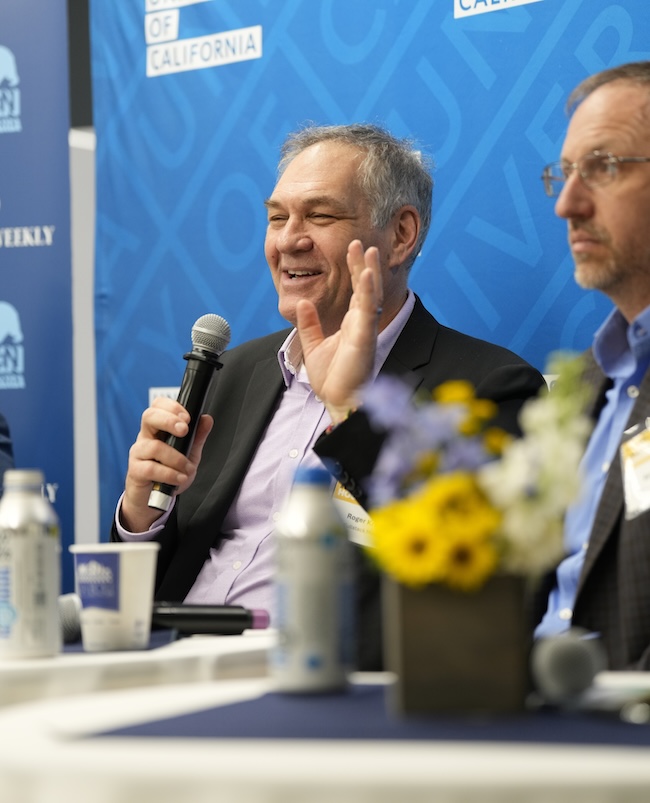
Roger Krulak, Fullstack Modular. Ben Metcalf, Terner Center for Housing Innovation on right. Panel 3 at A Conference on Housing, Feb. 24, 2026 in Sacramento. Photo by Joha Harrison
That’s why you industrialize everything: telephones, cars. And frankly, if you think about it, everything that goes into a building is basically made in a factory, and everything you use to put it together is basically made in a factory. The reason they do that is exactly what I just described. So that’s at the end of the day, everything we’re talking about, that’s the opportunity. But it has all of the requirements that we’ve all talked about in order to create it.
BM: I think on this question of permanent versus temporary, there’s an interesting question as to whether this is a crisis, or anything should be on the table. Should we really encourage Californians to just go buy RVs off lots and put their kids or their old folks in their driveway living in an RV? In theory, that’s an option. The problem with that, or by extension, you know, like sanctioned encampments too, is, ‘Hey, maybe we should just — from a quality of life perspective, folks are homeless — let’s just make this as comfortable as we can, as controlled as we can.” It’s not a bad approach. It’s just that it doesn’t tend to solve the structural problems. And when you squint and look out a couple of years, it’s not clear what you’ve really achieved.
So it may be useful as an accompaniment to a set of other broader reforms. But temporary housing is generally not the solution in any sense. So that’s one point. The other point, I think, which is important to understand,is that the construction industry itself is poised to go through a period of change. Not only is there an opportunity to move more of it into sort of factory settings, but also, like every other sector, every other sector of the economy is going through incredible transformation that’s fueled by productivity gains, big data, AI. Somehow construction has historically been pretty immune to that.
I don’t know that necessarily has to be the case. I think in fact, we’re seeing some of the big home builders, the publicly traded companies that are working, you know, more out in, you know, in the more suburban greenfield areas — they are actually bringing factory type techniques to their jobs every day.
They’re increasingly getting sophisticated in terms of tracking where all their workers are on the job site. They’re increasingly tracking where every piece of material is as it moves through the jobsite. They’re increasingly bringing more and more components that are, — roof trusses now are showing up on the job site — and so the other way to think about this is how can the state and policymakers just simply, again, create certainty in the regulatory environment that enables people to bring factory-type conditions to the job site, so you have a factory without walls? I think actually that may be part of where we’re headed too. I worry sometimes in all this discussion about modular and modules that we get too focused on sort of like, “Okay, we need a box coming out of a factory and that will solve all of our problems.”
Modular, for sure, has a huge space to play, but there’s a bigger transformation that we need to support in the construction sector over the next several years.
JW: You know, what we’re trying to do in Solano with California Forever, is build a great community. Not a good one, but a great one, with what we know about great cities. So build a new city. Don’t make the mistakes of the past. Don’t allow for urban sprawl. Actually build a compact place with moderate to high density, with green spaces, with bike paths and walking paths that encourage safety; a school that’s in the center of the community, not on the extremity; build different levels of housing for different levels of people who have different levels of income and and financial capabilities; but have the basic house be available to people who are just regular people, working people, who can afford the price, which they can’t do in most of the state at any time, and be actually able to do it in a place where there’s a job opportunity close by. So that all enhances the quality of life. So that’s setting a standard. That’s not just saying throw up anything, any way, in order to accomplish the goal, but it’s a broad standard.
The notion of the city is that it’s meant to be 400,000 people. It’s not determining from the beginning what it’s all going to be, but allow it to grow organically, because over the course of decades, priorities will change, times, you know, preferences will change, and so forth. A couple of years ago, I started a group called the New California Coalition, which some people in the room are involved with. It is kind of a group of groups around the state who want to solve core problems. And you can imagine housing rises right to the top of the list.
This year, we’re sponsoring a bill run by Assemblymember Sharon Quirk-Silva, which would enable the faster and easier development of townhomes. So townhomes have proven to be part of a denser mix, are cheaper to build, offer a lot of different qualities that people seem to demand, and builders seem to be able to build them and sell them. But it takes too much time given the housing needs. So AB1751 seeks to address that. It doesn’t solve the whole problem, but at least it gets to a core opportunity, I think, for the state to build the type of housing where you can have home ownership, which I think is really important for people to be able to — young families — to be able to build wealth and have a stake in the community and so forth. I don’t think the bill speaks to the type of construction, but certainly with row houses, it would, you know, I think probably be amenable to kind of an industrial development kind of opportunity.
And so I hope — I don’t know whether the bill will go or not, because what seems simple is never simple in California, and then before you put all these restrictions on it and suddenly what you think was affordable is not — for California Forever, what we’re looking at is a starter home in the $400,000 range. And then they go up, but they don’t go too far up so a family can get a bigger house. But generally, the point is to build housing that is actually affordable to folks based on the income people earn and can earn.
That’s what we stopped doing in the state, so we created this divide and this incredible commute problem and these things that are making people frustrated with California, instead of loving California. So we’ve got to start loving our state again by doing the things in our state that feel good and can be related to by real people. And not just people who want a certain something, but to the general public.
BH: And Jim, quick follow up for you. AB 1751 is that “missing middle housing?” And I know last year California made big moves in terms of transit-oriented housing and apartments, specifically with Sen. Scott Wiener. You said, for you, in California Forever, the biggest feature is tapping into greenfield areas. So those are kind of like the farmlands, open spaces, undeveloped, untouched areas. Can you talk about that a bit more? Why do you think that is the future? And again, just how doable is tapping into that type of scenery, when it comes to building housing?
JW: It’s must doable because we’re not going to get there if we don’t do it. My predecessor at the Bay Area Council was a woman named Sunny McPeak, who some of you know, was a is a kind of leading policy thinker and was a cabinet secretary to Arnold Schwarzenegger, and took that job and left the Bay Area Council, leaving that job to me, which was nice of her to do. And she coined the term “smart growth” and “transit-oriented development.” She was a huge advocate. And if you go to the Pleasant Hill BART station in Contra Costa County, you’ll see what she built when she was a supervisor there, before she was at the Bay Area Council. It was one of the original examples of building denser housing in an open area. And then others started popping up because of that one. And they make sense to do that, especially by a BART station, where you’ve got this major mode of transit.
Sunny was the biggest advocate for this. And Sunny said, “If we do everything we can do in infill, we’ll only get to 50% of the need.” That’s what she said 25 years ago. And that’s what she would say today — are you here? She’s not here. But she would say it. I’m quoting her. We don’t want to be insensitive to needs for farming, where there’s active, quality farming opportunities. That’s one thing. It happens to be in Solano, if you drive Highway 12 from Suisun City out to Rio Vista, you’re not going to see you’ll see some cattle grazing. Occasionally, but this is not great farmland. And so you have to kind of look at where you’re where you are and what the opportunities are.
This is a county that passed a no-growth ordinance back in the early 1980s, and just basically hasn’t grown. And you know, with a lot of impact on the community in terms of its opportunity. And it’s about 87% open space in the county, something like that. There’s seven cities there. This number is not too much higher. It’s a little higher than the rest of the Bay Area, which compared to the rest of the country, is really, really high. And so, you know, if you whittled away a little bit of that percentage, you’d still have a beautiful, open green county, but with a couple of percent, you could accommodate really a lot of people and solve some of this problem. And I think, you know, it’s a question of balance, of how we balance this out. Because what we have done is we’ve just made it really impossible to build. We’ve built the communities we’ve built. So it’s really hard.
The people who live in a suburban community, they kind of want it to be like it is. It’s really impactful to them to see big buildings where there are. So it’s always a fight. In this case, you can design it from the ground up, and you can build with greater density and something that especially young people will like and want to want to be in a community like that, and actually solve the problem. It’d be nice to actually solve the problem.
I know they say in Silicon Valley, “We really like failure.” I actually don’t like it that much, but I experience it a lot. I’d like to get past it at some point. So I’d like to see a lot of cranes. I’d like to see jobs. I’d like to see manufacturing come. I don’t think industry is a bad thing. I think it’s good. And I think we got lost somewhere here in California. We need to find ourselves again, make things possible where they were impossible. Is it going to ever be perfect? No, it’s never going to be perfect. Is everyone going to be happy? No. But we have to think about the needs of people overall and in the future of our state, because we’re doing well.
If you look at the Bay Area economically, you know, it hasn’t recovered from the pandemic. If you look at Solano, it’s at the bottom of the barrel in the Bay Area. And you’re seeing the effects of it, and it’s resulting in real people losing their jobs and their livelihoods because of the lack of investment and what’s happening. I think we have an opportunity at this moment. And I think Buffy Wicks, who spoke earlier, did a really great job. And Scott Wiener really pushed, pushed, pushed. And I think it’s time to really try to really get behind that. I appreciate the work everybody on this panel is doing.
JH: Question for all four of you. California is a massive state, no doubt. All these forward-looking solutions and tactics that we are talking about, are there regional limits? What works in the Silicon Valley, for example, can that work in the Central Valley, can that work in Los Angeles and San Diego? Are there any methods that may work in Northern California that don’t, again, work in Southern California? Are there regional limits when it comes to these various techniques that we are talking about?
JG: I think if you’re in a warehouse, a warehouse is a warehouse for a warehouse, right. You build, you do what you need to do. When it comes to environmental limits — I’m from the desert. So it gets to 120, 130 degrees, and it’s hot. So there might be some limits with respect to that. But if you’re in a warehouse, hey, air conditioning. That’s a good piece. So I don’t think, I don’t want to land on, “Hey, we should just do the cookie cutter for everything,” because California is so diverse. But I think when we’re talking specifically about this style of building, I don’t think there are many limits.
BM: Yeah, I’ll just get in and double and affirm that. I think one of the challenges in California has been at the construction stage. So let’s put aside the question of planning and design. You’re going to build the building. You have very different regimes that you’re operating on, depending on where you’re building in the state. Your local building inspector, your local building chief, your local fire chief, has tremendous influence on how you actually build the thing you were approved to build, down to construction details and weatherproofing and insulation, and how the fire truck maneuvers and all that kind of stuff. I think there’s a need to rethink some of that, and really think about how we can have a standardized set of rules. Again, I’m talking about the health and life safety of these buildings — really trying to standardize that. Because the more variation you have regionally across California, the harder it will be for any one factory to be able to build a single product that can get deployed into the LAs and the Bakersfields and the Vallejo’s and the fill-in-the-blank.
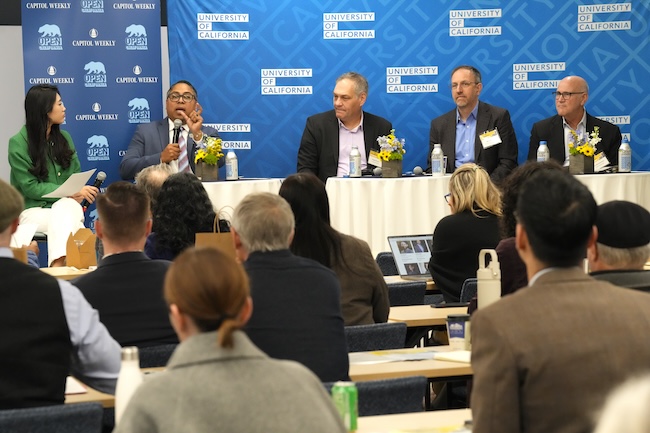
L-R: Jenny Huh, ABC10; Asm. Jeff Gonzalez; Roger Krulak, Fullstack Modular; Ben Metcalf, Terner Center for Housing Innovation; Jim Wunderman, California Forever. Panel 3 at A Conference on Housing, Feb. 24, 2026 in Sacramento. Photo by Joha Harrison
We need to think about how we can provide more standard guidance to those local building chiefs. How can we maybe have clearer appeals and interpretation processes at the state level, a state body that’s really giving clear guidance and direction on what to do. I think we have a lot of trouble right now, even in our factory-built housing program that the state operates, around giving deference on some of these building code issues.
The modules right now that are approved by the state, are being delivered to different parts of the state, are actually getting built in slightly different ways because the state is deferring to local building code. And then when those modules land, you have local building inspectors who are actually using local building code to determine what those connections look like and how those foundations sit. At a certain point, that’s just loony. We have to figure out how to come up with a simpler, more standard pathway, particularly if we want these kinds of new technologies to flourish.
RK: I think it’s also worth noting that there’s two things here: there’s product and process. So the product is applicable to different places and different things because of the nature of that environment. But the process, just like Ben said, has huge opportunities for streamlining, huge opportunities to move things along, huge opportunities to embrace. You see. international building code, and they’re like, “We use international building code, except for these 37 exceptions. Or we use these 200 things that we don’t agree with. We’ve done this.” So the idea of cleaning that up provides opportunity to place the right product in the right place with efficiency.
BM: The state over the last couple of years has really decided, “Hey, there’s a housing crisis and we’re going to take some control away from local planning officials. We’re going to say you have to approve a multifamily house if within a quarter mile. We’re going to make you approve a cottage if it’s in the backyard of a single family home.” We really haven’t done that as a state on the building code. So I think we need to sort of think about all those things we’ve been doing on the planning side and think about what it would look like. What are the analogies on the building side where we can say, “Hey, some local control is good, but within parameters?” There still needs to be pathways for things to be built cost effectively.
JH: We’ve talked a lot about the people that are involved in the construction process and just the planning process. But like we were saying, the people in the construction, — the labor, the workforce — I think in California, especially when it comes to labor, we see a lot of labor unions, and there are the political implications of that. I’m sorry, I’m a political reporter, so political implications are always big. Going back to factories and that construction, Gov. Newsom actually has said in an interview, “This holds a lot of promise. It holds a lot of political peril in the context of the politics within labor. And it means which unions, which different skills and which trades are part of that. And therein lies the issue we have to address.”
When it comes to, again, the labor unions, the immense political power they hold and the Legislature, where do we see the future and any compromise there?
RK: Well, I know what Fullstack does, and Fullstack is building-trade aligned. The people that work in our factory are our signatories with the trades, all of them. And so we’ve addressed that process, certainly for California. We think of ourselves as an alternative apprenticeship program for the building trades. So we get young graduates or people who don’t want to climb steel anymore, and they come to the factory, and they get a living wage and benefits, etc., but still in a factory environment rather than a building-trade environment. But we are completely aligned. We started in Brooklyn, but we have always been focused on that. So that’s what we do.
JW: We have a labor agreement that was signed in the fall with both the California Building Trades Council and the Northern California Carpenters. Our intention is that the vast majority of the building that gets done on the site over the next 50 years will be done by union workers, and the people who work on the site will buy a home on the site and not have to commute two hours to get to their construction job. We shouldn’t be building homes for wealthier people on the backs of poorer people and doing that.
So this is an opportunity when you, I think, operate at scale to be able to address those kinds of things. If it pushes the cost up of housing a little bit in order to have the workers getting a fair shake and actually having a career in this business rather than passing through, is really worthwhile. We’re really proud, we think it’s the biggest labor agreement in America, and we’d like to actually get people working on it.
But we do not have the entitlement to build anything. And so we need the state to actually see this project at its scale — 400,000 people, 2,100 acres of advanced manufacturing and a very, very large shipyard to meet the needs of the future of the maritime industry, which we’ve neglected in America. To actually build that, this will employ many, many, many, many people over the course of generations. And we’re, very, very excited about it. But we see it as more, although this is going to be built in Solano County, a project of significance to California, maybe the country, but certainly to the state, which has crises in these areas and these big lacks. You’re absolutely right, the labor issues are a really, really big issue. We should try to get past that so that we can get on to the business of building. Again.
JH: I think we’re transitioning to Q&A soon. But assembly member, I do want to have you weigh in on this. You know firsthand the power of labor unions and working with them directly as a legislator. What would your reaction be to both my question and what our panelists have said in terms of being able to work with labor unions for the future of these models we’re talking about?
JG: As an electrician, we had to go through a class, and it was about why unions were created. And I thought, “Man, that was a really good idea,” because I really didn’t know the history behind that. And it was for health and safety, and so on and so forth. So unions have a vital role in our atmosphere. They have a vital role. Do they also wield a lot of influence in Sacramento? Absolutely.
As an individual legislator, you have to then ask yourself what’s right for your district, and is it right for labor to be in the district, or is it not right for labor to be in the district? I have a 20% unemployment rate in my district — 20%. That’s huge. The average is 4.7%. So for me, I need shovels in the ground. I need houses being built. I need jobs and I need generational jobs, and jobs that can stay and get paid.
So in looking at it from that lens, labor provides that for my community. So whether they wield leverage or don’t, I look at it from the perspective of, “What does it mean for my community and in my community?” We need them in there. We need apprentice jobs. We need the grandfather, the dad and the son and the daughter all working, if you will, in the same factory, so to speak. For years to come.
JH: Alrighty. Well, with that, we’ll open it up for questions.
TIM FOSTER: While we’re getting to them, I do have a question. Jim, you mentioned earlier that California was building houses at what I would characterize as a normal pace up until about 1980. The elephant in the room there is that what happened in 1980 was that Prop 13 went into effect when it was enacted. Is there anything that you, any of the panelists, see happening with Prop 13 that could change that? It’s come up multiple times in the other panels, the other discussions. Prop 13 is sort of the elephant in the room in this entire thing. I’m just wondering if there’s any new ideas related to Prop 13.
JW: There’s always new ideas. The question is, can you get them to happen? It’s been called the third rail of California politics and all that. I don’t know whether it’s been tested lately. I will say, if you go to a city council meeting and the city manager puts up the chart of the city’s revenues, there’s retail sales tax and various taxes. And then you get to the ones related to housing. They’re tiny, relatively speaking. And so you can understand from the city council’s point of view that building more housing doesn’t solve the fiscal problems that cities face. So I think at some point we need to address this.
Cities should be the biggest advocates for building housing, not fighting it. You have to appreciate what Gov. Newsom has done: really paid attention to housing; created an accountability unit in his office; threatened to sue people, I think actually sued some cities. That’s not the way it really should go down. It should go down as the cities need to get back in the business of being incentivized to build housing.
How that fits with the political realities of Prop 13 is probably above my pay grade, but at some point I think, maybe the next governor wants to take a look at that and really explore, given just where we are today with today’s demographics, whether there’s some other way to fund the government, you know, that actually encourages housing development rather than suppresses it.
AUDIENCE MEMBER: My question is about factory-built housing and the relationship with governments. On one hand, we have a beautiful relationship and love for capitalism. We also like to sue governments. But on the other side, government has the ability to demand guarantees for factory-built housing. It has the ability to ask for the same consistent product versus every developer coming up with their own choice of products, and they have price setting power. They have the ability to negotiate drug pricing. So the question is, is there any version of the future where we can imagine the government or some part of government agencies acting as a developer like Singapore does, for example.
BM: Yeah. I mean, there’s a bunch of international examples where government is much more heavily involved. And I think there is a story here that to really get this space to scale, you do need the government’s purchasing power to be deployed directly into this space. They don’t need to own it or build it themselves, but they need their purchasing power at a minimum.
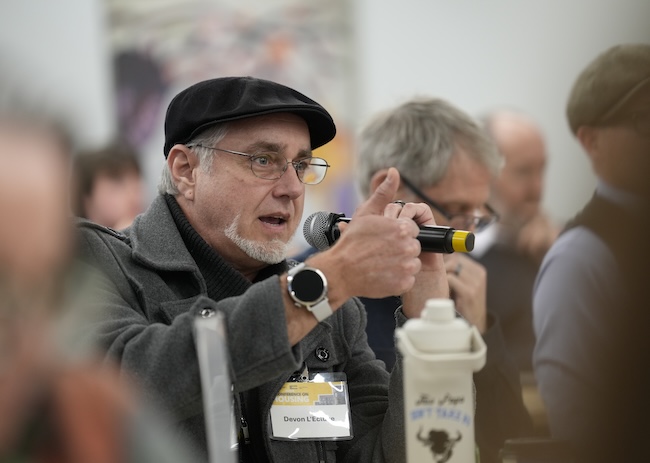
A member of the audience poses a question during Panel 3 at A Conference on Housing, Feb. 24, 2026 in Sacramento. Photo by Joha Harrison
I think the challenge at this moment today is it’s very hard to shift that purchasing power writ large, when you still have so many other sorts of regulatory code issues, so you sort of have to do a both-and here. You got to fix a lot of these little glitchy things that are causing the industry not to be cost effective. It’s chicken and egg, right. You need to get to scale, but you also need to make sure that before you start shifting that firehose of purchasing power, that you’re actually getting to a product and a delivery system that in fact will deliver for the taxpayers what they want, which is stuff that’s cheaper, faster, quicker, better.
RK: And there are a number of cities throughout California that we’re talking to right now that have different ideas of how to amp up the participation — worth a long conversation about. If you lower the cost of the land and the price of the construction goes up. The point is, there are plenty of people, lots of cities you would know who are trying to do things along those lines.
AUDIENCE MEMBER: Thank you. We’re talking about innovation, we’re talking about new technology and new ideas. One that utilizes AI increases efficiency, is more sustainable, that I have not heard yet about is 3D printing. Any reason why not, and what we need to do to get more?
JG: I’m not against it. So there is no, “Why not?” I’m for innovation. Adapt. Innovate. Overcome. As long as it’s safe, roof overhead. People can be warm. Family can be good. Everyone has a different way of doing it, so 3D-away.
RK: And you’re talking about a product. And I personally think there’s a huge future in 3D printing elements of the built environment. No question. And it’s coming.
BM: I mean, this is another example where you have to get a better regulatory environment in place because right now you do not get code compliance with something coming out of an inkjet printer thing. So we need to get to a world where you actually can do performance-based code, which I think is the future — needs to be the future, but we’re not there today.
Rich Ehisen: I have a question for you really quick here, because we were talking earlier about local code. Housing has always been local purview. I mean, you were talking about a sea change when you’re talking about taking even small parts of local control away. How realistic is it to make the kind of sea change that would benefit the Assembly member’s district, like we’re talking about?
JW: I don’t know if you talked about former Sen. Hertzberg’s housing bond — did that come up today in the conversation? — but one of the ways you could do it is through the financing structure. So you could apply that globally to the housing market. The problem is for a young family, getting to a 20% down payment is a really difficult thing. So what he’s proposing essentially, is that you’d be able to buy a home if you’re a first time homeowner for 3%, and there would be a bond that would be passed that would get repaid as a revenue bond for the remaining 17%. That would, no matter what part of the state you’re in, would certainly help cities encourage younger homeowners to be able to get into housing. And it only applies to new homes. So this is the way he’s approached it, with the resale market.
Therefore, it encourages new homes to be built, which then adds to the supply, which hopefully softens pricing. So it’s something I think for us all to really consider. I think that’s going to be on the ballot, and we’ll have a chance to consider that. There are some ways without being overly determinative in a local community, for the state to come in and say, “Thou shalt do this,” which rubs a lot of people the wrong way. At least to be able to provide the supports for the local communities to encourage housing development.
BM: You know, we’re here at the University of California Policy Student Center. I’d be remiss not to say, “I think to do this, we need to have better data, better research.” We need to make the case that these kinds of policy changes will result in the outcomes that we want. I will confess that in many ways, we are flying blind as a state. We don’t have good current construction cost data on how much it’s costing to actually get stuff built in different ways. We don’t — Assemblymember Wicks mentioned this — have great data on current rents and what’s being charged. We don’t, really. So there’s a lot of work I think we need to do for the case making. I think it is clear that there are cheaper, better, faster ways to work. And so we need to just build the evidence base to facilitate making the case for that.
RE: On that, I know you guys could probably give me a much better answer or longer answer, but we’ve got to let the Assemblymember go. So we’re going to wrap this up right now. I’m going to say thank you to everybody for coming today. March 26, we’ll be back here to have our California gubernatorial debate.
Capitol Weekly intern Chris Ramirez contributed to this report.
Thanks to the sponsors of A Conference on Housing:
THE CALIFORNIA BUILDING INDUSTRY ASSOCIATION, THE TRIBAL ALLIANCE OF SOVEREIGN INDIAN NATIONS, WESTERN STATES PETROLEUM ASSOCIATION, KP PUBLIC AFFAIRS, PERRY COMMUNICATIONS GROUP, CAPITOL ADVOCACY, THE WEIDEMAN GROUP, CALKIN PUBLIC AFFAIRS, STUTZMAN PUBLIC AFFAIRS, RANDLE COMMUNICATIONS and CALIFORNIA PROFESSIONAL FIREFIGHTERS
Want to see more stories like this? Sign up for The Roundup, the free daily newsletter about California politics from the editors of Capitol Weekly. Stay up to date on the news you need to know.
Sign up below, then look for a confirmation email in your inbox.
Leave a Reply