
Podcast
Special Episode: A conversation on housing with Asm. Buffy Wicks
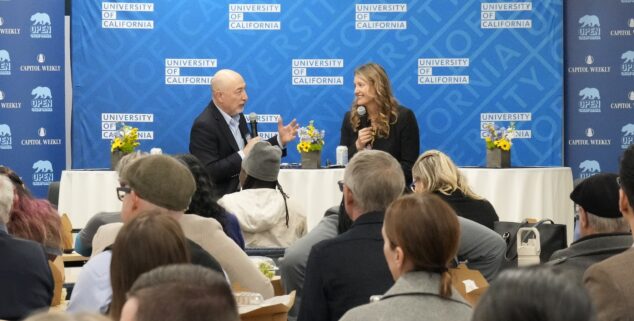 Asm. Buffy Wicks in conversation with Capitol Weekly Editor Rich Ehisen (left) at A Conference on Housing, February 24, 2026. Photo by Joha Harrison, Capitol Weekly
CAPITOL WEEKLY PODCAST: This Special Episode of the Capitol Weekly Podcast was recorded live at A Conference on Housing, which was held in Sacramento on Tuesday, February 24, 2026.
This is the Keynote: Asm. Buffy Wicks in conversation with Capitol Weekly Editor Rich Ehisen.
This transcript has been edited for clarity.
RICH EHISEN: All right. Well, hello, everybody, and welcome to our keynote with Assemblymember Buffy Wicks. Most of you, I don’t think I need to give you too much of an introduction. I think everybody that is here, knows who you are. So, I think we’re just going to jump right into this. And again, I appreciate everybody. We’re going to try to keep it tight and be respectful of the demands on her time, which are many.
But I want to get started with something I think kind of personal, because it feels like so much of your efforts on housing do feel personal. You’re really passionate about this. So, if you don’t mind, maybe just give us the brief. You know, why you care so much about housing and how it has reached the top of your agendas your whole time in the legislature?
ASM. BUFFY WICKS: Sure. Thank you. Is this. Everyone can hear me? How are y’all doing? Good. Great. Okay. Enjoy your lunch while we chat.
Thank you so much for having me, Rich. I really appreciate really love being in this room with fellow housing nerds. So, yeah, so I, I grew up in a tiny little town called Foresthill. I don’t know if anyone knows of it. Yeah. a Woo woo over there. Great. Very working class community. About a half an hour outside of Auburn. And I grew up in a mobile home, and I was very embarrassed about that a a kid
I didn’t I was, like, nervous to have friends over, didn’t want to have slumber parties, wanted to go to other people’s homes. But as I got older and, you know, realized that that mobile home was actually my housing security… I went to community college, I got a four year degree. I got into politics, worked for Barack Obama,became a state legislator. I realized that that housing security in that manufactured house, gave me the ability to focus on self-realization and all of the things that led me to be where I am today, and that for so many people in our communities, they’re not afforded that opportunity.
And then when I when I decided to run for office in 2018, I did 239 house parties. That was like how I built my campaign… it was literally like one living room at a time. And it was living rooms like low income subsidized housing in San Pablo and like $5-10 million homes in Piedmont and everything in between. And at every house party, there’d be about 20 people there. And I would say, why are you here? And I go around the room and about 80% of them said “housing.”
And whether it was older folks who their kids were graduating from college, but they wouldn’t come back to California because they couldn’t afford to live here or people considering leaving California. Housing, housing, housing.
And so I just knew I was going to work on this. And so from the jump, the second I got here, I knew that this was going to be the defining issue that I worked on. I’ll also say when I first ran, I had just it was in my early 40s and I just for the first time bought a home and had gone through the experience of trying to buy a house in California – a home, by the way, now that we couldn’t, my husband and I couldn’t afford to be in, because we’re now priced out of the neighborhood that we bought in 2016, which is for a lot of people, like, same story and just the gargantuan down payment and all of the stress and the anxiety.
And this is, you know, we’re sitting on like a 2.8% interest rate, you know, so we were lucky at the time that we were able to, to do that.
But, you know, for us as like starting a family and, you know, I just I was pregnant when we bought our first home. And just going through that experience, and we’re dual income earners, you know, if we can barely do it. How do single how do single moms.. I don’t know how single moms do anything because my God… it’s the deck is stacked against them, you know?

Asm. Buffy Wicks in conversation with Capitol Weekly Editor Rich Ehisen (left) at A Conference on Housing, February 24, 2026. Photo by Joha Harrison, Capitol Weekly
So I knew this was going to be a thing I wanted to work on because the housing issue to me in California is like such a fundamental issue that impacts everything else. It impacts kids’ ability to be good at school. It impacts someone’s decision to start a small business. You know, it impacts, you know, are you going to get health care or not? Like it’s the underpinning issue on so many things that if we can structurally fix this issue, we actually can create really substantial change for our working class folks in our communities.
RE: Well, you know, I want to see if you can clarify something for me, because I have heard a range of our housing shortage from around 875,000, up to 3.5 million. I think it matters in that you need to understand the scope of the size of a problem you’re trying to deal with. Do you have a number that you feel comfortable working?
BW: I feel comfortable saying about 2.5 million homes shy… about 1 million low income homes for our lowest income folks, is roughly where I think our our whole is where our needs are. And what happens with such a shortage of housing is. And I see it in the Bay area. I see it in my community. You know, we’re home to the tech sector. Those are good paying jobs
“How do we bring down the cost of construction? Because that is a big driver on this.”
By the way, when all these big AI companies go public, the housing market in the Bay area, like you think it’s bad now, it’s going to be very difficult for people to buy a home because you have a whole bunch of new rich people, you know who and good for them, I don’t I don’t harm them for, you know, getting good jobs, and they’ve sort of struck it rich, but it’s going to put a lot of downward pressure on the market in the Bay area.
But what happens then is you have like the tech workers competing with our public school teachers to buy a house, you know, and our nurses and others. And so they’re priced out of the community. You know, the saying the realtors say in my area, drive till you qualify. Just keep driving east until you can qualify for the house that you think you can get. And that means then these huge commute times. We have teachers at Oakland Unified School District commuting four hours a day. I mean, it’s just crazy. So it’s… which then impacts of course, our environmental issues because the the greenhouse gas issues and also quality of life issues and all kinds of other things. So again, that’s why I think this is such an important issue.
RE: It really is significant. I have a friend who’s in law enforcement down in Southern California, and he talks about how so many of the officers that he was with don’t live in their communities. And so they come to that community not really even understanding the people that they’re expected to serve. And so anyway, yes.
BW: You see that with cops, firefighters, teachers, nurses, others who, they want to live in that community and some of them are from that community, but they can no longer afford to live there anymore.
RE: What is your primary goal on the housing front this session? I mean, I think last year everyone has acknowledged you had a pretty good success at reaching some of your goals. What’s this year looking like for you?
BW: Great question. You know, I think we’ve taken a sledgehammer to a lot of the bureaucratic hurdles that have been put in the way to stop housing over the past eight, ten years or so. Culminating last year, we had a big CEQA reform bill, which I think we may or may not talk about, but a lot of really good work to really streamline. And I kind of have the scars to prove it. Of all that work that we did.
And when we made it through last year, what I started looking at is, how do we bring down the cost of construction? Because that is a big driver on this. That’s a big reason why there’s, you know, the per door is so pricey. And so looking at what are the ways we can do that.
“Sweden builds 85% of their new single family homes in a factory”
And so I established a Select Committee on Housing Construction Innovation to look at the different models of newer models of construction innovation with the idea of how can we embrace some of this more… with the idea to bring down the cost.
And so I took the select committee that we had developed in the in the late summer early fall, we went to Sweden and looked at the models of construction there. It’s fascinating what Sweden does, and obviously Sweden’s very different than California, but it’s important to go see what could be in the realm of the possible.
When you go to a factory in Sweden, you could literally eat off the floor… like it’s pretty pristine. Sweden builds 85% of their new single family homes in a factory. Yes. And we went and toured some of the the developments, and they’re beautiful, like, of course, Scandinavian aesthetics, design of housing. But they’re, they’re gorgeous homes and they’re built quickly more affordably.
And again a different model. What I also realized with that model is there’s a strong coordination between the timber industry and the factories, and the cities are actually developers. So there’s like a through line with the sort of supply and demand which I thought was interesting. So I’m very curious to entertain conversations with our timber industry here.
So anyways, I was looking at all of that. We went to Idaho as well and looked at some of the factories there. They have Nashua, Autovol, Guerdon are some of the main factories they have there, a lot of which serve projects here in California. But really trying to understand are there newer technologies that we can create a better regulatory environment for that would bring down the cost?
“We also still have to fix the market itself because we can’t subsidize our way out of this crisis. The market needs to work. The private sector market needs to work”
So that’s what we’ve been exploring. We’ve been working with the Terner Center at UC Berkeley. They’re actually.. they’ve been interviewing experts. They’ve been doing this for a long time. We’ve been working collaboratively on a white paper that they’re going to be releasing next week, looking at a series of policy proposals that will then be bills that we’re doing this year all around the idea of how do we create a better environment for factory built and newer technologies with the goal of bringing down the cost of housing.
And I think one of the things in this space, I’ve realized is it’s very easy to get excited by shiny objects which I’m guilty of myself. But we have to make sure we approach this with a lens of does this bring down the cost of housing? So our working class families can afford a roof over their head? That is the goal. The goal is not a factory for the sake of a factory. The goal is to bring down the cost of housing. So there’s going to be a big body of work this year in that space around that notion.
The second thing I’ll say is I’m fighting like hell to get the housing bond on the ballot this fall. That’s a $10 billion bond that would primarily go to the Multifamily Housing Fund, which is our workhorse for low income, subsidized affordable housing that serves the folks who are on the precipice of experiencing homelessness or experiencing homelessness that need a stable roof over their head. I strongly believe just in terms of housing, we have to do the streamlining work, we have to embrace new innovation and we need public subsidy to support our lowest income folks.
But we also still have to fix the market itself because we can’t subsidize our way out of this crisis. The market needs to work. The private sector market needs to work. We need missing middle market rate housing in addition to low income subsidized housing. I’m a yes, and all of the above person when it comes to our housing crisis.
RE: You mentioned CEQA and I’m going to circle back to that in just a minute. But before we leave innovation and maybe factory built housing, because I’ve been to a couple of the select committee’s hearings, and I’m pretty fascinated by the possibilities of factory built housing. I know some of the concern around that are things like construction defect, liability. That’s become an issue across all of housing right now, if you don’t mind. They were talking about on some of the earlier panels, too, if you don’t mind, address that a little bit, because I believe you have a bill that’s aimed at that. That’s right now in in process. So maybe talk about that a little bit if you would please.
BW: So California builds 2000 condos a year. Two thousand for how big is our state…. 40 million people? That is such a small amount of condo development in California to serve the needs of, of people. And condos are really good in particular for, you know, you’re just starting out. You’re you know, starting a family or you’re retiring. You don’t need, you know, your kids are out of the house. It’s such a good way to build equity.
And in America, as you know, like how you build wealth and financial security is through home ownership. And right now, condos are not really an option for most people. And a lot of the rationale for that as we’re diving into this, is because of the construction defect liability.
And so I think what we’re what we’re trying to figure out is we want to figure out a pathway that can honor the consumer protections that we all believe in and allow for if there is if there’s construction defect, how does that get addressed? How does that get fixed by the developer or the contractor, while at the same time not allowing for any abuse abuses of the law. Which happen on occasion, right?
So that’s that’s the plane we’re trying to land. It’s a tough political conversation. But I love the tough political conversations. That’s where I think you can get the most change. As maybe noticed by my previous work. But it’s one that I think we need to have because the impact of our construction defect liability is the fact that we just have such a deficit of condos.
And so I think the home ownership question is a really, really important one that we haven’t really grappled with in California. We’ve been doing a much.. I think, a pretty good job of streamlining and building multifamily. And we’re starting to see the fruits of our labor in that regard. And apartments are really important. But homeownership opportunities, I also think are very, very critical.
And again, I think especially for our Brown and Black folks in our communities, the homeownership opportunities are just not afforded to a lot of our lowest income folks and disproportionately impacting people of color. So really focusing on some of these changes, I think will have a systemic change that I think will be really helpful for our working class families.
RE: I promised I would circle back to CEQA… So there was some real movement on CEQA last year. First time in half a century. So two aspects that come to mind. First of all, what impact do you see that success last year maybe having on further success this year on the legislative front? And then we also know there’s a ballot measure that the Chamber you know, Jennifer Barrera was here earlier talking about it. What role maybe is that playing in what you’re doing inside the building.
BW: Yeah. So yeah. So last year we had a lot of reforms around CEQA. The one that I led was the CEQA exemption for infill housing. So, no more CEQA if you’re building on a current footprint of housing, essentially in its most simplest terms.
“I’m done with bill signing ceremonies. I want ribbon cuttings because ribbon cuttings means we’re actually moving people into homes. I’m done with all the performative bullshit”
That was about 55 years in the making. And took a long time to get there and was set up by, I think, previous efforts where we learned our lessons and, you know also a lot of stakeholder outreach. I’d had a select committee on permitting reform, where we did multiple hearings across the state, brought in all the stakeholders, did 150 interviews, did a white paper around the need for this… and that, landed in a bill package of about 20 bills focused on permitting reform to fast track housing, with the biggest one being the CEQA exemption.
So passing that having the governor sign, that probably will be in the totality of my career, maybe the biggest legislative achievement I have. And hopefully lead to the most housing that we can see. So that was a pretty big deal. And it was very exciting. And what I, what I learned from that as I was leaving that bill signing ceremony, I was driving home and I called one of my favorite land use attorneys out of LA.
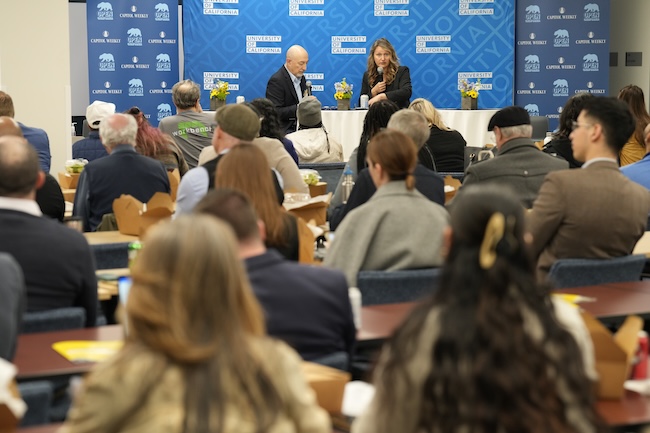
Asm. Buffy Wicks in conversation with Capitol Weekly Editor Rich Ehisen (left) at A Conference on Housing, February 24, 2026. Photo by Joha Harrison, Capitol Weekly
And I was like,” hey, is this going to get used? Like, honestly, tell me,” because we bang our head against the wall here, we take on all these tough fights politically. We make amendments, we make concessions. We get it through the process. We’re dealing with the assembly and the chairs and the, you know, the leadership. And then it goes to the Senate. We do the same thing there. And then we’re engaging with the governor’s office. And we got all the stakeholders and we got all this stuff going on. So we go through that process and then often it just goes out into the wild and nothing changes.
So it’s like, what the hell are we doing here? You know. So I called my favorite Land-Use attorney and I said, are you is this going to work? And he’s like, “Buffy, I’m literally rewriting all of my applications for permits right now to use this.” And I’m like, okay, I’ve got hope and faith that’s going to work.
“I support the Chamber’s ballot measure… you know, we have to build for the modern era, and I think we can do so in a way that still respects our environmental values”
And what I’ve said since then is I’m done with bill signing ceremonies. I want ribbon cuttings because ribbon cuttings means we’re actually moving people into homes. I’m done with all the performative bullshit, you know, like I want actually to solve the problem.
And fortunately, what we’re seeing with AB 130 is we’re seeing it used. That’s the goal. You know, when we put in tracking. Because I also think it’s important. And I think this is a lost art for people like myself, us politicians, we go do all this stuff and then it’s like we’re on to the next shiny object. But it’s like we have to make sure there’s an implementation part of what we’re doing to see if it actually works or not. And so I’ve been laser focused on like, okay, are these projects coming in? Are they getting used? And we’re starting to see the projects use AB 130 for the exemption, which is good.
“As Democrats, we have to have an honest conversation about what we’re doing here and where our values are. And for me, as a Democrat, government has to deliver results. That’s what it means to be a Democrat”
So I’m cautiously optimistic that it’s going to unlock a lot of some of the, you know, challenges that we’ve had and, and create a smoother pathway so that we can get those projects built. The thing we can’t control, obviously, is interest rates. There’s other stuff beyond our control, supply chain issues, other things like that. But from my perspective, where I have any ounce of power or agency where I can make any kind of change to fast track this and make it quicker and faster, that is what we are laser focused on, and I’m cautiously optimistic we’re going to be able to do that with AB 130.
RE: So does the Chamber’s ballot measure help or hinder that? Does it?…
BW: I support the Chamber’s ballot measure. I think it’s the next iteration of this. I think it’s, you know, we have to build for the modern era, and I think we can do so in a way that still respects our environmental values.
But I do think it’s the year 2026. We have, you know, 300,000 people experiencing homelessness. We have, you know, on… beyond housing to climate resiliency projects, getting caught up in in litigation and lawsuits. And we can’t build enough renewable energy projects because of the permitting process.
I mean, when I did those hearings, we were listening to a solar company down in Southern California. It took 12 years and an 11,000 environmental impact. 11,000 page environmental impact review and 72 permits through 28 agencies for one transmission line. You know, and so we say we have these climate goals and yet we make it almost impossible to reach them.
And I just think and I think this as Democrats, we have to have an honest conversation about what we’re doing here and where our values are. And for me, as a Democrat, government has to deliver results. That’s what it means to be a Democrat. You know. And so that’s why I care a lot about this work, because I think when we deliver results for people, you know, it shows that we can actually solve problems. And that’s ultimately what I think government should be doing is solving problems.
RE: Well, then let me drill down very specifically to your Select Committee on Housing Construction, because we talked about that just briefly earlier. What are your expectations for this committee? It’s a new thing. You’ve got some really good people on it. I see you’re getting a lot of participation from a lot of smart people. What’s going to be success for you in this initial year of having this out there? And what do you hope to see come out of this?
RE: It’s a great question. And I will say what I love about the select committees… First of all, the select committees are only as good as the work you put into them. But it’s sort of like a it’s an incubator for ideas. It’s not a standing committee where we’re kind of like funneling. It’s like the bill factory, you know, that’s what the committees churn out all the bills and do all the analysis and make the amendments and stuff.
This is for us as lawmakers to ask fundamental questions and have the convening power to bring in experts from across the board: from industry, from government, from advocacy to say, is this a model we should be embracing or not? And we’ve had failures in this space. Katerra being the most notable one, which was a factory company that I think essentially ended up wasting about $3 billion and sent shockwaves through the industry.
So how can we learn from the Katerras, and how do we build on the successes of the factories that are actually here, that are building to see if we can create a better regulatory environment? So we’ll have a body of about eight or so bills in this space that are looking to actually maximize the benefit of factory built housing.
So looking at some building code reform work, looking at trying to create more of a financial backstop so that so that as developers are building out these projects, it’s a more of a viable option for them. Looking at bringing down the transportation costs. I mean, running a factory is really hard. That’s the one thing, the one thing I’ve definitely learned.
It is very difficult. It’s like a thousand tiny details, all timed at the right time. And what they need is constant demand, constant demand. And so figuring out a way to have that kind of constant demand, because that gives them the economies of scale. if they’re, you know, up and down, fluctuating fits and starts or if they’re having to address really bespoke issues, it gums up the ability of the factory to actually work. And so, for instance, with, you know, permitting that takes forever. It makes it hard for factories to run in a more streamlined way.
So there’s things like that, that how can we make sure that we actually can realize the benefits of the factory, again, with the goal of bringing down the cost of housing?
RE: You know, I think one of the other issues that’s starting to gain a lot of traction and a lot of talk around California and beyond, is the corporations buying up a lot of the available housing stock, whether it’s the turn it into short term rentals or whatever their goals are, it’s making it difficult for people to actually buy their own homes. There has been talk about legislation. Even our governor has talked about the need to do something about this. So the question is, what do you do? Is it viable to have legislation that blocks corporations from buying large blocks of housing? Is that is that a legal issue that we’re going to just create a bigger problem? I mean, what’s your thought on that?
BW: Yeah. So I do think your average working class family is at a competitive disadvantage. And often competing with bigger forces that make it very difficult to buy. One, we need more production so that there’s more supply, but in addition, on this specific issue, what I would love to see is data around this. And is there a transparency law that we can put in place so we have a better understanding of what the actual problem is, so that we can then figure out what the right solution is.
“You are going to piss off your friends. You are going to piss off your enemies all the time. That’s the job.”
I mean, I carried a bill. Gosh, I’m like the old lady in the legislature now… this must have been in like 2019, 2020. Just a rental registry to understand, just like basic data around the rental market, you know, and I couldn’t I tried for three years. I couldn’t even get it out of my own housing committee. So I think transparency and sunlight around ownership is actually really important. Transparency and data around eviction rates and other trends. When we have daylight on all these issues, we can then figure out what the potential policy solutions are in a much more, I think, effective and data driven way.
RE: I don’t want to put you too much on the spot. I’m not asking you to pick a favorite here.
BW: I’m literally on the spot. So now’s the time!
RE: This governor, our current governor, Gavin Newsom, has, you know, made housing a big part of his agenda. Obviously, you know, we’re in an election year. What, given the opportunity, would you tell the millions of people running for California governor right now when it comes to housing, what would you… they were going to sit down and say, “Assemblymember, give us your top priority.” What would you what’s your words of wisdom for all of the people running for governor right now, regardless of party?
BW: Yes. Well, one, I will say Gavin Newsom has been a champion on housing, and he’s been a real partner of mine, and provided a real backstop on a lot of these really tough issues. And it’s been a real joy working with him in that space. And so I will miss the opportunity to work with him in housing here in California.
And having said that, I have sat down with a lot of them actually, with this exact question coming at me from them saying, okay, what do you think we should do? How should we handle this? You know.
And I think there’s this and I don’t want to single out anyone in particular. There’s a, I think a sense and I think this is a political calculation from a lot of their parts to say Sacramento is broken and they aren’t doing anything. I’m going to come in and fix it all. And I get it like I’m a politician. I’ve been a candidate, like, totally get it right.
And also, I think there’s a lot of us here trying to actually fix the problem. And by the way, they’re going to have to work with us. So… but most I mean, all the, all the candidates I’ve spoken to have genuinely come to me saying, what can I learn? Can we partner can you help me think this through? And I think that’s a that’s great. And again I’m one of 120. So I’m not the only one here. There’s other people with other opinions and ideas.
But just the, the overture of like how do we work together to fix this problem I think is the right approach. And what I’ve said to all of them is, listen, like when you’re governor you’re on the hot seat every single day and you have to be very comfortable being always uncomfortable. The job in and of itself is uncomfortable.
You are going to piss off your friends. You are going to piss off your enemies all the time. That’s the job. And you have to have the spine to live in that space comfortably and to call the shots and to be the adult in the room, because I’ve seen how legislation and ideas move through the legislature with the idea of like, oh, well, the governor will just veto it, it’ll be fine, you know, like or whatever, you know, or the uncertainty that some lawmakers, others face when they know that there’s an obvious problem here, there’s an obvious solution, but it’s too hard politically to do.
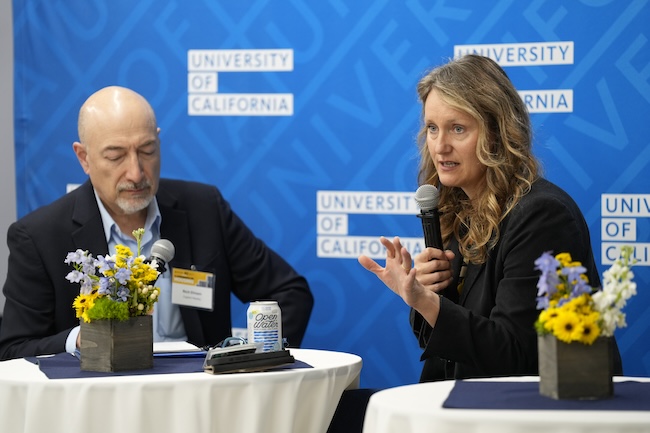
Asm. Buffy Wicks in conversation with Capitol Weekly Editor Rich Ehisen (left) at A Conference on Housing, February 24, 2026. Photo by Joha Harrison, Capitol Weekly
So I think just having that, that backbone, that strength is going to be really, really important. Having honesty and integrity with the public about that is absolutely important. And so I think those attributes are very critical. And that’s what I’m looking for in a governor. I don’t actually need to agree with them on 100% of the things. I don’t agree with anyone. I don’t agree with my husband on 100% of the things. Right? But I want to know their core values are there and that they have the strength to be able to deliver on those tough things.
In terms of the policy itself, though you know, we’ve done a lot of headway. There’s more work to be done. I think we need to, like, stay the course on continuing to do a lot of the streamlining and fast tracking and moving, which means sometimes you’re coming up against the cities, sometimes you’re coming up against the environmental groups, sometimes you’re coming up against labor. All these like really important constituencies of for Democrats. like you live in that land all the time. That’s the space I live in all the time, you know.
So we have to be comfortable doing that and building the right kind of coalition politically to be able to move that stuff through through the legislature and on to the governor’s desk.
“I think we fundamentally need 2.5 million homes, and we need all the above. We need the low income subsidized. We need the missing middle, the market rate. We need multifamily. We need single family. We need workforce housing. We need an all of the above strategy”
So and then plus then the public subsidy, I think the public subsidy is critical. And in the end of the day, from my perspective, like, again, I have the scars to prove a lot of this and have lived through this. For me. It’s like I am focused on how are we getting our working class families into the homes they deserve? And that has to be, from my perspective, the driving force of what our next governor does, which means sometimes taking on the sacred cows, sometimes having the tough conversations and taking the swings to get those victories.
RE: We’re going to open up to questions here. But I have one last thing. Is this a solvable problem in your eyes?
BW: Yes 1,000%.
RE: Okay. I knew you were going to say that, but I figured I’ll.
BW: Go get a new job if I don’t think so.
RE: Absolutely. Okay. Yes. And I’m going to. I’m going to channel my inner Liam [Dillon] and say, please, no, no pontificating if you have a question. Really trying to be respectful of her time here because she’s got to run off. So if we have a question, now’s the time. My colleague Tim is out there with a with a microphone. He will, he will. Oh, I always like when the first questions from a reporter. Thank you. Antonio.
ANTONIO HARVEY: Excuse me, but I always like to have these conversations with Assemblymember Wicks because housing is a critical need in this state… and where I’m going with this to and, and you just mentioned, you know, for the Black community and low income what are some of those barriers in this state? Because right now we’re seeing, like, an exodus.
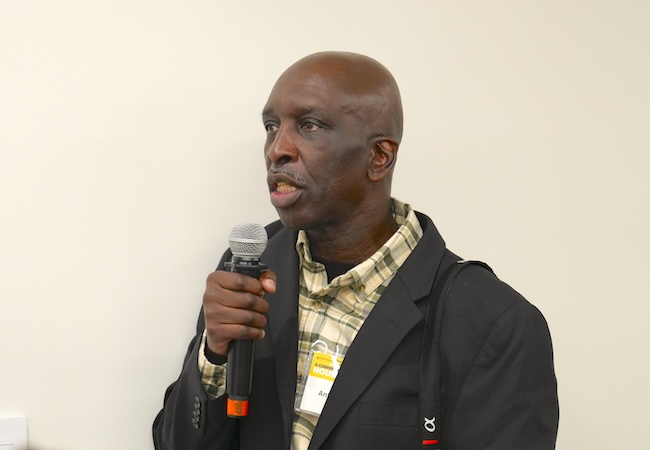
Antonio Harvey asks a question of Asm. Buffy Wicks at A Conference on Housing, February 24, 2026. Photo by Joha Harrison, Capitol Weekly
You know the population was up around 2.6, 2.5 million, but a lot of people are leaving because the housing prices are too high. And then, you know, they have to pay for gas, for transportation. And that’s another issue too. I’m sure Assemblymember Jeff Gonzalez might bring that up. What are some of the barriers and solutions to, you know, help people to get into housing? As you said, there’s 2.5 million less housing. How can they be a percentage of that going forward Assemblymember Wicks?
BW: It’s a great question, and I don’t think there’s one silver bullet here. I think it’s a lot of different things.
One, I think we fundamentally need 2.5 million homes, and we need all the above. We need the low income subsidized. We need the missing middle, the market rate. We need multifamily. We need single family. We need workforce housing. We need an all of the above strategy. We need to be creative around how we do that. I did a bill last year to make it easier for school districts to build housing on their campuses, for example.
I mean, you look at Oakland, there’s so few black teachers in Oakland serving a diverse body, in part because of the housing crisis. We can’t keep teachers because of the housing crisis, you know. So I think it’s an all of the above strategy that we have to really embrace. And that is often politically fraught because you have a lot of special interest groups who like it exactly the way it is because it benefits them.
And so how do we move those big policies through building a political effort to move those through is like really, really, really critical. And it requires leadership. I will say, I think the Speaker has done a great job of providing a backstop and being a leader on these issues. The governor has done a great job on that. I am very excited about Monique Limon as our new pro Tem. I think you have leadership across the board, in the legislature and with the governor right now that are that really want to solve this problem, and it’s my hope that our next governor will join them. And what I’ve seen preliminary from the gubernatorial candidates is there is a willingness, I think, to really take on these intractable issues.
RE: And do I see any other hands out here? Tim is rushing to you. I saw a hand.
BW: He went a long way back there, I see. Okay.
AUDIENCE MEMBER: I’m glad. Finally I heard about that issue of corporates owning homes. But also there is another issue where we seem to need to focus on and where our state leadership and probably the national leadership agree, that is to close the tax loopholes for corporations who are buying these homes. And so if it is a problem that is already recognized at state level and national level, why that is not a priority.
BW: It’s a good question. I mean, I think we actually needed an overhaul of all of our taxes and tax reform writ large. We have such a cyclical budget in California, and it’s like feast or famine here. And I think the original sin there is Prop. 13, you know, and it’s a very difficult political issue to fix. We have to go back to the ballot for any Prop. 13 reforms, which will be incredibly difficult because in the end of the day, people don’t want to vote for something where they think their property taxes are going to go up.
And that’s just kind of the fundamental, basic truth about that problem. And so figuring out how we tackle that, I think is key. But I do think there needs to be a broader conversation around tax reform in California.
RE: Well, I mean, with Prop. 13, I mean, the whole property tax thing, I mean, it is a feels like an insurmountable thing because if property taxes go up, then people might not be able to stay in their homes, which is the exact opposite of what you’re trying to do with this.
BW: It’s a hard one.
AUDIENCE MEMBER: Thank you so much. Assemblymember Wicks. There’s another shiny object in your Sweden story that I’m curious about, which is publicly owned housing. And I’m wondering about the extent to which we might it might be on the table to reduce legislative barriers that have so far prohibited that in California, and about reintroducing the idea of locally owned or state owned properties.
BW: Yeah. Social housing, otherwise known as social housing. And I actually had chaired a select committee on social housing in previous iterations. And so and there’s other models in Europe that have explored this very, very successfully. I know Assemblymember Lee has done really good work in this space as well as Senator Wahab. And there’s a study coming out that was that was a study built to look at the viability of, of social housing and how that could actually be a part of the solution.
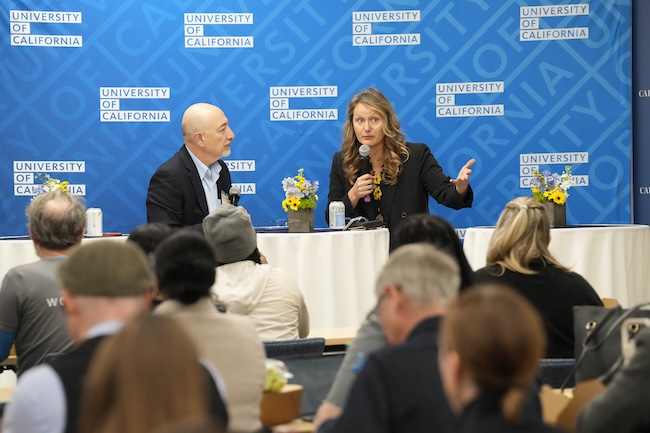
Asm. Buffy Wicks in conversation with Capitol Weekly Editor Rich Ehisen (left) at A Conference on Housing, February 24, 2026. Photo by Joha Harrison, Capitol Weekly
And again, I’m a yes and all of the above. And if there’s ways that we can, you know, incorporate social housing, I’m fully supportive if there’s, you know, models of like community land trusts, those are also interesting models. Like we have to put all the ideas on the table. None of us have a monopoly on smart ideas. And so all of those ideas, I think, need to be considered and should absolutely be elevated through the legislative process to see if they’re viable. And I’m eager to hear and learn more about the study when it comes out.
RE: I think we have time for one more right here.
AUDIENCE MEMBER: Are you finding AI a real help in the last six months? I mean, we have we my son said, mom, look what I did. In three minutes. He developed an electrical system for a six unit apartment building. Got it approved the next day, and then designed a 23 unit apartment complex in six hours.
BW: Yeah, I think there’s exciting promise. And also maybe some snake oil situation going on and probably both, you know, as we as we figure this out. But again, creative ideas love them.
I’ve heard about some companies that are like navigating the permitting process very quickly, some AI programs that are navigating the permitting process, if that helps us navigate permitting, by all means, let’s embrace it.
I’ve also seen some of the examples that you’re talking about. I’ve also seen architects and engineers like poke some holes in some of that stuff because, you know, maybe it’s not as good as we thought, but obviously human review of all of that is going to be critical. So again, I, I embrace all of those things. If it helps us, again, with the goal of bringing down the cost of housing than we should be looking at it, embracing it, and wrapping our arms around it.
RE: All right. Well, with that, I promised we would try to keep you on time. So we’re going to we’re going to wrap this up and let you go. Assemblymember Buffy Wicks, thank you so very much.
Thanks to the Sponsors of A Conference on Housing:
THE CALIFORNIA BUILDING INDUSTRY ASSOCIATION, THE TRIBAL ALLIANCE OF SOVEREIGN INDIAN NATIONS, WESTERN STATES PETROLEUM ASSOCIATION, KP PUBLIC AFFAIRS, PERRY COMMUNICATIONS GROUP, CAPITOL ADVOCACY, THE WEIDEMAN GROUP, CALKIN PUBLIC AFFAIRS, STUTZMAN PUBLIC AFFAIRS, RANDLE COMMUNICATIONS and CALIFORNIA PROFESSIONAL FIREFIGHTERS
Want to see more stories like this? Sign up for The Roundup, the free daily newsletter about California politics from the editors of Capitol Weekly. Stay up to date on the news you need to know.
Sign up below, then look for a confirmation email in your inbox.
Leave a Reply