
News
Optimism and skepticism at Capitol Weekly’s housing conference
 Capitol Weekly Editor Rich Ehisen interviews Asm. Buffy Wicks at a Conference on Housing, Feb. 24, 2026 in Sacramento. Photo by Joha Harrison
Panelists grappled with California’s housing crisis Tuesday at Capitol Weekly’s first conference of 2026, painting a discouraging picture of the current state of affairs in the Golden State.
“We’re hurting in California when it comes to the housing market,” said Assemblymember Jeff Gonzalez (R-Indio), one of the conference panelists. “But do I think we (legislators) have reached the tipping point? Nope.”
Panels explored permitting reform, the impact of environmental concerns and new ideas for addressing affordability, punctuated by a keynote address from Assemblymember Buffy Wicks (D-Oakland), who acknowledged the loads of work that still needs to be done but also sounded an optimistic note that things could improve in California.
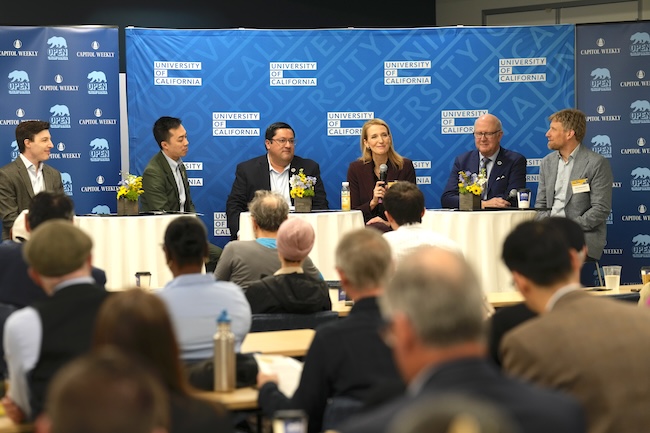
L-R: Liam Dillon, Politico; Asm. Alex Lee; Sen. Jesse Arreguín; Jennifer Barrera, California Chamber of Commerce; Dan Dunmoyer, California Building Industry Association; Chris Elmendorf, UC Davis School of Law. Panel 2 at A Conference on Housing, Feb. 24, 2026 in Sacramento. Photo by Joha Harrison
Panel 1: Reforms: Permits, Building Code, CEQA
The first panel of the day brought together a pair of legislators (Bay Area Democrats Sen. Jesse Arreguin and Assemblymember Alex Lee), leaders of two of the state’s most influential special interest groups (Jennifer Barrera of the California Chamber of Commerce and Dan Dunmoyer of the California Building Industry Association) and UC Davis law professor (Christopher Elmendorf) to discuss ideas for making it easier to build housing and impediments getting in the way.
California faces a sizable housing shortfall, with the state lacking 840,000 units according to 2024 estimate by the housing organization Up For Growth. [That shortfall figure is not widely accepted, with many housing advocates placing the number at 2-3.5 million). At the same time, only 16% of California can afford homes at the state’s median home price.
Panelists hit on many of the usual talking points: the need for CEQA reform and incentivizing housing affordability and access and the thorny challenges of regulatory restrictions.
But Elmendorf suggested the problem may be more systemic, citing what he called an unfortunate “deep ambivalence” in the Legislature to prioritize actually building new housing. He said that regulation still saddles builders with high costs and constricts all aspects of housing,
Dunmoyer, however, said he’s optimistic that budget bills signed by Gov. Gavin Newsom last year to temporarily freeze local and state residential building standards will save builders up to “a billion dollars.” He also said the six-year pause will give builders the time to adapt to regulations.
Panelists also discussed the potential help offered by accessory dwelling units (ADUs), which are self-contained residential structures erected on single-family lots with existing structures. But Elmendorf warned that a lack of labor standards and a ministerial approval process “without any kind of discretionary condition of approval” could prevent them from reaching their full potential as a solution.
Lee promoted the value of single-staircase, multi-family buildings to create more housing within a smaller footprint than multiple-staircase designs. But he also noted that a potentially valuable study expected at the first year on single-staircase designs has yet to be produced by the state fire marshal.
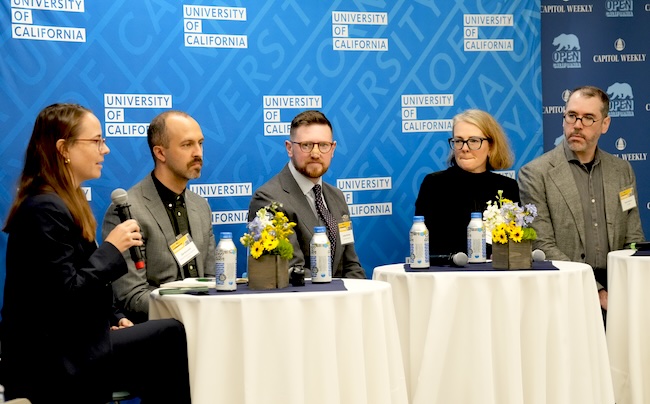
L-R: Camille von Kaenel, Politico; Zak Accuardi, Natural Resources Defense Council; Jordan Grimes, Greenbelt Alliance; Moira O’Neill, UCSF School of Law; Brian Hanlon, CAYIMBY. Panel 2 at A Conference on Housing, Feb. 24, 2026 in Sacramento. Photo by Joha Harrison
Panel 2: Intersection of Climate and Housing Policies
The second panel of the day was moderated by Politico environmental reporter Camille von Kaenel and featured Moira O’Neill, a public law and urban planning scholar at UC Law San Francisco; Jordan Grimes, Legislative Director with Greenbelt Alliance; Brian Hanlon, President and CEO of California YIMBY; Zak Accuardi, Director of Mobility Choices, Climate & Energy at NRDC.
Infill housing was one of the focal points in this discussion. A few panelists argued that the way the current system is designed creates obstacles for building infill housing. Accuardi said infill housing hasn’t been a priority for environmentalists overall in California, even though some environmental groups are big supporters.
O’Neill argued that while policies supporting options like infill housing seem impressive at first, they may not perform as well when they get implemented. Indeed, she said policies encouraging infill housing sometimes negatively affect some communities more than others.
Panelists also discussed the struggle environmental groups face in protecting communities’ rights while also preserving affordable housing. Accuardi said often these groups clash on their approach, leading many of them to take a step back from housing issues. Grimes agreed that environmental groups often lack cohesion.
“A lot of these organizations opportunistically use the language of environmental justice in order to achieve their other larger ideological and factional goals,” Hanlon said.
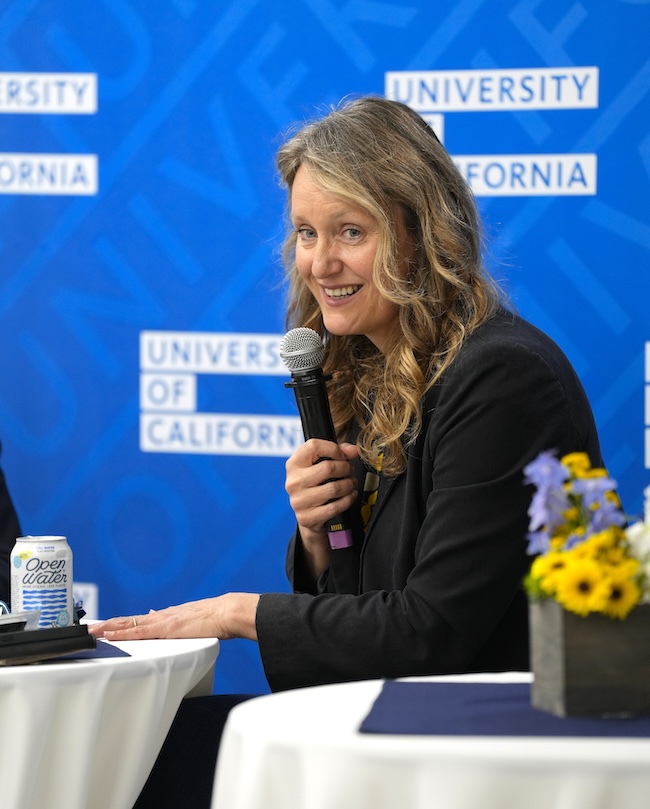
The Keynote from Asm. Buffy Wicks at A Conference on Housing, Feb. 24, 2026 in Sacramento. Photo by Joha Harrison
Keynote Address
Wicks, the four-term assemblymember who chairs the Assembly Appropriations Committee, opened her lunch-time remarks by reflecting on her upbringing in a mobile home in Foresthill and how that experience shaped her policy priorities.
“I realized that that housing security in that manufactured house gave me the ability to focus on self-realization and all of the things that led me to be where I am today,” she said.
That stability is not available to many Californians, she noted, a reality that has made housing the defining issue she has focused on since joining the Legislature.
Wicks said California is short roughly 2.5 million homes overall, including about 1 million units needed for the state’s lowest-income residents. The lack of housing, she argued, spills into almost every other major challenge facing the state.
Wicks highlighted last year’s major CEQA reform, which exempts certain infill housing projects from environmental review, calling it one of the biggest achievements of her tenure. But she stressed that legislation alone doesn’t solve the crisis.
“I’m done with bill-signing ceremonies,” she said. “I want ribbon cuttings, because ribbon cuttings mean we’re actually moving people into homes. I’m done with all the performative bullshit.”
Wicks also addressed environmental review laws more broadly, arguing that California must modernize its permitting system while still upholding its environmental values. She pointed to delays not only in housing projects but also in renewable energy and climate resiliency efforts.
She expressed support for a Chamber-backed ballot measure to streamline the state’s environmental review process and set clearer timelines for project approvals.
“I’m done with bill-signing ceremonies….I want ribbon cuttings, because ribbon cuttings mean we’re actually moving people into homes. I’m done with all the performative bullshit.”
“Government has to deliver results,” she said.
When asked for advice to the field of candidates running for governor, Wicks said the next administration will need political toughness to continue tackling housing reform.
“You have to be very comfortable being always uncomfortable,” she said.
Wicks said the next governor must be prepared to anger allies and opponents alike in order to move difficult but necessary housing policies forward.
This year, the assemblymember said her focus is on lowering construction costs. Through her Select Committee on Housing Construction Innovation, she is looking at factory-built housing and other ideas to make projects cheaper and faster.
“The goal is to bring down the cost of housing,” she said.
Asked whether she believed the housing crisis can actually be solved, Wicks didn’t hesitate: “1,000 percent.”
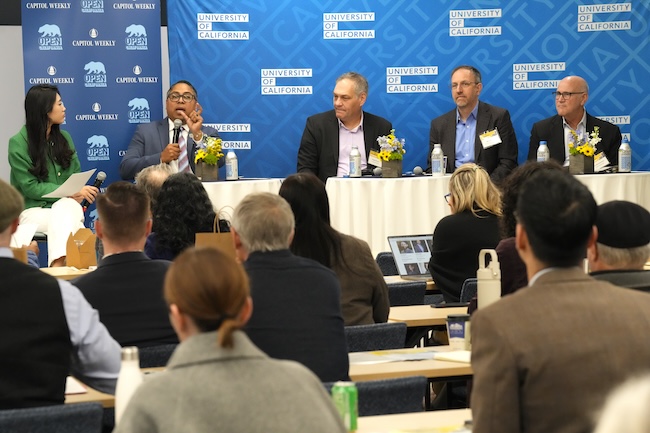
L-R: Jenny Huh, ABC10; Asm. Jeff Gonzalez; Roger Krulak, Fullstack Modular; Ben Metcalf, Terner Center for Housing Innovation; Jim Wunderman, California Forever. Panel 3 at A Conference on Housing, Feb. 24, 2026 in Sacramento. Photo by Joha Harrison
Panel 3: Innovations and New Ideas
Don’t expect legislators to tackle housing code reform, at least in 2026, Gonzalez, the Indio Republican, said.
The assemblymember offered that assessment during the conference’s third panel, moderated by Jenny Huh of ABC10. In conversation with them were Ben Metcalf, managing director of the Terner Center for Housing Innovation; Roger Krulak, founder of the Fullstack Modular company; and Jim Wunderman, head of public affairs at California Forever.
Gonzalez criticized the Legislature for failing to take action on housing code reform — spanning construction, planning and building — to eliminate obstacles for modular housing.
Capitol Weekly Editor Rich Ehisen asked the panelists how realistic it would be for legislators to take an interest in housing codes, noting that centralized control of local rules would overhaul development in California. Some panelists argued in favor of state involvement, saying that if local jurisdictions coordinated predictable codes, demand would increase and costs decrease.
Metcalf, of the Terner Center, said the lack of data on construction costs keeps the state “flying blind,” minimizing lawmaker enthusiasm for modular housing. He said that even when builders shave off six months on a timeline, he’s surprised by how few financial savings exist when developing factory-built homes.
Wunderman, of California Forever, pointed to Proposition 13 as to why housing development slowed down in the ’80s. The proposition slashed the general tax rate to 1%, eliminating local government revenue from investments on developments. It remains popular among most Californians, according to a 2018 report by the Public Policy Institute of California.
“Cities should be the biggest advocates for building housing,” Wunderman said, “not fighting it.”
Capitol Weekly staff reporters Brian Joseph and Leah O’Tarrow and interns Aidan Wyrough, Jasleen Kaur and Chris Ramirez contributed to this report.
The next round of Capitol Weekly internships will begin in June 2026. If you or someone you know is interested in an internship, please submit two writing samples, your resume and a cover letter to [email protected] by April 17, 2026.
Click here for a Capitol Weekly Internship FAQ
Want to see more stories like this? Sign up for The Roundup, the free daily newsletter about California politics from the editors of Capitol Weekly. Stay up to date on the news you need to know.
Sign up below, then look for a confirmation email in your inbox.
It’s too bad the conference presenters seemed to be unaware of the infill housing opportunities presented by urbanized, unincorporated communities – home to 5-6M Californians who do not have Mayors and City Councils, but must instead rely on county Boards of Supervisors to make local land use and economic development decisions. County Supes tend to outsource development decisions to developers, who make short-term profits and then go away (to the next sprawl opportunity). After the developers leave, County Supes also move on (to the next sprawl opportunity), leaving aging – often close-in – suburbs in their wake. If those decaying urbanized places were incorporated municipalities, their city Mothers and Fathers would probably be striving every day to make their city better, not worse. Yes, being a city does not mean everything is hunky-dory – think LA, Stockton, Fresno, Commerce or Bell. But among the states 483 cities are plenty of success stories. For example, Truckee has invested in workforce housing. Right next door in unincorporated, urbanized Northshore, the housing story is all about short-term rentals and luxury condos; workers are priced out. Unfortunately, the Legislature, the Media, and public dialogue only distinguish between cities (urban) and counties (rural – cows and trees), which steers the housing conversations into “good” sprawl vs. “bad” sprawl. So if you want infill housing, why not start by asking if local people who yearn to improve their urbanized, unincorporated communities could do a better job than the County Supervisors who abandoned them? State policy, being protective of the existing power base in a region, actually works to defeat municipal formation initiatives. There is not, but there should be, a viable pathway whereby new cities can be formed and empowered to help with housing and community development. California (un)Incorporated (www.caunincorporated.com) has more information.