
Opinion
A safety net gap: income support for undocumented farmworkers
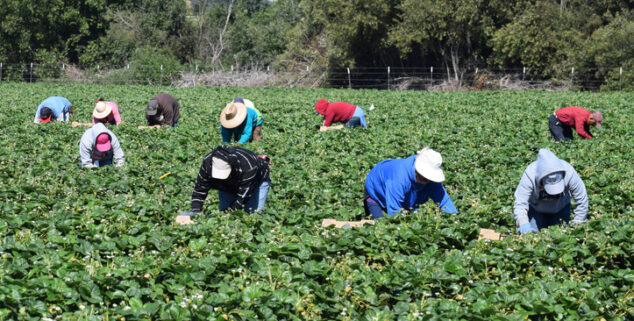 Salinas, California, USA - June 19, 2015: Seasonal farm workers pick and package strawberries.
Capitol Weekly welcomes Opinions on California public policy or politics. Please read our guidelines for opinion pieces before submitting an Op-Ed. Submissions that do not adhere to our guidelines will not be considered for publication.
OPINION—“To be honest, it is very hard to stop working even if we are in danger because of wildfires, or smoke, or bad air quality. We still have to work. We do not have any other form of income.”
This quote from a farmworker recounting their experience during a wildfire in Sonoma County underscores the growing tension many farmworkers across California face—work in hazardous conditions during climate disasters or struggle to pay for basic needs such as housing and groceries. This impossible choice is already routine for many of California’s farmworkers— and as climate disasters become more frequent, state policy has yet to catch up.
Rising temperatures, wildfires, floods and other climate disasters are making outdoor labor increasingly dangerous across California. Yet for the workers who feed us, staying home during hazardous conditions isn’t an option. Most farmworkers lack access to any form of income replacement if they can’t work.
Combined with dire climate projections, new research from our community partnership underscores the need for California to provide unemployment insurance for undocumented workers. In our survey of more than 1,000 farmworkers, nearly all said they would be unable to pay rent if they lost work due to a wildfire. Ninety-seven percent said they would be very worried about lost income. Even when they faced serious health risks, workers described feeling they had no choice but to continue working.
This is not just a labor issue—it is a policy gap.
California has the largest agriculture workforce in the country, with an estimated 850,000 annual workers who grow and harvest the food that feeds all of us. However, most of this workforce is undocumented—meaning that the very workers who power California’s $61.2 billion agricultural economy are not eligible for income replacement when climate change makes it too dangerous to work. Notably, undocumented workers contribute an estimated $485 million to the state’s Unemployment Insurance System each year, yet they are excluded from accessing any of the benefits.
As climate change drives more frequent and severe disasters, this exclusion is increasingly impacting farmworkers’ wellbeing. Heat waves, wildfire smoke, and flooding are not only endangering workers’ health directly—they are also disrupting work itself. Most farmworkers in California are paid “piece rate,” meaning their pay is based on the quantity of crop they harvest. This both incentivizes farmworkers to continue laboring through dangerous conditions and leaves undocumented workers with virtually no resources to make ends meet when they can’t work.
California lawmakers have already recognized this gap. In recent years, the Legislature passed bills to establish an Excluded Workers Pilot Program that would have provided temporary income support to undocumented workers during periods of unemployment. Both measures were ultimately vetoed by Governor Gavin Newsom, citing economic concerns.
But the underlying problem has not gone away—if anything, it has intensified under the Trump administration.
Other states are beginning to chart a path forward. Colorado has established a Benefit Recovery Fund that offers income support to workers excluded from traditional unemployment insurance, offering a potential pathway for California to follow. U.S. Senator Alex Padilla (D-Calif.) and colleagues have also laid out a blueprint in their Disaster Relief for Farm Workers Act, in which grants would be provided to farmworker-facing organizations to distribute emergency relief to workers affected by a disaster.
California should pass comprehensive unemployment insurance for all workers, regardless of documentation status. Such a program would not only protect workers—it would stabilize the agricultural sector more broadly. California has long positioned itself as a leader on climate policy and protections for workers and immigrants but has designed a safety net system that excludes the very workers most impacted by climate change. When farmworkers are forced to choose between their health and their income, the consequences ripple outward, affecting their families, community health, and local economies.
Undocumented farmworkers are the backbone of California’s economy and make our state’s agricultural industry one of the most profitable in the world. Despite contributing nearly half a billion dollars to our unemployment insurance system each year, undocumented workers are systematically excluded from accessing unemployment benefits, forcing them to choose between sacrificing their health or paying for rent and groceries.
California has a responsibility to address the threats climate change poses to farmworkers’ health and economic security—starting by expanding unemployment insurance for all workers.
Carly Hyland is an assistant professor in the School of Public Health, Division of Environmental Health Sciences at UC Berkeley. Zeke Guzman is a farmworker advocate in Sonoma County.
Want to see more stories like this? Sign up for The Roundup, the free daily newsletter about California politics from the editors of Capitol Weekly. Stay up to date on the news you need to know.
Sign up below, then look for a confirmation email in your inbox.
Leave a Reply