
News
Will prediction markets spark new war with casino tribes?
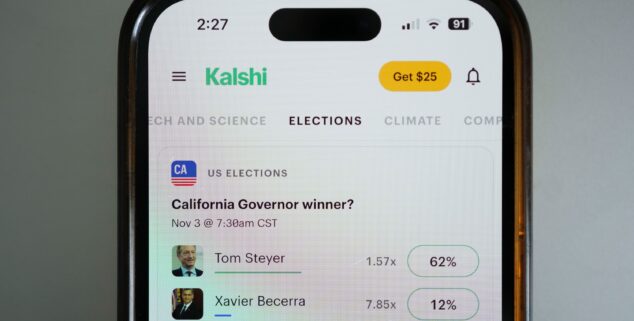 Photo by AP.
 After the 2022 election, the state of play on sports gaming seemed abundantly clear in California.
Following that bruising and historically expensive campaign, virtually everyone in politics agreed the state’s gaming tribes had thoroughly bested a coalition of sports betting operators led by DraftKings and FanDuel, even though neither side’s initiative actually won on election day.
So much has changed since then that you may need a refresher. The tribes and operators ran dueling measures on the Nov. 8 ballot, each seeking to get their plan to legalize sports betting in the Golden State approved by voters.
Proposition 26, supported by the tribes, would have legalized in-person sports betting at tribal casinos and horse racing tracks. Prop. 27, backed by the operators, would have legalized online sprots betting.
The sides battled it out down to the wire, raising and spending so much money that the fight became the most expensive ballot campaign in U.S. history. The operators fought with passion, seeing riches in California’s enormous, untapped gaming market. The tribes fought with desperation, feeling as though their survival was at stake.
But unlike the operators, the tribes didn’t have to actually see their initiative pass in order to win. They could win as long as they maintained their stranglehold on the gaming market in California.
And that’s exactly what happened. Both initiatives failed, but common wisdom said that by protecting their turf the tribes had shown that any effort to legalize sports betting in California would have to come through them.
In the months and years that followed, the tribes gloated over the operators, who came hat in hand to tribal gaming conferences in Southern California, where they said over and over again that tribes would decide when sports betting would become legal here.
In fact, as late as April 2025, the leaders of DraftKings and FanDuel effectively bent the knee to gaming tribes, appearing on stage with one of the tribe’s most outspoken advocates and declaring that sports betting wouldn’t happen in California without the tribes’ cooperation.
Oh, how the sands have shifted since then.
A new model emerges
What the tribes and operators didn’t count on was the rise of prediction markets, which have upended the sports gaming sector in America.
Prediction markets like Kalshi and Polymarket, which have become fixtures in the news media, manage trading platforms where customers can buy and sell predictions on future events, such as who will win the next presidential election or what the high will be in Los Angeles.
Multiple states have filed enforcement actions or lawsuits against prediction markets, arguing that the platforms are illegal, unlicensed gambling operations, with their sports contracts playing a starring role in the proceedings. The CFTC has fought back, arguing that the states cannot outlaw or override federal derivatives regulation.
They also offer contracts on sporting events.
But unlike traditional sports wagering, which is regulated at the state level, prediction markets are regulated at the federal level, by the Commodity Futures Trading Commission or CFTC. Their national regulation means prediction markets may operate everywhere in the United States now — including in states where sportsbooks aren’t legal.
This has afforded the sports betting operators another chance to enter California without tribal cooperation.
Both DraftKings and FanDuel rolled out their own prediction markets in late 2025. Through those platforms, the sports gaming operators are now offering what some would call a version of sports betting in California — although both companies are careful about the words they use to describe their products.
On the DraftKings website, the company advertises in a banner headline, “DRAFTKINGS IS AVAILABLE NATIONWIDE FOR SPORTS”. Scroll down and it says, “DraftKings brings your favorite ways to engage with sports together in one app. With access to Sportsbook, Predictions, and free-to-play sports contests — where available based on your location — you can make your picks, follow live matchups and back your team with ease.”
Below that DraftKings says where it offers sports betting and where it offers prediction markets. California only appears under prediction markets.
On the FanDuel site, the company says “FanDuel is live in California,” but avoids the phrase “sports betting” or “sports gaming.” It refers to the action as making a “trade,” which is consistent with language often used with prediction markets.
‘Down like a piñata’
Multiple states have filed enforcement actions or lawsuits against prediction markets, arguing that the platforms are illegal, unlicensed gambling operations, with their sports contracts playing a starring role in the proceedings. The CFTC has fought back, arguing that the states cannot outlaw or override federal derivatives regulation.
The legality of prediction markets, and prediction market wagering on sports, is an issue that likely will be settled in the courts at a date to be determined. In the meantime, DraftKings and FanDuel have an open lane to offer their prediction market products in California, giving them access to a lucrative market they’ve lusted over for years.
They may be playing with fire, however. California tribes, like many prediction market critics, see the platforms as sportsbooks by another name. They consider the presence of prediction markets in California as a threat to their gaming operations.
Both DraftKings and FanDuel rolled out their own prediction markets in late 2025. Through those platforms, the sports gaming operators are now offering what some would call a version of sports betting in California — although both companies are careful about the words they use to describe their products.
Tribes want prediction markets out of the Golden State — and they’re particularly incensed that DraftKings and FanDuel jumped on the prediction market bandwagon and came to California.
“DraftKings is fucked,” prominent tribal member Victor Rocha recently told Gaming America in September.
Rocha is the conference chairman of the Indian Gaming Association, a member of the Pechanga Band of Indians in Riverside and founded the tribal politics and gaming news site Pechanga.net. In the press, he is often seen as an “attack dog” for tribal interests.
That said, he doesn’t claim to speak for all California tribes, which are not a monolith. In fact, three California tribes recently negotiated partnerships with Kalshi, including a tribe with traditional albeit limited gaming interests, the Alturas Indian Rancheria in Modoc County.
But he is adamant that there will be significant pushback by gaming tribes against both the sports wagering and prediction markets.
“Once prediction markets lose sports betting, DraftKings has to come down like a piñata, and we’ll be waiting with baseball bats,” Rocha told Gaming America. “A lot of companies will lose big after we neuter Kalshi.”
Rocha also recently told the New York Post that Kalshi’s CEO Tarek Mansour once asked him to join the company as an advisor, but he rejected the idea, feeling like it was an attempt to make him the token “cigar store Indian” who Kalshi could say, “Hey, look, we have an Indiana on our side.”
Six months later
Rocha recently met with Capitol Weekly at the Global Gaming Expo, otherwise known as G2E, the largest gaming trade show in the world, held annually every fall in Las Vegas.
There, he explained that the tribes changed strategies during the 2022 election, abandoning any pretense of trying to get their initiative passed and instead focusing on seeing “how much pain we can inflict on these guys,” meaning DraftKings and FanDuel.
After that election, Rocha said the tribes were always wary of the sportsbooks, even as they proclaimed that the tribes held all the keys to California’s lucrative sports betting market.
“There was always this fakeness with them, where they’re putting out a hand like we’re going to be their friends,” he said, “and we never trusted them.”
The prediction market explosion of the second half of 2025 revealed DraftKings and FanDuel’s true colors, he said.
At G2E last year, Rocha said he and several other tribal leaders met with DraftKings CEO Jason Robins. This was just six months after Robins had appeared on stage with Rocha in San Diego at the Indian Gaming Association conference and promised DraftKings would work with the tribes. But things were now dramatically different for the sportsbook.
“There was always this fakeness with them, where they’re putting out a hand like we’re going to be their friends….and we never trusted them.”
DraftKings’ stock plummeted in September right when the fortunes of prediction markets rose.
“DraftKings is no longer the hot product, the new thing,” Rocha said of that moment. “The bloom is off the rose. The shine is gone. They’re not Gen Z, they’re Boomers now.”
In the meeting, Rocha said Robins told the gathered tribal leaders, “We’re really sorry, the shareholders are demanding that we go into prediction markets. We apologize.”
Rocha described Robins’ words as betrayal. He said he told Robins in that meeting that a friend of his had been asked if the tribes were willing to spend $100 million annually to keep sports betting out of California. Rocha told Robins his friend had said yes, but it wouldn’t cost that much the next time the tribes needed to do it.
“You could just see the blood draining out of Jason’s face,” Rocha said, “which was my way of telling him to go screw himself. The fight’s gonna come.”
2028 looms
Today, Rocha said the tribes in California want nothing to do with DraftKings and FanDuel — and they’re gearing up to punish them for their duplicity.
He said the tribes are preparing an initiative for the 2028 ballot to legalize sports betting, and it will include language that says if a sportsbook worked with a prediction market, it won’t be permitted to come to California.
“We’re going to cut their balls off,” he said.
Rocha said the political winds will be at the tribes’ back in two years, setting them up for victory.
“This is the thing we’ve been waiting for,” he said. “2028, presidential election. Kalshi and those guys have gone MAGA. They’ve tied their boat to MAGA. We’ll see what happens after the midterm elections.”
Rocha said sports betting operators currently partnering with California tribes — Caesars, Boyd and Hard Rock — will emerge as winners under the tribes’ new world order. Hard Rock is owned by the Seminole Tribe of Florida, one of the most successful gaming tribes in America.
“The one thing that people don’t realize, and I think is important about the tribes, is they demonstrate what happens when you take care of your people and you take care of your elders and you take care of your families,” Rocha said. “In a weird way, it’s kind of the antithesis of where we’re at now in this end-stage capitalism that we call America.”
InGame reported last month that the California Nations Indian Gaming Association (CNIGA) reached out in June to commercial online sports betting operators seeking “input from prospective Vendors and Partners” as it’s working on the 2028 ballot measure.
The Request for Information obtained by InGame outlines three possible models for legalized sports betting in California.
Under one model, there would be only one sports betting platform allowed in the state, a single website owned and operated by all of California’s gaming tribes.
Under another model, there could be multiple sports betting platforms, each branded with a tribe’s name, like [TribalName]Wagering.com or [TribalName]Bets.com, as InGame reported.
A third possibility calls for multiple platforms co-branded with the name of a tribe and the name of a commercial sports betting operator like DraftKings or FanDuel. InGame likened it to something similar to the “Rose Bowl, presented by AT&T.”
Regardless of the scenario, the RFI envisions that the tribes, collectively and working together, would govern the sports betting marketplace in California.
Divergent business interests
Rocha’s comments don’t differentiate much between Kalshi, DraftKings and FanDuel. He frames them all as enemies of the tribes. But the companies’ business interests are not aligned.
Kalshi is solely a prediction market. It is building a customer database in California and across the nation under one license issued by the federal CFTC.
Customer databases are the lifeblood of any gaming operation. They tell sports betting operators or casinos who their customers are, how they gamble and what it will take to bring them back to gamble again.
DraftKings and FanDuel are now hybrid sportsbooks and prediction markets. Under their state-issued sports betting licenses, they have been building customer databases in places like Arizona, Illinois and New Jersey. Under CFTC oversight, DraftKings and FanDuel are now building customer databases in all the other states where sports gaming is not legal.
If DraftKings and FanDuel did not enter California, prediction markets like Kalshi would get a head start on building a customer database in the state before 2028 or whenever sports betting becomes legalized. When prediction markets suddenly became hot last year, they adapted.
Last month, the leaders of DraftKings and FanDuel, along with the leaders of several other sportsbooks, sent a letter to CNIGA affirming their commitment to working with the tribes and describing their participation in prediction markets as a stopgap measure to preserve their market position in California. The company leaders promised that when legal sports betting comes to California, they’ll work exclusively with the tribes and close their prediction market platforms.
Kalshi didn’t respond to a Capitol Weekly request for comment. A spokesperson for FanDuel said in an email, “FanDuel is committed to working collaboratively with all tribal partners to develop a thoughtful framework for the legalization of online sports betting that benefits tribes and their communities.”
A spokesperson for DraftKings offered a similar written statement: “DraftKings is committed to working collaboratively with tribal groups to develop a framework for the legalization of online sports betting that creates meaningful benefits for tribes and the communities they serve.”
Customer databases are the lifeblood of any gaming operation. They tell sports betting operators or casinos who their customers are, how they gamble and what it will take to bring them back to gamble again.
For DraftKings and FanDuel, the politics is sensitive and complex. They’re trying to thread the needle of competing with prediction markets without ruining their chance of ever having a relationship with the tribes. But CNIGA Chairman James Siva said that might not be possible because the tribes view prediction markets as an attack on their sovereignty and the gaming exclusivity granted to them by voters under Proposition 1A in 2000.
“We remain focused on 2028 as the goal to find and file an initiative that is led by the tribes, that’s controlled by the tribes and keeps tribal interests up front,” Siva told Capitol Weekly. “We continue to work on that, but the inclusions of those operators in prediction markets has very much complicated the issue and forced us to have some really kind of different conversations amongst tribes and how we view any kind of partnership with any kind of outside entity.”
Ongoing conversations, tempered by distrust
Siva said a pivotal moment for many tribal leaders came in early 2025 when prediction markets started to expand. That’s when he said tribal leaders met with representatives of DraftKings, FanDuel and other members of the Sports Betting Alliance, an industry organization advocating for legalized online sports betting nationwide, and he asked the sportsbooks, “Would they use prediction markets as a way to backdoor their way into the California market?”
Siva said they told him and the collected tribal leaders, “No, absolutely not. We would not do this.” Months later, DraftKings and FanDuel were both in prediction markets, he said.
“It became very clear that the market and those conditions would always be more important than promises made to tribes,” Siva said. “I think that really opened a lot of leaders’ eyes to how this relationship was going to be moving forward. We have to be very careful with what they tell us and let their actions really show who those companies really are.”
Siva was quick to add that it’s possible the tribes could have some kind of relationship with DraftKings and/or FanDuel, “because we continue to have conversations on what it could look like to move forward. But I think it definitely has changed our approach in looking at any kind of partnership with those companies.”
At this point, Siva said nothing is off the table. The tribes could partner or work with outside groups, or the tribes could agree amongst themselves to move forward on sports betting in California without any corporate involvement.
“I think both of those are very much in play,” he said, “and I think both of those have the possibility of coming to fruition and being what the reality of what online sports betting looks like in California.”
Siva said he can understand the corporate concerns and pressures that led DraftKings and FanDuel to embrace prediction markets. But he also said that embrace makes it hard for the tribes to want to work with them because prediction markets are “the largest threat we are dealing with right now, and probably the fastest moving threat we’ve seen.”
“There’s no way around it,” he said, “they’re actively participating in the largest threat we’ve seen to tribal gaming in the history of the industry.”
The next steps
Gaming tribes have joined with other segments of the traditional gaming industry in battling prediction markets in court. Two California gaming tribes are the plaintiffs in one case in which the Ninth Circuit recently ruled prediction markets like Kalshi are likely violating state law.
“It became very clear that the market and those conditions would always be more important than promises made to tribes. I think that really opened a lot of leaders’ eyes to how this relationship was going to be moving forward. We have to be very careful with what they tell us and let their actions really show who those companies really are.”
“Our issue really isn’t with prediction markets themselves,” Siva said, “it’s with these sports-event contracts that they’re now offering. That’s really the key issue here.”
California tribes and Attorney General Rob Bonta have also filed amicus briefs asking the U.S. Supreme Court to take up the appeal of another case, in which the Third Circuit ruled that federal law preempts state regulation of sports-related event contracts. The NFL also recently filed a brief in support of a Supreme Court review of that case.
“This has to end up in front of the Supreme Court,” Siva said.
While we await a decision by the court, Siva said the fight over prediction markets has in the meantime helped to unify California tribes.
“The last thing they should want to do is get us united and have us working together in a cohesive manner because we can be incredibly influential and incredibly powerful,” he said, while also acknowledging that because of sovereignty, tribes always have the right to break away, like the three that recently announced partnerships with Kalshi.
Siva called that decision “disappointing,” but said he doesn’t “hold it against them, because they are making the decision that they believe is best for their people.” But he also cautioned other tribes from following suit because he firmly believes prediction markets will eventually be found to be on the wrong side of the law.
If that happens, the threat of prediction markets to California’s tribes would vanish, but it won’t settle the question of how or if sports betting becomes legal in the state. The path to that answer has become so much more complex thanks to DraftKings and FanDuel jumping into prediction markets, Siva said.
“Everything in Indian country is very relational,” he said. “We’re very trusting and loyal people, but we also have very long memory. It adds such a level of complication to this because without their entry, this could be an entirely different conversation we’re having. But unfortunately, that’s not how things turned out.”
Want to see more stories like this? Sign up for The Roundup, the free daily newsletter about California politics from the editors of Capitol Weekly. Stay up to date on the news you need to know.
Sign up below, then look for a confirmation email in your inbox.
Leave a Reply