
Micheli Files
Legislative drafting examples with needed changes
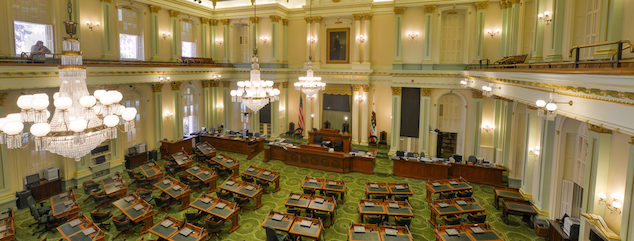 The Assembly chamber at the state Capitol in Sacramento. (Photo: Felix Lipov, via Shutterstock)
In reviewing some of the bills on Governor Newsom’s Desk after the conclusion of the 2026 California Legislative Session, I have come across a number of examples of bill language that I believe is in need of improvement. The following are some of the examples along with an explanation of my concerns.
What do you think I find wrong with this amendment?
It is the intent of the Legislature in enacting this section to ensure that enrollees and subscribers benefit from reductions in the rate of growth in health care costs as a result of the establishment of the Office of Health Care Affordability. The department, as part of the existing rate review process, may consult with the Office of Health Care Affordability to consider information submitted pursuant to this article.
Answer: First, an intent statement should be set forth in a separate subdivision and not be combined with other statutory language. Second, the second sentence being added should either be in a subdivision (b) or in a separate code section following the intent statement.
 Why do you think I believe subdivision (f) does not belong there?
The Legislature finds and declares all of the following:
(a) Transboundary pollution consisting of untreated sewage and industrial wastewater, containing toxic chemicals, fecal matter bacteria, and pathogens, frequently crosses the border from Baja California as a result of population growth, sewage infrastructure inadequacies, and wet weather events.
…
(f) Thus, the Legislature recognizes a need for occupational safety and health standards to ensure a level of protection for workers exposed to transboundary pollution in outdoor occupational environments.
Answer: First, the Legislature does not “find and declare” that “the Legislature recognizes…” Second, subdivision (f) belongs in an uncodified Section 2 of the bill, or else make the findings in subdivision (a) with five paragraphs (1) – (5) and make (f) subdivision (b) instead.
Why do I dislike this statement of legislative intent?
It is the intent of the Legislature that the department offer educational resources to an enrollee of a Medi-Cal managed care plan who needs assistance with understanding continuity of care and coordinating Medi-Cal and their other health care coverage when requested by the enrollee.
Answer: Instead of stating an opinion, the better approach is for the Legislature to mandate the department to offer educational resources. Yes, this would cause a fiscal impact, but if the Legislature wants something done by an executive branch department, it should mandate the department do it and should provide the funding for it to get done.
Why do I like these nonsubstantive changes to this statute?
(4) The wagers are accepted in an area that is accessible only to those persons who are at least 21 years of age.
(5) The board has approved the accommodation, equipment used in conducting wagering at the site, communications system, technology, and method used by the site to accept wagers and transmit odds, results, and other data related to wagering.
(b) Parimutuel clerks shall be available to service the self-service tote machines at these minisatellite wagering locations, and to cash wagering vouchers on a regularly scheduled basis.
Answer: These two changes bring clarity to the statutory language. They do not change the law substantively; rather, they make clear what the words “those” and “these” actually mean.
Why do you think this legislative intent statement was codified?
It is the intent of the Legislature that this act is designed to address the unique and limited circumstances of Jack London Square and that this act sets no precedent for any other granted lands or other public trust lands in the state.
Answer: Uncodified language is not readily available without some legislative history research being conducted. If the language is codified, it will be seen by everyone who reads the rest of the statute.
What is wrong with this amended language in a bill?
(2) The certificate of merit executed by the licensed mental health practitioner shall declare all of the following:
(A) That the mental health practitioner consulted is licensed to practice and practices in this state and is not a party to the action, that
(B) That the practitioner is not treating and has not treated the plaintiff, and that
(2) (C) That the mental health practitioner consulted is licensed to practice and practices in this state and is not a party to the action, that the practitioner is not treating and has not treated the plaintiff, and that the practitioner has practitioner has interviewed the plaintiff and is knowledgeable of the relevant facts and issues involved in the particular action, and has concluded, on the basis of the practitioner’s knowledge of the facts and issues, that in the practitioner’s professional opinion there is a reasonable basis to believe that the plaintiff had been subject to childhood sexual abuse.
Answer: Too many instances of the word “that” are used.
With two items following the colon, what is my concern with the following language?
To participate under this section, the participating party shall do all of the following:…
Answer: Because there are only two required tasks to be performed, it should say “both” rather than “all.”
Why are these intent statements done correctly?
(b) (1) It is therefore the intent of the Legislature to recognize that investments in public transportation are an effective strategy for reducing greenhouse gas emissions and for advancing California’s climate policies and statutory greenhouse gas reduction targets.
(2) It is the further intent of the Legislature that the projects and services described in Section 2 of this act be provided streamlined access to funding from the Greenhouse Gas Reduction Fund.
Answer: First, they are set forth in a separate subdivision, apart from the findings and declarations contained in subdivision (a). Second, they are split into paragraphs because each intent statement by the Legislature should be set forth separately.
Why is part of this phrase unnecessary?
Transit fare subsidies, including, but not limited to, discounted and free student transit passes.
Answer: You do not need the phrase “not limited to” when using “including” because the word “including” already means a list is open and not complete. Adding “but not limited to” is wordy and unnecessary. I understand courts sometimes interpret word lists in strict ways and so legal writers add the extra phrase to prove the list is only illustrative, but courts in this state should understand that the phrase is duplicative.
How could this be better phrased?
This section shall not be construed as authorizing the Natural Resources Agency to impose additional regulatory requirements…
Answer: The better language would be: This section does not authorize the Natural Resources Agency to impose additional regulatory requirements…
What is the problem with the opening phrase in this language?
Notwithstanding any other state law or regulation, the department may deny an application for a certificate for, or deny a training application for, a home health aide on the grounds that the applicant has been convicted of a crime or has been subject to formal discipline only if either of the following conditions are met:
Answer: Reference to regulation is unnecessary because a regulation cannot overrule a statute. As a result, this new provision does not need to exempt a regulation that is in possible contravention of the new statute; even if the regulation is contrary, the statute overrules any regulation.
What is the problem I would identify with this severability clause (besides the fact that it is not actually needed)?
If any provision of this act, or the application of any such provision to any person or circumstances, shall be held invalid, the remainder of this act to the extent it can be given effect, or the application of such provision to persons or circumstances other than those as to which it is held invalid, shall not be affected thereby, and to this end the provisions of this act are severable.
Answer: It has too much legalese, including the word “such” twice and “thereby.” Most severability clauses are more concise and clear.
What is the problem I have with this provision?
(ie) Any regulations adopted pursuant to the laws in sub-subclause (id).
Answer: There is no good drafting reason to have a sub-subclause because it will only create confusion and be difficult for someone to comply with its provisions, trying to track all the way to the sub-subclause level.
How well can the average reader follow this provision?
Amendments to ordinances and checklists to implement the amendments to this section made by the act that added this subparagraph shall be completed no later than December 31, 2027.
Answer: Probably not well, so it should be rewritten to be clearer.
Why is this “plus” section unnecessary?
The provisions of this bill shall be construed and applied in a manner that is consistent with the requirements of the California Constitution and the Constitution of the United States.
Answer: A state statute cannot contravene either the state or the federal Constitutions. As a result, this statement of unnecessary.
Why is this in the Section 1 legislative findings and declarations?
(e) Therefore, the Legislature further finds and declares that Sections 2, 3, 4, and 5 of this act, amending Sections 17958.12, 18931, 18945, and 18948.1 of the Health and Safety Code address a matter of statewide concern rather than a municipal affair as that term is used in Section 5 of Article XI of the California Constitution. Therefore, Sections 2, 3, 5, 6, 7, 8, and 9 of this act apply to all cities, including charter cities.
Answer: While it is an F&D, it does not belong there. It belongs in a standalone bill section at the end of the bill that is called a “plus section.”
What is my concern with this subdivision?
The Legislature finds and declares that the constitutional guarantee of free and effective assistance of counsel to indigent people facing criminal charges is threatened where counties and attorneys enter into flat fee agreements. Experts and policymakers around the country have condemned flat fee contracts for legal services because they undermine effective representation for the client by creating a financial conflict of interest for attorneys when the more the attorney works, the lower their hourly rate. These types of arrangements have been outlawed in several states including Idaho, Michigan, Nevada, South Dakota, and Washington. Indigent defense counsel in California already labor under high caseloads, sometimes as high as 1,000 cases or more each year, exacerbating the financial conflict of interest.
Answer: These findings and declarations should be in multiple subdivisions, rather than one lengthy subdivision. So, it should read:
The Legislature finds and declares all of the following:
- The constitutional guarantee of free and effective assistance of counsel to indigent people facing criminal charges is threatened where counties and attorneys enter into flat fee agreements.
- Experts and policymakers around the country have condemned flat fee contracts for legal services because they undermine effective representation for the client by creating a financial conflict of interest for attorneys when the more the attorney works, the lower their hourly rate. These types of arrangements have been outlawed in several states including Idaho, Michigan, Nevada, South Dakota, and Washington.
- Indigent defense counsel in California already labor under high caseloads, sometimes as high as 1,000 cases or more each year, exacerbating the financial conflict of interest.
What is my concern with this subdivision?
It is the intent of the Legislature to ensure that all Californians have access to effective assistance of counsel, regardless of wealth or income, geographic location, or type of indigent defense system. It is further the intent of the Legislature to provide a mechanism for counties to structure their indigent defense systems in a manner that encourages vigorous representation, pays attorneys a fair wage for work completed, and requires that if contracts are used, they have the structure and support to ensure the promise of constitutionally effective representation.
Answer: These two legislative intent statements should be in two, separate subdivisions, rather than in one lengthy subdivision. So, it should read:
- It is the intent of the Legislature to ensure that all Californians have access to effective assistance of counsel, regardless of wealth or income, geographic location, or type of indigent defense system.
- It is further the intent of the Legislature to provide a mechanism for counties to structure their indigent defense systems in a manner that encourages vigorous representation, pays attorneys a fair wage for work completed, and requires that if contracts are used, they have the structure and support to ensure the promise of constitutionally effective representation.
What is my continued concern with this provision?
The Legislature finds and declares that this bill furthers the purposes of the Political Reform Act of 1974 within the meaning of subdivision (a) of Section 81012 of the Government Code.
Answer: It is a mere declaration, without any explanation how this particular bill actually furthers the purposes of the voter-approved PRA of 1974.
Why should this language not be in an intent statement?
It is the intent of the Legislature that the appropriation described in subdivision (a) be sufficient to fund the reimbursement levels in whole.
Answer: If the Legislature want an appropriate to fully fund something, then that should be an affirmative statement in statute, rather than a stated wish or desire (which is what an intent statement is).
What do I think is unnecessary in this bill title?
This act shall be known, and may be cited, as the Sexual Contact and Rape Investigation, Victims’ New Enforcement Rights Act or the SCRIVNER Act.
Answer: Some bills are beginning to strike the phrase “and may be cited” because it is unnecessary as being duplicative. If the act is known by its name then naturally it can be cited by that name. Another bill on the Governor’s Desk has it done better: This article shall be known as the Workforce Housing Enhanced Infrastructure Financing Act.
Why is the introductory paragraph included in this section?
Unless subsequent legislation supersedes or modifies this division to extend the program, this division shall become inoperative if the fund balance has not been met by December 31, 2030.
Answer: It should not be. It is obvious that a future statute can extend or repeal the inoperative date specified in law. This section should just read: This division shall become inoperative if the fund balance has not been met by December 31, 2030.
What is my concern with this legislative statement?
The Legislature finds and declares that the amendments made to Section 17082 of the Revenue and Taxation Code by Section 2 of this act do not constitute a change in, but are declaratory of, existing law.
Answer: While this standard language is necessary for making a law change retroactive to the earlier state’s enactment, it lacks any explanation. There is a better chance for a court of law to accept this declaratory statement if it provided an explanation why the new statute was making a change to a prior statement.
What are the concerns with this special statute language?
The Legislature finds and declares that a special statute is necessary and that a general statute cannot be made applicable within the meaning of Section 16 of Article IV of the California Constitution because of the unique development regulations within certain areas of the state that are both a city and county.
Answer: First, there is no reason to use the cryptic “both a city and county” because there is only one in this state – San Francisco. With a special or local statute designation, the exact location should be specified. Second, simply stating “because of the unique development regulations” could be insufficient for some judges in this state. A designation like this one should have more explanation in case it is challenged in court.
What is my concern with this statutory language?
It is encouraged that a law enforcement agency makes family law advocates and veterans’ outreach programs aware of the program.
Answer: First, it is one approach to express legislative intent, but why bring a new expression into law (i.e., encouraged)? Second, this should be a mandatory provision, requiring a law enforcement agency to conduct outreach.
What is the better approach instead of the following language?
Notwithstanding any other law to the contrary, a person who is qualified to …
Answer: The term “notwithstanding” means any other law (regardless of whether it is contradictory or not) does not apply, except for this one that follows that phrase. As a result, the additional language, “to the contrary,” is unnecessary. The better approach instead is the following: Notwithstanding any other law, a person who is qualified to …
What is my concern with this provision?
The department may adopt regulations as necessary to implement this section.
Answer: The word “may” is permissive or discretionary, so including the phrase “as necessary” is duplicative and can be removed.
Is this language sufficient?
The Legislature finds and declares that this section does not constitute a change in, but is declaratory of, existing law.
Answer: I just do not think this is sufficient to pass judicial review. California courts do not automatically accept the Legislature’s mere label that an amendment clarifies rather than changes the law. Instead, the judiciary independently reviews whether the enactment truly clarifies ambiguous law or attempts to retroactively alter a legal standard. So why not strengthen the statement with a thorough explanation?
These two subdivisions are in the same bill and one subdivision away from each other. Yet they are complete different in effect. Why doesn’t the first one use the same language as the second one does?
This section shall not be construed to require new physical barriers.
This section does not apply to the Department of Corrections and Rehabilitation.
Answer: The first one uses the term “construed” while the second one uses “does not.” The first one could also simply say “does not require…”
What is the concern with this subdivision?
This section does not limit the Attorney General’s authority under the California Constitution or any applicable state law.
Answer: The second limitation is fine, but obviously a statute cannot contravene the Constitution, so that reference is unnecessary.
Should this single section contain so many provisions?
A retailer shall not sell nitrous oxide, as defined in Section 381c of the Penal Code, at a retail location. For purposes of this section, a retailer does not include a grocery store or a general retail merchandise store with a grocery department, as defined in Section 7100 of the Civil Code, except that a retailer includes a convenience store.
Answer: I do not think so. First, there is the probation on the retailer. Second, there is a definition of a term. Third, there is another definition. Fourth, there is an additional definition. I think this section should be broken up as follows: (a) A retailer shall not sell nitrous oxide at a retail location. (b) (1) “Retailer” has the same meaning as defined in Section 381c of the Penal Code. (2) “Retailer” does not include a grocery store or a general retail merchandise store with a grocery department. (3) “Retailer” includes a convenience store. (4) “Grocery department” has the same meaning as defined in Section 7100 of the Civil Code.
How can this section be revised?
The Legislature reaffirms the longstanding principle that “detention be the exception, not the rule” for justice-involved youth. (In re William M. (1970) 3 Cal.3d 16, 26.)
Answer: I think this drafters should stick with consistent language throughout the statutes. This section should be revised to state: It is the intent of the Legislature that the longstanding principle that “detention be the exception, not the rule” be used for justice-involved youth. (In re William M. (1970) 3 Cal.3d 16, 26.)
Support for The Micheli Files is provided by The McGeorge School of Law Capital Center for Law & Policy
Want to see more stories like this? Sign up for The Roundup, the free daily newsletter about California politics from the editors of Capitol Weekly. Stay up to date on the news you need to know.
Sign up below, then look for a confirmation email in your inbox.
Leave a Reply