
News
Panelists describe grim scenario at CW’s annual health conference
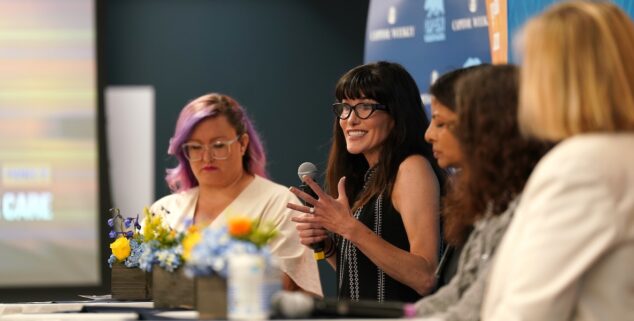 California Health Care, Panel 2: Aging and Elder Care. L-R: Robin Epley, Sacramento Bee; Dr. Lindsey Yourman, UC San Diego Health; Dr. Sarita Mohanty, SCAN Foundation; Hagar Dickman, Justice in Aging; Susan DeMarois, Leading Age. Photo by Joha Harrison, Capitol Weekly.
Panelists explored the state of healthcare in California today at Capitol Weekly’s annual conference on the topic Wednesday, describing a challenging time for providers and patients alike with little optimism for the near future.
“People will fall through the cracks,” said Tam Ma, Associate Vice President for Health Policy and Regulatory Affairs in UC Office of the President. “That’s just the sad reality of it,” she said.
Panels looked at mental healthcare and care for the elderly as well as federal cuts implemented last year while the keynote speaker, Sen. Akilah Weber Pierson (D-San Diego), discussed her ideas for improving healthcare outcomes in the state.
Panel 1: Impact of H.R. 1
The day began with a grim discussion of 2025’s H.R. 1, otherwise known as the One Big Beautiful Bill Act, which enacts $1.15 trillion in federal healthcare spending cuts over the next decade. The panelists all agreed the federal legislation will result in a dramatic decrease in access to care for Californians.
“People are going to lose care in high numbers, and they’re not going to know why,” said Christine Smith, a policy and legislative advocate for Health Access.
“It’s going to be heartbreaking,” said Ben Avey, the chief public affairs officer for WellSpace Health, a Sacramento-area, non-profit community health system.
People are going to lose care in high numbers, and they’re not going to know why.
Josh Stehlik, policy director California Immigrant Policy Center, said the bill “severely restricted” immigrant categories for Medi-Cal, removing “decades of protections” for humanitarian immigrants, including human trafficking victims.
“We’re looking at a real crisis,” Katie Rodriguez, Senior Vice President of California Association of Public Hospitals and Health Systems, who is currently serving as the organization’s interim president and CEO, noting that millions will lose coverage from H.R. 1.
“The state is going to have choices, and we’re going to have to figure out how we’re going to backfill these cuts,” she said.
Ma, with the UC Office of the President, said these cuts are coming at a time when health systems and providers are facing financial pressures on multiple fronts, even while nothing is being done to cut the need for services.
“Reducing payments doesn’t reduce the need for care,” she said.
Panel 2: Aging and Elder Care
The second panel wrestled with the difficulty of caring for the state’s older residents.
“This is not a niche issue,” said Dr. Sarita Mohanty, President and CEO, SCAN Foundation, an independent, public charity created by the Senior Care Action Network. “This is impacting all of us.”
Seven out of 10 adults will need assistance as they age, said Hagar Dickman, Director of California Long-Term Services and Supports Advocacy at Justice in Aging.
“Medicare does not pay for that kind of help,” she said, referring to basic self-care tasks like eating and bathing or cooking, shopping and managing medications.
“This is not a niche issue….This is impacting all of us.”
Once again, however, the discussion noted that the state is facing budget constraints in addressing care for the elderly and aging population, which is becoming larger and more diverse.
“I would advocate for more statewide services,” said Susan DeMarois, CEO of Leading Age California, which champions not-for-profit senior living and care, noting that the needs for elderly residents in rural and urban areas are often the same.
Dr. Lindsey Yourman, a physician for UC San Diego Health and a member of California Commission on Aging, said the challenges expand beyond healthcare to basic affordability concerns.
“I have a lot of patients who are concerned about rent,” she said.
Yourman said she can’t understand why elder care isn’t a top political priority in this country today. By 2035, Americans older than 65 will outnumber those under 18.
Keynote Speaker
The only medical doctor in the Legislature, Weber Pierson, an OB-GYN, began by fielding questions from Capitol Weekly editor Rich Ehisen about her bill package this year, which included SB 869 addressing sugary beverages and SB 977 about kid’s meals.
Weber Pierson said both of those bills represent her efforts to push lawmakers to consider more preventative measures rather than proposals that merely address existing problems. Preventing chronic medical conditions, she noted as a doctor, is much easier and affordable than trying to fix them once they’re already entrenched.
SB 869 would require restaurants to disclose beverages on their menus with high added sugar content, which is a driving factor in obesity rates, while SB 977 would require that chain restaurants offering children’s meals include at least one kid’s option that meets minimum nutrition standards, including a calorie count not exceeding 550.
Both bills are awaiting action from Gov. Gavin Newsom.
Ehisen then moved the conversation to the social determinants of health, which Weber Pierson called “one of my passions.” Exposure to toxins, access to services, even literacy, “all of these things impact one’s health,” the senator said. Thus, racism and microaggressions can cause women of color to suffer poorer health outcomes than white women at the same points in their lives, she said.
The senator said addressing these social determinants are a priority for her as a legislator.
During the Q&A, the senator was asked what it’ll take for the nation’s healthcare system to better respond to women’s needs. She said the country as a whole needs to follow in California’s footsteps and put more women in a position to make policy.
“For a very long time,” she said, “you did not have women at the table making policy decisions.”
Panel 3: Behavioral Health
This panel focused on untreated mental illness on the street and the question of whether institutions are an appropriate place to house those who are homeless and mentally ill.
Katherine Warburton, the medical director/deputy director of clinical operations for California Department of State Hospitals, said homeless people suffering from delusions or hallucinations travel a sort of institutional circuit where they cycle through emergency rooms, jails and state hospitals before they’re sent back to the streets to begin the loop again.
“These individuals are touching all of our systems….but it’s gotten much, much worse.”
“These individuals are touching all of our systems,” she said, but nowhere along the line is the system helping them enough to get them out of that cycle. “I’ve been watching it happen my entire career,” Warburton said, “but it’s gotten much, much worse.”
“We’re really literally treating the symptoms and not the causes,” said Michelle Doty Cabrera, Executive Director of the County Behavioral Health Directors Association of California, noting that economic concerns and a lack of access to insurance, among other factors, are at the root of driving the mentally ill to the streets.
Lois Cross, Vice President of Governmental Relations of NorthBay Health, a nonprofit health care organization serving Solano County, said there is “often no place” for this population to go, particularly if they struggle with multiple diagnoses.
“It’s very challenging to get any help,” she said.
Indeed, Kirsten Barlow, Vice President of Policy for the California Hospital Association, said that patients frequently spend time in institutional settings but don’t need that level of care simply because there isn’t a lower-level housing or treatment option for them available.
“Really,” she said of psychological services and placements, “that whole continuum needs to be bolstered.”
Note: We will have the full audio recordings of each panel and the keynote posted on the Capitol Weekly website early next week.
Want to see more stories like this? Sign up for The Roundup, the free daily newsletter about California politics from the editors of Capitol Weekly. Stay up to date on the news you need to know.
Sign up below, then look for a confirmation email in your inbox.
Leave a Reply