
News
Autonomous tractors stay stalled in CA agriculture
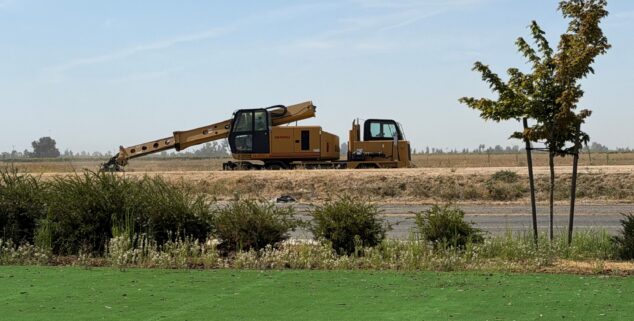 Photo by Leah O'Tarrow.
 In a world where autonomous robots can act as your server in a restaurant or vacuum your floors and driverless cars can get you from A to B, the question is not when but how these machines will continue to integrate across industries and our lives.
So what happens when you mix agriculture with automation? The jury is still out in California.
While most states do not require drivers at the helm of tractors, California adheres to a decades-old California Division of Occupational Safety and Health (Cal/OSHA) provision, Title 8, §3441(b), that requires moving, self-powered agricultural equipment to have a person at the controls.
The current version of the rule dates to 1977, decades before modern autonomous tractors. Federal OSHA’s agricultural standards contain no equivalent requirement.
The provision effectively prevents fully autonomous tractors from operating around workers without an operator at the helm – a restriction growers and agricultural groups have spent years trying to change.
Michael Miller, director of government relations for the California Association of Winegrape Growers and a member of Cal/OSHA’s advisory committee on autonomous agricultural equipment, argues the state’s regulation has failed to keep pace with advances in agricultural technology.
“That law may have been good 50 years ago, but someone’s got to at some point examine that and see how it works today, and for the most part they’re not willing to do it. That’s frustrating,” Miller said.
Meanwhile, autonomous agricultural equipment is already operating elsewhere.
Sabanto has used technology to retrofit conventional tractors for autonomous operation in Iowa since at least 2019. California-based Agtonomy has also deployed automated equipment for fruit, nut and winegrape operations in Washington – crops more comparable to California agriculture than Midwestern corn and soybeans.
Other states generally have not passed laws explicitly “legalizing” autonomous tractors. Rather, most lack California’s requirement that someone remain at the controls of moving agricultural equipment.
For growers, the argument for bringing that technology to California is also economic.
“That law may have been good 50 years ago, but someone’s got to at some point examine that and see how it works today, and for the most part they’re not willing to do it. That’s frustrating.”
Steven Fenaroli of the California Farm Bureau said farmers facing rising costs and an increasingly difficult agricultural economy need access to technology that can improve efficiency.
“In today’s world where it’s harder and harder to grow, farmers need every advantage they can get,” Fenaroli said. “Farmers are happy and interested in pursuing the technology. It’s got to work, and it has to work well, and it’s got to just make sense.”
Growers argue autonomous tractors could improve efficiency and allow workers to spend less time on repetitive or dangerous tasks. But the prospect of removing operators from tractors has also raised questions about what happens to those jobs.
Farmworkers’ rights icon and United Farm Workers co-founder Dolores Huerta told Capitol Weekly that broadly allowing the technology could threaten workers who currently operate tractors.
“I think that any type of automation that takes away people’s jobs, whether it’s a checkout counter at the local drugstore, is bad unless we can somehow balance that out and be able to say if we’re going to eliminate these jobs, we’re providing work at some other part of our economy,” Huerta said.
Worker safety presents another concern.
During Cal/OSHA advisory committee meetings, manufacturers including John Deere and now-defunct Monarch Tractor demonstrated systems designed to stop when tractors detect an obstruction. Labor representatives questioned whether those systems would perform consistently around workers across different crops, terrain and working conditions. They pushed for regulatory review before deployment and for the state to collect accident and near-miss data.
That uncertainty has driven California’s regulatory debate for years.
In 2018, the Association of Equipment Manufacturers petitioned the state’s Occupational Safety and Health Standards Board to change the operator requirement. Cal/OSHA declined to recommend simply allowing autonomous equipment to operate according to manufacturers’ instructions, citing limited accident and reliability data and differences among manufacturers’ safety systems.
“I think that any type of automation that takes away people’s jobs….is bad unless we can somehow balance that out and be able to say if we’re going to eliminate these jobs, we’re providing work at some other part of our economy.”
Regulators instead sought more information. In August 2021, Monarch and participating agricultural operations received a temporary experimental variance – essentially a limited exemption allowing the company to test driverless tractors despite the operator requirement. The experiment was intended to generate the safety data regulators said was missing.
But it did not fully answer the question. Standards Board staff later reported that Monarch operated under a “keep out” policy that kept workers away while tractors ran autonomously, limiting data about how the machines performed around employees.
By 2024, Cal/OSHA’s position had evolved. After reviewing autonomous equipment and observing demonstrations, the agency said it no longer opposed the technology outright. The unresolved question was how heavier autonomous equipment should operate around workers. Cal/OSHA formally asked the Standards Board to convene a balanced advisory committee to consider possible regulations.
That led to meetings involving growers, manufacturers, labor, researchers and regulators throughout 2025, with the final meeting held in August last year.
Miller, who participated on behalf of winegrape growers, said relying on the variance process is no longer practical for technology that has moved beyond the experimental stage.
“We need a regulation that reflects real technology used under real circumstances in a real workplace,” Miller said. “Through an experimental variance process, where they’ll let you try it one place at a time – the technology is well past that. It’s just utterly ridiculous to do it that way.”
But Monarch Tractor’s collapse complicates the argument that regulation alone is preventing widespread adoption.
The Livermore company raised more than $200 million to develop its electric, driver-optional MK-V tractor but later ran into financial and manufacturing problems. After multiple rounds of layoffs, the company entered an assignment for the benefit of creditors, and its remaining assets and autonomous technology were ultimately acquired by Caterpillar.
Three dealers also sued Monarch, alleging its tractors did not perform autonomously as promised. Monarch denied the allegations in a court filing.
Fenaroli said Monarch’s experience illustrates some of the challenges companies face when bringing new agricultural technology to market.
“I think their execution was not quite perfect, and they tried to build the tractor, and then tried to figure out if it worked in the real world,” Fenaroli said.
The advisory committee found some common ground, including support for a tiered regulatory approach if California moves forward and agreement that autonomous tractors should not pull platforms carrying workers.
In November 2025, Standards Board staff recommended creating a system requiring manufacturers to obtain Cal/OSHA approval before deploying self-propelled autonomous agricultural equipment. Manufacturers would have to show how the equipment was tested and validated and report crashes and accidents. Cal/OSHA could revoke approval if equipment posed an unreasonable safety risk.
But the underlying rule has not changed. An 11th hour push to craft a bill allowing automated agricultural equipment to be used alongside workers failed to materialize amidst opposition from labor unions.
As the 2026 legislative session came to a close, California Farm Bureau President Shannon Douglass pointed to autonomous agricultural equipment as unfinished business. In a Sept. 1 statement, she said the lack of access puts California growers at a competitive disadvantage and pledged to make the issue one of the organization’s highest priorities next year.
“The Legislature and the administration, however, failed to make autonomous equipment in farming a reality this year,” Douglass said in the statement.
As of September 2026, the Standards Board’s posted materials do not show that it has adopted the proposed framework or formally amended the operator-at-the-controls requirement. California’s 1977 rule remains in place while the debate over what should replace it heads into another year.
Want to see more stories like this? Sign up for The Roundup, the free daily newsletter about California politics from the editors of Capitol Weekly. Stay up to date on the news you need to know.
Sign up below, then look for a confirmation email in your inbox.
Leave a Reply