
Opinion
Action Needed to Ensure State Water Project Reliability
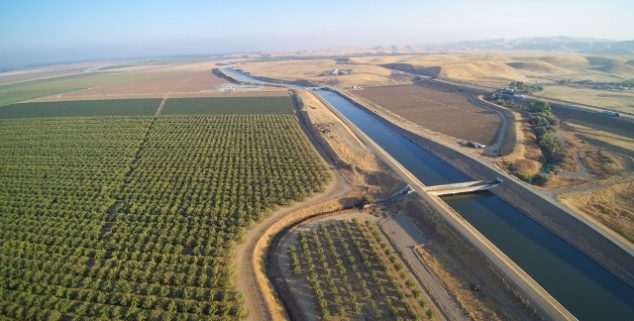 The California Aqueduct, part of the State Water Project, flows by an almond orchard in the Central Valley. (Photo: Alabn, via Shutterstock)
Capitol Weekly welcomes Opinions on California public policy or politics. Please read our guidelines for opinion pieces before submitting an Op-Ed. Submissions that do not adhere to our guidelines will not be considered for publication.
OPINION – California’s lead water agency, the Department of Water Resources, has been developing its existing State Water Project water rights over 30+ years – building 36 water facilities, 25 pumping plants, five hydroelectric power plants and approximately 700 miles of canals, tunnels and pipelines. In so doing, DWR has delivered a reliable water supply to communities across our state, allowing California to grow and thrive.
But as that infrastructure ages and climate change produces bigger rainstorms and faster melting snow, DWR must continue investing in the State Water Project to support continued water deliveries. The SWP must adapt so that it can take on larger amounts of water during big storms and store it for use during dry periods, which will be longer and hotter.
Unfortunately, DWR’s ability to make these investments has been complicated by an unnecessary administrative hurdle.
In 2009, DWR petitioned the State Water Board for a time extension on its existing State Water Project water rights, seeking more time to build the infrastructure and secure the permits necessary to ensure the system’s continued reliability. Time extensions are typically seen as a routine, administrative action, and they are regularly granted when a water right holder needs more time to make full use of their already-approved water right.
Yet, the request hasn’t been processed in the 16 years since it was submitted – leaving California’s most significant water infrastructure in limbo. Without an approved time extension, securing funding to improve and even just maintain the State Water Project is at risk. This uncertainty raises unnecessary speculation for investors seeking to fund project improvements to this essential infrastructure.
For this reason, a coalition of business, labor, water and environmental justice groups is advancing legislation (AB 2215) to extend the time to fully develop the State Water Project water right to 2046 – aligning it more closely with current contracts between DWR and public water agencies that fund 100% of the operation and maintenance of the system.
This extension would give DWR the same amount of time to fully develop an existing water right that public water agencies and their ratepayers are obligated to pay for.
AB 2215 is common-sense legislation that prioritizes administrative approval that would take the Water Board many more years to finalize. It allows for the ongoing operations of existing infrastructure. It does not approve or authorize any future project, including the Delta Conveyance Project, or change in State Water Project operations. Nor does it diminish the rights of the public to challenge future SWP permitting activities or exempt any actions from regulations that protect the environment, water quality or water rights holders.
More work needs to be done to secure water for future generations of Californians, especially in the face of climate change, increasingly erratic weather and evolving science.
Just this year, we have seen wild deviations in rain, snow, snowpack, runoff and temperatures. A time extension allows DWR to refine operations and develop adaptive infrastructure that can respond to these changes.
Key parts of the State Water Project system, like Lake Oroville, the North Bay Aqueduct and the South Delta pumping facilities, all need major infrastructure improvements to make the whole system work for the future. Additional delay in approving the time extension puts the development of these projects in jeopardy.
Building infrastructure in California takes time. Environmental review and permitting alone take years, often delayed by litigation. So, it’s not surprising that DWR needs more time to continue developing the State Water Project.
Recognizing that the narrow action called for in AB 2215 is needed to protect the SWP and the 27 million Californians and 750,000+ acres of farmland it serves, the Assembly Water, Parks and Wildlife Committee recently approved AB 2215.
We thank the legislators for their leadership and commitment to California’s primary water delivery infrastructure, which serves communities and farmland in Solano, Napa, Santa Clara, Alameda, San Luis Obispo, Santa Barbara, Kings, Kern, Ventura, Los Angeles, Riverside and San Diego counties.
Accepting the status quo would leave the system permanently underutilized and unreliable, increase costs for ratepayers and limit California’s ability to adapt to climate change. With significant investments already made in the State Water Project, DWR must be allowed to adapt and continue reliable water deliveries.
Jennifer Pierre is the General Manager for the State Water Contractors, an association of public water agencies that contract with the Department of Water Resources to receive water from the State Water Project.
Want to see more stories like this? Sign up for The Roundup, the free daily newsletter about California politics from the editors of Capitol Weekly. Stay up to date on the news you need to know.
Sign up below, then look for a confirmation email in your inbox.
DWR never asked for the 2009 petition to be moved forward and instead withdrew it, then submitted a new petition in 2025. Now that SWC is trying to “fix” this at the Legislature, DWR has apparently asked the State Board not to move forward with the latest petition. DWR and SWC just want special rules that don’t apply to any other water users. Unfair and unnecesary EXCEPT to advance the controversial Delta Tunnel. DWR relies on its Long Term Operations Plan for daily operations and responding to normal changes. This is for the Tunnel. plain and simple.