
Podcast
Special Episode: A Debate on Proposition 50
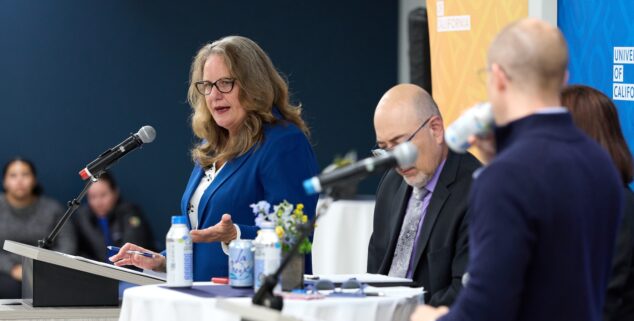 Patricia Sinay speaks at the "California Votes: Proposition 50" debate at the UC Student and Policy Center in Sacramento on Oct. 14, 2025. Photo by Fred Greaves for CalMatters
CAPITOL WEEKLY PODCAST: On October 14, 2025, Capitol Weekly, CalMatters, and the University of California Student and Policy Center presented California Votes: Proposition 50 – Should Californians support mid-decade redistricting?
Proposition 50 would require California to use new congressional district maps through 2030. Use of independent Citizens Redistricting Commission maps would resume after that date.
Governor Newsom and Democrats in the legislature argue that the “Election Rigging Response Act” is a temporary, emergency proposal to counter mid-decade partisan gerrymanders underway in Texas and other red states that are designed to benefit President Trump and the Republican Party. Republicans counter that California should not return to partisan redistricting in which the party in power controls the maps.
Proponents from each of the campaigns offered their arguments in a debate moderated by Rich Ehisen of Capitol Weekly and Juliet Williams of CalMatters. Rusty Hicks, Chair of the California Democratic Party represented the Yes side. Patricia Sinay of the California Citizens Redistricting Commission represented the No side.
This transcript has been edited for clarity.
CATHARINE BAKER: Welcome to the UC Student and Policy Center. I’m Catherine Baker, director of the Center. And I am delighted to welcome you to our very first debate here at the center. You are part of an inaugural event today. [Applause] So yes. That’s good, I appreciate that.
And this debate today, on a matter that affects all of us here in California, is very much what this center, what the University of California is all about. Our mission here is to promote good not only debate, but dialogue and discussion, innovation, research and analysis so that we are learning. And both our policymaking community and all of us, regular folks, can go out into the world and be more knowledgeable, more informed, and hopefully solve challenges better. And that’s very much what the University of California is all about.
I hope that this is not your first time here, but if it is, I’m going to out you right now as a freshman. Please raise your hand if this is the first time coming to the UC Student and Policy Center. Thank you. You are very warmly welcomed and I hope you will keep coming. Raise your hand if you came more than two hours away. Okay. More than three hours away. Okay. We had folks come as far as Santa Cruz today. So we’re delighted to welcome you here. Thank you. And yes, I’m going to out you a little bit.
We do hope to see you here at the Center. We have a terrific speaker series. We have many briefings and conferences and programs, and our doors are open to you. And we’re so new at doing debates that the biggest thing that happened this morning is we had to find a coin to do the coin toss. None of us carry money with us anymore, but we did find one. And you’re going to see part of that go down today.
My job is over. I’m happy to welcome you here. Except I do want to say, if you would like to make sure you get notices about events like this happening here at the center, or provide feedback or even a suggestion for an event, please contact us at [email protected].
And I want to give a big thank you to our speakers and definitely to our moderators today. You’re going to hear from them in just a moment. And to our partners, Capitol Weekly and CalMatters. I know they were a big part of putting this event together today, put a lot of energy into it and we are grateful.
With that, I’m going to turn it over to Rich Ehisen and Juliet Williams from CalMatters and Capitol Weekly. We are in your good hands for taking it from here. Take it away. Thank you.
JULIET WILLIAMS: Hello and good afternoon, everyone. We’re happy to be here. We’re going to start off today with some opening statements from each of the sides. So Patricia, if you want to introduce yourself and give your opening statement.
RICH EHISEN: Because she did win the coin toss.
JW: You won the coin toss.
PATRICIA SINAY: Good afternoon, and thank you for providing this opportunity to discuss Proposition 50. I am Patricia Sinay, a private citizen who identifies as a Democrat. I’m not here in my capacity as a California Citizens Redistricting Commission commissioner.
When I was in third grade, I went running to my mom and said, “Mommy, mommy, mommy, I’m going to be the first female president of the United States.” And my mom kind of hesitated. And the reason was, I wasn’t born in the United States, so I couldn’t be the president.
That night, I complained to my dad, said, “Life’s not fair. I can’t be president.” And he said, “Well, I understand. I was born in Argentina. My dad was born in Argentina, and my grandfather grew up in Argentina. But none of us could be president because we were Jewish.” That started my first inkling that I had to figure out a different way to serve my communities.
Fast forward to 2020, and I think that little girl would have been really proud. I was selected from a pool of 22,000 Californians to serve on the California Citizens Redistricting Commission, the independent commission that draws congressional, State Senate, State Assembly, and Board of Equalization maps. With the people of California for the people of California. Those of us selected went through a very long, arduous process that checked in our, you know, our conflict of interest and many other things. And the State Auditor’s Officeconducted it.
By law, the commission membership includes five Republicans, five Democrats and four No Party Preference. Our commission also reflected the diversity of California in other ways. We are eight women and six men. We equally represent Southern California and Northern California. Our ages at the time of selection ranged from almost 30 to a little over 60. We have different lived, educational and professional experience. We represent various ethnic, racial, LGBTQIA+ identities and ability status.
“Proposition 50’s congressional maps were drawn by Democrat politicians for the benefit of Democrat politicians” – Patricia Sinay
During the 16.5 month process most members balanced full time jobs, several had children who were school age, and, we also had, several of us were caregivers for our aging parents. We all understood our mission: to draw four fair maps, with 176 electoral districts, that reflected the needs and wants of all Californians.
Our first task was to inform all Californians what redistricting was and how they could participate, and then we needed to get them engaged. Remember, this was all during the pandemic. To achieve this, we conducted over 248 public education sessions, reaching an estimated 9,000 People. We facilitated 35 communities of interest meetings, with 1,240 calls. During the draft and final maps phase, we received over 35,000 submissions. In the end, our maps had over 36,500 public engagements.
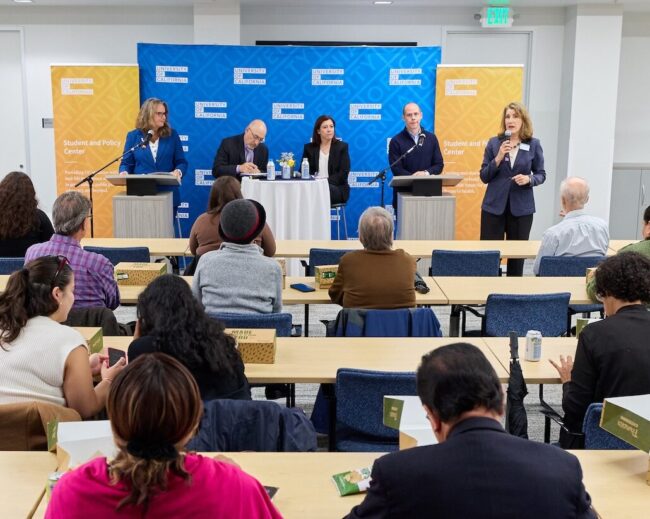
The “California Votes: Proposition 50” debate featuring California Democratic Party Chair Rusty Hicks, and Patricia Sinay, moderated by Rich Ehisen of Capitol Weekly and Juliet Williams of CalMatters, at the UC Student and Policy Center in Sacramento on Oct. 14, 2025. Catharine Baker introduces the event. Photo by Fred Greaves for CalMatters
We wanted to ensure that Californians could participate, so we increased language access, created input tools for different literacy rates, technological abilities and internet access, worked with teachers to create curriculum for high school students, hosted meetings at different times and days, and we intentionally reached out to those in tribal communities, rural communities, and those who were incarcerated.
In contrast, Proposition 50’s congressional maps were drawn by Democrat politicians for the benefit of Democrat politicians. They were drafted so quickly that Californians could not give any communities of interest, nor were we able to give input on the lines once they were drawn.
It is also important to note that the Commission diligently followed six ranked criteria when drawing the maps, and we explicitly were banned by the Constitution to review partisanship.
Besides the ability for Democrat politicians to win, we do not know what criteria was used to draw the Prop 50 maps because no summary or analysis has been provided. In addition to being transparent and open to our mapping process, we have made all the data, including district analysis, accessible to Californians on our website, wedrawthelines.ca.gov. Unfortunately, the politicians have not made that data used to draft the gerrymandered maps accessible.
Prop 50 proposes a gerrymandered map, disenfranchises millions of Californian voters, and undermines California’s Independent Redistricting Commission, leaving the door open for politicians to exploit the next crisis and rig another election. Thank you.
RE: Chairman Hicks, your response?
RUSTY HICKS: Thank you. Good afternoon, everyone. It’s great to be with you. And thank you to the center and all of you for being here to have a conversation about Proposition 50. My name is Rusty Hicks.
“Proposition 50 is an emergency measure that levels the playing field, that’s temporary and ultimately puts the power in the hands of voters” – Rusty Hicks
I’m the chair of the California Democratic Party. And I’m proud to stand before you today in support of Proposition 50. Proposition 50 is an emergency measure. Proposition 50 levels the playing field. Proposition 50 is temporary. At the end of the day, Proposition 50 puts the power in the hands of voters to make the final decision.
Certainly, when Proposition 20 was passed setting up the independent redistricting process for congressional seats. The world looked different, in 2010, than it does today. What do we see out of Washington, D.C.? What do we see out of the White House? We see a president making his way around the country, shopping for congressional seats to try to stack the deck, rig the game before it’s ever played. Particularly as it relates to the congressional seats in the 2026 midterm election.
This is not a fight that California Democrats, Governor Newsom or California started. In fact, Donald Trump went to Texas, had a conversation with the governor and said, I want five more congressional seats.
Usually, parties in power run on their record. It’s very clear that that’s not what this administration is interested in doing. And as a result, California has a responsibility to step forward and speak up and speak out in this important moment. Because I think it’s California that has felt the impact of this administration, that has been unchecked by congressional Republicans, and has been only affirmed by a conservative Supreme Court.
And so I recognize that the conversation is going to be about one line and one district and one map or the other. But in many ways, this is not a California fight. This is a national fight, and it’s incumbent upon all of us to put forward a measure to the voters and to put the question to California voters as to whether they want to support these specific maps.
And so, again, Proposition 50 is an emergency measure that levels the playing field, that’s temporary and ultimately puts the power in the hands of voters.
JW: Thank you, Rusty. I’m going to direct the first question to you. You addressed a little bit of it, but California voters seem pretty happy with the Independent Redistricting Commission, so why should they forgo that, even temporarily, to vote in favor of Prop 50?
RH: Well, certainly, I think you’re right in the sense that there is broad support for independent redistricting. That’s why Proposition 11 and Proposition 20 passed in 2008 and 2010. But again, we are in a different moment in 2025.
Proposition 50 actually reaffirms a commitment to fair, independent redistricting. Calling upon the rest of the country to draw their lines through an independent redistricting process. And returns to the Independent Commission following the 2030 census. At the end of the day. The power is in the hands of voters, not just on the process, but ultimately the map itself. And so that is where the final decision will be made and where it should reside.
RE: Patricia, let me stay with that just a bit, because isn’t this in many ways the only option California has to essentially resist what we are seeing coming out of Washington, D.C.? Where they seem to be shopping in friendly states to get seats that President Trump has said he is entitled to.
PS: Yeah, I hear that a lot. And I actually heard that even before Trump came into office. You know, what’s happening right now is abhorrent. What the federal government is doing is terrible. As, you know, I don’t have words because, it hits home. Just a few weeks ago, a father was kidnapped by ICE three blocks from my home. We witnessed this while kids were walking to school. In Parkdale Lane, to Parkdale Lane.
I’m a naturalized, vulnerable, I’m a naturalized immigrant who has been outspoken against this administration. So I do carry my passport with me at all times. But I don’t think that this is the answer. California Citizens Redistricting Commission was created to ensure representative maps. Maps drawn by Californians with Californians, for Californians. Fair maps lead to more competitive districts, meaning politicians must earn votes and stay accountable to the people they serve.
We all win when politicians care more about the people they serve than power. And that’s how we begin to change the system that allowed for these injustices to happen in the first place. We need to get together and make those changes. My community, when this happened, got together and we had a standing room only at the city council office that night, and forced our majority Republican City Council to take action to protect our immigrant neighbors. It wasn’t the politicians, it was the people.
California’s gerrymandering is not fighting back. It’s cheating. This is copying the very authoritarian tactics we Democrats have spent our entire lives fighting against. Voters go to the ballot box, and their votes make a difference. That’s the ultimate form of resistance.
JW: Sticking with you, Patricia. A recent Public Policy Institute of California analysis concluded that the Prop 50 maps that are on the ballot largely match the existing map on the sort of criteria the CRC was required to consider racial and geographic representation. Do you agree with that?
PS: No. Yes, I can speak further on it. The way that they looked… Well, first of all, we have no analysis. So I’m not sure what PPIC used to do their analysis.
Second of all, communities have been cut apart. Just look at places like Stockton. Lodi was cut through three different places. It’s easy to say, to look at maps and look at it as maps, but not people.
What created the California maps that we have right now are you, the voice of, it was voices of people from California. And that’s one of the main reasons I don’t agree with the analysis. Also, I think that talking about cutting districts is over here. It’s a distraction. The truth is, or sorry, cutting counties and cities. The truth is you have to cut cities, counties because of the numbers. When you look at how we have to stick to certain numbers for each district.
And people tell us, I will tell you, I’m from San Diego County. The City of San Diego is very diverse. You cannot put La Jolla, which is on the coast, predominantly very wealthy people, with City Heights, which is our Ellis Island. They wouldn’t want to be in the same district. That was the input we needed when we drew our maps.
RE: You know, I’m sorry, I think it was me, right?
JW: I just wanted to offer Rusty an opportunity to respond.
RE: Oh, yes.
RH: Well, I would simply say there’s a reason why PPIC and UCLA’s AAPI Institute spoke favorably about the maps that ultimately came forward and are a part of Proposition 50. Certainly strengthens AAPI representation and the opportunity to see the AAPI community support one of its own. Affirms Latino districts, in fact, includes an additional influence district. Doesn’t touch any Black or African American districts in California.
“I think it’s important to note that the North State has 600,000 Democrats and has 400,000 Republicans. And as a result, these lines represent that” – Rusty Hicks
And when we talk about splitting cities and counties, certainly the former commissioner knows that there are a series of trade offs that are made in any map, whether it’s the independent commission or through the legislative process.
Lodi was mentioned, for instance, but as a result of the trade off of splitting Lodi, you saw Martinez, you saw Vacaville, you saw Antioch be made whole. You saw Solano County, for instance, be made whole for the first time, which was not done in 2021. The fastest growing Black community in the North state, Northern, Northern California.
And so certainly I understand we can talk about one line or the other. These are a series of trade offs. And at the end of the day, the current maps before the voters as it relates to Proposition 50, are as strong, if not stronger than what was drawn in 2021.
[Muttering.] Was it something I said?
RE: No, it was actually. But it was, you answered a question before I could ask it. That was good.
So we just talked about communities of color. There’s also been a lot of concern about how this is going to impact rural districts, particularly, you know, them getting lumped in with districts that are decidedly non-rural. In particular putting their voters together with much more liberal voters. Please talk about is that trade off worth disenfranchising those rural voters?
RH: Well, I think what you’re alluding to is Congressional District One, currently represented by Congressmember Lamalfa, the far North East part of the state with San Francisco. I think it’s important to note that the North State has 600,000 Democrats and has 400,000 Republicans. And as a result, these lines represent that. And so there is a lot of complaints about folks in the North State being connected to the Bay Area or San Francisco specifically.
And yet there’s on the other hand, there’s a complaint about Congressional District Three… Representative Kiley. Well, that connects the Roseville Galleria to Death Valley. Folks in Death Valley can’t even hardly get to Sacramento in the wintertime. It connects Sacramento with Tahoe which is much more of a community of interest than what we saw out of the commission’s map in 2021.
“We’ve been able to pass our California progressive agenda and be a progressive blue state because of moderate Republicans and independents” – Patricia Sinay
These are ultimately a series of trade offs, as has already been mentioned. And there are Republicans that are being represented by Democrats today. There are Democrats that are being represented by Republicans today. At the end of the day, the map that is before the voters as it relates to Proposition 50 is a fair map.
RE: I assume you would like to respond to that.
PS: Yes, I would, thank you. First of all, I want to correct the record. I’m not a former commissioner. The Independent Redistricting Commission is still seated. We are seated for ten years, so we could have been asked to review these maps and create these maps. So I just want to make sure you have that.
RH: My apologies, commissioner.
PS: The governor likes to say that as well, but I’m not here as commissioner today. On the same. And the other piece I wanted to correct was, the chair had mentioned it was a fair process. It wasn’t a fair process. How many of you had an opportunity to submit a community of interest? I’ll tell you, I submitted all of our communities of interest that we received as an independent redistricting commission.
But honestly, the maps came out the Monday after the website was put up to submit your communities of interest. As someone who had to read 36,500 public engagements, I can tell you there’s no way anything was read. Going to this question that you asked, which I think is is really at the heart of this. Democrats only make less than 50% of Californians, which proves to us that you don’t have to be a Democrat to be a progressive. Think about that. You don’t have to be a Democrat to be a progressive.
The truth is, we’ve been able to pass our California progressive agenda and be a progressive blue state because of moderate Republicans and independents. This map disenfranchises millions of voters. How is that not putting in jeopardy our future of our state?
RH: Well, first I would just say my apologies, Commissioner. I want to be clear that was not an intention.
PS: No, Patricia. No “Commissioner” today.
RH: Fair enough. And the second is you’ve raised a couple times about disenfranchising voters and also said that Proposition 50 was an authoritarian move. That seems to be a bit of a stretch, given that it’s ultimately before the voters for consideration. In fact, something that Texas did not do, they simply did it. Took five seats and that was it.
In this case, there are potentially five more Democratic seats, but ultimately the voters will have the opportunity. All of you registered to vote, make your voices heard, and you’ll have the opportunity as to whether we have new lines or not.
JW: Rusty, why should voters trust that we’ll return to the independent redistricting Commission Drawing maps after 2030? Will the Trump threat be gone from America, or will voters be asked to just do this again?
RH: Well, because that’s what Proposition 50 says. That’s the language in Proposition 50, which is to return to an independent redistricting process following the 2030 census process.
JW: Patricia, did you want to respond?
PS: I do, thank you. So if this is really about the current threat and about Texas, why was the trigger taken out, the trigger clause taken out of this initiative? Originally, it said, we will only do this if Texas puts maps in place first.
Do you all know that the Texas maps are actually in the courts, and they’ve been in the courts since they were passed? And they’ll probably stay in the courts for a while, and they’re not even going to come into place in 2026. But right now we’re doing a preemptive strike. We’re doing this now. If the voters pass.
The voters get to vote for all the districts. They do not get to vote for their own. So as much as we can say this is democratic, this is, you know, the voters’ choice. It’s not the voters’ choice. The way the Voters’ Choice Initiative was written was you got input all the way through the process. It was, the maps were to be drawn by Californians, with Californians, for Californians. This is drawn for Democrat wins, for politicians. And it’s going to the Californians. It’s about political wins.
We know that during an off year. I think that’s the right term since I’m not a politician, but the, thank you. During an off year, usually there are big wins for the party opposed to the president that was known. That is why he asked for something that was so abhorrent from Texas. But we need to go back to the fact that the Texas isn’t happening. And I know there was a question that I’m not answering, so I apologize.
RE: Rusty, let me follow up on something she said. Why was the trigger aspect of this removed from this legislation?
RH: Well, I think there was a recognition that what has happened could potentially happen, which is these issues could end up in the courts. Obviously, Texas could turn on a dime and do something completely different, because we have to have a different process than what we have here in California.
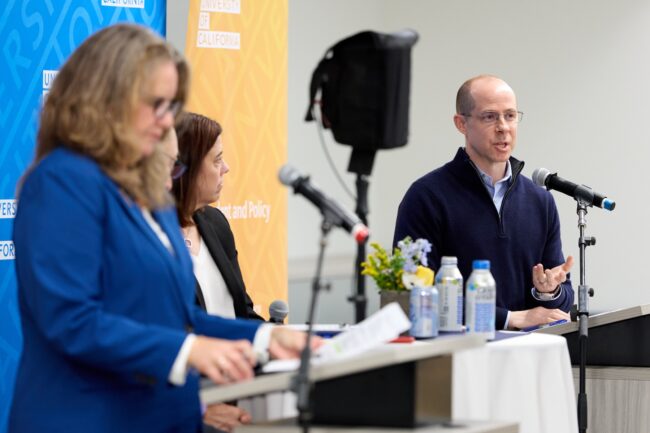
The “California Votes: Proposition 50” debate featuring California Democratic Party Chair Rusty Hicks, and Patricia Sinay, moderated by Rich Ehisen of Capitol Weekly and Juliet Williams of CalMatters, at the UC Student and Policy Center in Sacramento on Oct. 14, 2025. Photo by Fred Greaves for CalMatters
But whether it’s Texas or Indiana or Missouri or North Carolina or any number of other red states where Republicans hold state legislatures, you are likely to see a change in the maps of multiple states. California is the one place where you can fight back, that you can fight fire with fire, as has been said time and time again. And it’s incumbent upon us to do so.
PS: I remember the question.
RE: Go ahead.
PS: Okay. You had initially asked, how can we guarantee that this is temporary? Yes. It is written in the Proposition. Thank you for doing that. But what’s not written in there is the reality that politicians don’t like to give up power. That’s why we have an independent redistricting commission. People were tired of gerrymandering. They were tired of the politics.
If history is our guide, we know that another crisis will always be ahead. Unilateral disarmament means asking voters to give up their voice and relinquish their power to hold politicians accountable. Now, that’s exactly what politicians are asking voters to do with Prop 50. That is why I’m so concerned.
“I completely agree that we need to do everything possible. I also completely understand, and I want to say sorry to all of you who are impacted by what’s happening…. It’s bad, but I don’t think this is the way to do it” – Patricia Sinay
Temporary measures can often set a precedent. I’m going to say that again, because we need to remember that it can set a precedent and that future politicians may exploit this authority, leading to long term erosion of independent commissions’ authority. It is not too hard to imagine what the next crisis will be. It is forecasted that after 2030, after the 2030 census, blue states will lose congressional seats to red states because of population decline. Will that be our next trigger to a gerrymandered map?
RE: So Rusty, how does Prop 50 align or conflict with any state constitutional requirements or the federal Voting Rights Act?
RH: Well, in fact, the map that was drawn sought to ensure that we abided by the Voting Rights Act. A part that is, of the Voting Rights Act that’s actually in question in the Supreme Court as we speak. The Louisiana versus Callais case, which could potentially unleash a whole different kind of gerrymandering around the, around the country.
And so certainly the lines that were drawn for Proposition 50 sought to abide by both the constitutional requirements, but also the Voting Rights Act as well.
RE: Do you agree with that, Patricia?
PS: Well, it depends which constitution we’re discussing. So it may be that they abide by the US Constitution, meaning that there’s a VRA requirements in every district needs to be of equal size. It does not abide by the California Constitution, which said, you know, you needed to look at communities of interest and hear from communities of interest. So let’s just be clear about that.
And I do, I’m glad you brought up the VRE district and the fact that it is in peril. And I wish that we were putting more energy into fighting the Supreme Court and making sure that they understand that this isn’t okay or that the VRE districts are important. We already lost. We already lost the Fifth Amendment piece of the VRE district.
But I also want to remind us all, because we keep being told this is a hurry. You know, this is a new world, this is… We are in this situation because some, because politicians had the long game in mind. Republicans didn’t just put Trump into office. And here we are. This was a very, very long game. And the Democrats have had a long game about creating representative democracy. And we’re stepping back from that. What does that mean for our future, the future of our democracy as a country?
So I do hope that you all do fight to keep the VRA, the Voting Rights Act in place. I know it’s hard to fight the Supreme Court. But also that you support representative democracy throughout our state and the country.
JW: Patricia, this is another argument that we hear frequently. Given the negative impact of the Trump administration on California, we’re already seeing, you know, hundreds of millions of dollars, billions of dollars being cut. Shouldn’t we do everything possible to prevent Trump from enacting any more of his agenda here?
PS: I completely agree that we need to do everything possible. I also completely understand, and I want to say sorry to all of you who are impacted by what’s happening. This. It is awful right now. I’m a nonprofit consultant and I have had to work with my clients, you know, that have lost millions of dollars that they were going to use to serve the LGBTQIA community, immigrant community, hungry people, families. It’s bad, but I don’t think this is the way to do it.
I think democracy, you know, I don’t always agree, fighting fire with fire. And I hate using that analogy in California, especially because I did work with the Eaton Fire Collaborative and helped them, I’m helping them rebuild after their fire. But the best way to get rid of fire is either water or other deterrents. The best way to fight authoritarian governments is for the people to organize and move forward. It’s not the politicians. Politicians have never stopped authoritarian governments.
RE: Rusty, what do you think about that?
RH: It’s a nice response, but it falls woefully short of where we are at this particular moment. Whether it’s high cost as a result of tariffs. Whether it’s the result of Medicaid cuts or higher health care premiums, you’re likely to see. Whether it’s the defunding of Planned Parenthood. Whether it’s ICE agents or the United States Marine Corps marching down the streets of both big cities and rural communities alike.
And so to say that we should do something, but we shouldn’t do this. My response would be, what else would you like to do? Because at this point, you have an administration that is essentially out of control, with virtually no check from the legislative branch. Virtually no check from a Supreme Court that has affirmed, the president has requested 28 times to the Supreme Court. They’ve taken up 26. They’ve found for the president and expanded his powers 23 of 28 times. That is not likely to stop.
And if there was such a strong record to run on, why is the president shopping around the country for more seats to pad a 3 or 4 vote majority in the House? So it’s an unpopular record to run on. He knows that. So he’s shopping for seats, and Californians are impacted probably more than anybody else. We are a big fat target.
UCLA, the alma mater, to a few folks in the room. $1.2 billion in a leveraged play that would essentially bankrupt the institution. California’s attempt to address global warming and climate change rolled back.
A target for military style tactics on the streets, picking up not just undocumented immigrants, but citizens as well. The fact that my colleague has to walk around with a passport, simply because she might be in the wrong place at the wrong time, speaks to the emergency that we are in.
And so I certainly recognize that there may be, you know, Prop 50 is not perfect, but it is needed to respond at this particular moment. For the time that we are in today.
RE: Rusty, let’s go back to something you noted earlier. There’s a lot of other red states. You listed them Indiana, North Carolina, others that are considering doing the same thing. I mean, if all of that happens, doesn’t this just blunt what California is doing anyway?
RH: Well sure. Is it as effective as you would want it to be? Of course not. But you got to understand that every time a Democratic seat is taken off the table. It’s a swing of two. So when we talk about picking up five seats in Texas, well, if California doesn’t do anything, that’s a ten seat swing in the House of Representatives.
So, yeah, the party out of power in Congress typically does well in the midterms. But the question is how deep is the hole going to be and whether it is North Carolina or Missouri or any of these other states. It’s incumbent upon California to step forward and do its part.
RE: Patricia, What do you think?
PS: Yeah. You know. It’s Armageddon. Okay. English is my second language. Armageddon. Right now, in regards to redistricting and congressional seats.
I just, California must lead by example. We always have. You brought up global warming. We’ve led by example in so many different things. Until every state adopts independent redistricting and bans midterm gerrymandering. Someone must prove that fair, transparent mapping works and that representative government is important.
For my national work promoting democracy, I’ve learned that reform doesn’t start with politicians giving up power. It begins with people demanding fairness. People are always shocked when I tell them, you know what the Independent Redistricting Commission did not come about by Democrat politicians. It came about by a Republican governor who really pushed it with a funder who’s funding the issues, funding the initiative, the No campaign now. It was Arnold Schwarzenegger who was tired of gerrymandering and pushed this.
It is always going to be the party that’s not in power. Across the country, communities realize the independent redistricting strengthens democracy by keeping political power where it belongs, with people. Proponents of Proposition 50 want us to give up our fair congressional districts. If we keep giving up our system of democracy at some point, what are we fighting for?
This midterm gerrymandering fiasco is a reminder that politicians who are in party don’t want to give up their power. Thankfully, the voters disagree. According to a September 2025 Common Cause Redistricting poll, so it just came out last month, 78% of U.S. voters support a boundary drawing process that puts communities of interest ahead of political advantage. They also at a majority of 80%. I think it was said that how you draw your lines really impacts democracy. So the nationally, people want California to continue to lead.
JW: Rusty, what happens for Democrats if Prop 50 doesn’t pass?
RH: Well, my job as chair of the party is the same. Which is to go out and fight and try to win as many congressional seats as we can. In my view, we’ve got a responsibility either way, which is to, the road to retaking the House of Representatives runs through California, and it has for quite some time. I think that doesn’t change from one map to the other.
RE: Patricia, what happens if prop 50 doesn’t pass for Democrats here in California?
PS: As a Democrat, we got to continue to work hard and make sure that people are elected on their record. Competitive districts ensure that politicians are responding and are accountable to their constituents. It’s always better when politicians care about you and me versus power.
RE: Patricia, you noted that the Texas maps are tied up in litigation, to some extent. I assume, are you expecting litigation on Prop 50 as well?
RH: I mean, there’s already been litigation. There’s already been litigation to this point.
RE: More litigation, I guess, is what I should say.
RH: I… there’s a lot of lawyers and a lot of potential plaintiffs, so I have no idea.
RE: What do you think?
PS: So here’s an interesting little tidbit. When this all first came out, up that we needed to do this. Luckily I was no longer chair. I had just let go of my chairmanship, and we had a new chair, and he needed to figure out, do we need to defend our maps? Because the Constitution says, California Constitution says that the Commission needs to defend their maps. Do we need to defend our maps or not? What are we supposed to do?
Well, we have a very small budget. So we were told, you know, for legal counsel, use the California Attorney General, we call the Attorney General’s office. And guess what? They told us it was a conflict of interest. So, we kind of figured that we figured the legislature wasn’t going to give us a bigger budget right now, and therefore we’re like, okay, we’re all right. Because we’ve got the good government organizations, the ones that called us consistently and asked us, you know, to keep the process democratic.
Well guess what? Most of those organizations are standing out this time around. And so we’ve been left alone. Will, will there be um. The reason this is going to the voters is because the Democrats couldn’t do what they wanted to do.
And it’s been proven. It’s been written up in Politico. They wanted to do it without having to go to the people, and they were told it’s too popular and it will automatically go to the courts. So this is coming to us as a way to get around ending up at the courts.
RE: Rusty, do you agree with that?
RH: News to me. And with no disrespect to anyone in Politico. I’m not sure I would necessarily believe that idea that was written. Certainly it was passed by initiative. There was, I think, an understanding that would have to go back to the voters for a change.
RE: You know, we’re going to go to questions here in just a minute. But you’ve both mentioned Representative Kiley, who has proposed the idea of federal legislation that would ban mid mid-decade redistricting across the country.
On the snowball’s chance in hell that that will ever actually make it to the president’s desk and get signed. You know, I guess we’re not really hearing that much, though, about that from either side. About, you know, could not there be a lot of pressure put on Mike Johnson in the House of Representatives to bring such a bill to the floor and to try to actually get something like that through? And forestall all of this.
RH: Well, Mike Johnson probably needs to call over to the White House and ask if he could bring that to the floor. Congressional Republicans have gone so far as to not swear in a duly elected member of Congress in Arizona. Why? Because she had affirmed that she would be the 218th vote to release part of the Epstein files.
That sounds like a call that was made to the White House, and an understanding that we need to slow roll swearing her in. So I don’t think Kevin Kiley’s Bill is going to be at the top of the list for coming to the floor anytime soon.
PS: Besides the fact that the government is shut down right now.
RE: Well, that notwithstanding, though, I mean, I think a lot of people agree with you about some of the things we’re talking about with, you know, barring mid-decade redistricting. But I mean, how realistic is that?
PS: Yeah. You know, I’m a huge proponent of the John Lewis Act. And during the Biden administration, it did pass the House, never made it through the Senate. There are initiatives that we need to push. The John Lewis Act had pieces in there about voter rights. We need to push for better voter rights. We need to push for independent redistricting commissions across the whole country.

The “California Votes: Proposition 50” debate featuring California Democratic Party Chair Rusty Hicks, and Patricia Sinay, moderated by Rich Ehisen of Capitol Weekly and Juliet Williams of CalMatters, at the UC Student and Policy Center in Sacramento on Oct. 14, 2025. Photo by Fred Greaves for CalMatters
And we need to also push, you know, I will tell you, I never had mid term redistricting on my bingo card. So this was a new one for me. We joked around why we have ten year terms and then we figured it out.
But I think that we need, it’s not a one, there isn’t going to be one solution. And, you know, the chair keeps saying, why isn’t the Republicans running on their strong record? Why aren’t the Democrats running on their strong record? Why do we feel that we need to rig our elections here in California? Why aren’t we stepping, why aren’t we supporting those candidates?
Independent redistricting commissions have created the most diverse state assembly. State Senate. That’s ever been possible. When you rig elections, new candidates can’t run.
RE: Okay, I swear we’re going to go to questions. I have one more thing, though. If you got your questions get ready.
Because we talked really briefly about communities of color. Is it not a fact that the districts that we’re talking about in Texas, they’re pretty much breaking up communities of color. And all of those district changes are going to deeply and negatively impact communities of color. So I know what we’re talking about here in California, but that is a big issue as part of what is happening in Texas.
So how do you rationalize being okay with that and not being okay with California, doing something to try to counter that?
PS: Who said I was okay with Texas? I think what Texas is doing is abhorrent. I think all gerrymandering is abhorrent. I think that representative democracy is the way to go. And the more that we can ensure that people have a voice and they get to vote, the better it is for all of us.
RE: I apologize, I did not mean to infer that you were okay with it. I’m just speaking in general. Rusty, do you want to have a last word on that?
RH: I think all has been said that needs to be said.
JW: All right. Well, with that, we are going to turn it over to the audience for some questions. I do have one question, first. From a member of our, from a college journalism fellow at UC Davis.
CB: Go Aggies!
JW: Cue to Catharine for that. Are there any signals about how the youth will vote on Prop 50? Is that a Democrat, is that a demographic that either side is targeting? I know you’re not on the campaign, Patricia, but maybe Rusty, you can talk about your efforts in that respect.
RH: Well, certainly we’re going, after all 22 million voters in California from North to South, East to West. And certainly young voters on college campuses or in communities are an important part of that. Communities that have been substantially and significantly impacted by this administration, and the affirmation that he’s gotten from congressional Republicans.
And so it’s an important part of the campaign, whether it’s in the social digital space or being on community college campuses or college campuses. We’ll continue to do that all the way through Election Day in 2025, and certainly, whatever the outcome, through into 2026.
PS: Yeah, I had an aha moment that most of, a lot of people have never lived in a gerrymandered California. And so the youth, I asked my, I told my 17 year old and my 19 year old where I stood on this issue. My 19 year old can vote. My 17 year old can’t. And both of them kind of looked at me and said, of course, mom, why would you not?
And then my 17 year old said something that really stuck to me. He said, how does going back on all the good stuff we’ve done for California’s democracy help our national democracy? And that’s the piece I keep sticking to, and I mean, I keep thinking about.
And I hope all students vote. I know my daughter is out there right now watching me, and she’s doing a watch party at UCLA. Go, Bruins.
CB: Go, Bruins!
PS: And so I’ve, encouraged everybody to talk about this. Students. Please have these conversations because we need everyone’s voice.
RE: All right. With that, if you’ve got a question out there in the audience, please. I see a hand and my colleague, Tim, will get you a microphone.
AUDIENCE MEMBER: Rusty, thanks for being here. I appreciate you taking your time. I know you’re busy these days. One of, something you said earlier kind of caught my attention. You said that it’s a different day than 2010. But is it?
Because Democrats and Pelosi and Padilla, they all opposed Prop 27 or Prop 20, and they were for Prop 27, and this was just they poured tens of millions of dollars to try to repeal the redistricting commission. That was only two years after Prop 11, in 2008. So I’m just wondering, like, what’s different today than your opposition then?
RH: Well, anyone who would say that 2025 looks a lot like 2010, isn’t looking around, isn’t reading the paper, isn’t watching TV, isn’t on social, digital, has their head in the sand.
No, I’m talking about the world that we are living in with an out of control administration that seems to be affirmed time and time again by congressional Republicans, in Congress, and a Supreme Court that continues to consolidate power in the executive. And it’s important that California, led by California Democrats, step back and push back at this important moment.
RE: I see a hand over here, Tim.
CB: All right. Mic is coming your way. And then any up front, be sure to raise high.
AUDIENCE MEMBER: Hi. I think it’s pretty clear that nationally, Democrats have essentially been bringing sticks to a gunfight. And you know, your suggestion, this is to Patricia, is for more people to participate locally. And we did see that during the first Trump administration, a lot more people went to Democratic central committees. They went to city councils, they went to state boards of education and their local education boards, too. And that hasn’t resulted in any national gains.
So then what can we do to fight back now that healthcare is in danger? People’s parents are being kidnapped off the streets? If not Prop 50, what can we do when we know that this localized plan hasn’t worked in the past?
PS: I would argue it does work locally, and to ask the parents that are walking their kids to Parkdale Lane and that a sheriff is sitting there now so that the ICE can’t, ICE and border patrol, because we get both in San Diego, we’re very lucky.
But I hear what you’re saying, and I think that that’s a real concern. I have, you know, to LGBTQIA nephews and nieces. And we talk about this often. It is hard, but I do think that things are working. We have seen some off elections where Democrats have won. We’ve also seen that the nonprofits , you know, a lot of the advocacy groups are taking things to the courts and they are putting, that the lower courts are working.
In addition, think about all the economic boycotts that are happening. And it is stopping. I don’t think that gerrymandering and taking votes away from Californians is going to help.
CB: All right. We got a question up front. Let’s go to the front of the room, if that’s all right. Yes.
AUDIENCE MEMBER: I’m Miss Wilson, I’m from MedGo. And my question is this is not our first run around with Donald Trump. We had the same issues in his first election, snatching people off the streets, putting them in cages and things like that.
I feel that Democrats are just really, really are scary, you know, you’re scared. And I want the Democrats, Bill Clinton and Obama who rallied the troops and would send them into these cities, knocking on doors, doing phone banks. I really do not feel like 50 is the answer to the national question.
I feel like if we got our leading Democratic politicians to raise the money, raise the funds. Can you imagine $200 million in Texas? Can you imagine? I mean, even if they had the five seats, they still have to run an election to get those five seats. 200 million in Texas. And you take all these people in California, who has the highest unemployment rate, and. And he said, hey, we’ll send you to Texas, represent the rest of the state of California and the country, and let’s get these five seats back in the Democratic Party. Patricia, is that what you’re talking about when you talk about people power?
PS: Yes. I think we need to be creative. We need to be innovative. We you know, in 2020, we, the Democrats did have the presidential, were the president and had a majority in Congress. And things were not codified. The politicians did not do their job and did not prepare for this, what could happen.
“At the end of the day, Proposition 50 is an emergency measure that responds to what Texas and other Republican held states have done. It is temporary. We go back to the independent redistricting process in 2030” – Rusty Hicks
It wasn’t that we didn’t think it would happen again or it could happen worse. They didn’t prepare the way that we’ve been doing things in California, is we do it in partnership with independents, with Republicans and with Democrats. And it’s important.
Politics, politicians play a game of power. We, the citizens, need to play a game of trying to figure out what is the greater good. We need to not be afraid to talk across party lines. We need to be able to try things that are risky, and we need to be able to say, no, I’m sorry, politicians. The power, the power stays with us.
RE: I’m sorry, did you? The Democrats were, not did not have the presidency in 2020.
PS: Yes. I mean we did have the presidency after 2020. So yes.
RE: After January 20th, 2021.
PS: January 2021. Yes. But what I meant was during the Biden administration, if you want me to call out names. So you are absolutely right, because I also had to remind my husband that the last census was done during the Trump administration.
RE: We have a question over here.
CB: Got one in the back.
AUDIENCE MEMBER: Thank you. I would like to say thank you to both of you guys for being here and taking your time. I guess, and this is directed towards Patricia, it was kind of asked earlier. I don’t feel as though I received the answer out of that question earlier, that I kind of wanted out of it.
I guess I would just ask you, you mentioned that there’s a lot of people who haven’t lived in a gerrymandered California. I myself haven’t, I wasn’t even old enough to vote until a couple years ago. But I guess I would say, you know, I feel like there’s a lot of dancing around and a lot of you repeating, don’t be scared. Let’s be creative. Let’s take risks. Is Prop 50 not the risk that California is taking?
Obviously, some might see it as a step backward, but is it really backward if there’s language written that it is only temporary? I mean, obviously, I guess like you could say it goes both ways. And you mentioned who’s to say it from going again and another trigger being, like happening.
But I guess I would just kind of say, like, what do you, where do you see California going? And where do you see the creativeness? Where would you want that? And I know Rusty mentioned it earlier. If this is the risk that we’re not going to take, what would you like us to do in a sense, especially for young people who, even though we haven’t lived in a gerrymandered California, we are fearful, and this is the voice that we are trying to have. This is the risk that we want to take.
And this is also, in all due respect, like, the world that we’re creating and that we’re going to live in as someone who’s in university still. What would you say to that and to the young people?
PS: I hear you and I think about this so often. What can we do? Honestly, I feel like the politicians have left us in the dust. I feel that a lot of the good governance organizations have left us in the dust. I feel that a lot of philanthropy has left us in the dust, and nonprofits. And it’s up to us to think creatively.
What are the answers? Every day I sit there and try to think about it, and what I wish for you and my kids is, is a country that actually believes in representative democracy. There are other tools besides just redistricting. And the more you learn about how things can be different than how it’s been for the 200 plus years, the better it’s going to be for all of us. I want you to feel that you can run for office if you want, or that you can be the CEO of a corporation or whatever it is you want, and to feel that you’re taken care of.
That’s the same thing I wish for my kids, my nephews and my nieces. What are the answers? Those are the conversations I wish we were having. And I also wish, as you were saying, that we were investing the $200 million plus right now in investing in people powered democracy.
RE: Tim, I think there’s a question right here.
TIM FOSTER: And I did have one question from our remote viewers, and I think this is probably for Rusty.
Can you talk about the actual process of Prop 50? If it does pass, what happens in 2030 when we go back to the redistricting commission? That does not require a vote. Can you kind of walk us through how the actual process would work if this does pass, what happens in the next few elections, and then what happens to the redistricting commission? That’s a question we have from our remote viewers.
PS: Do you want me to answer it?
RH: Well, certainly. I was going to turn it over to my colleague who may know, but I would simply say it says in the ballot measure that we return back to the independent commission process that we’ve, that we’ve had in 2021. And so that process would take place after the 2030 census.
PS: It’s important to note that we still have three out of the four maps that were drawn by the Independent Redistricting Commission and Californians. The process, we are still no matter what happens, the commission is still going to work on the transition between the 2020 commission and the 2030 Commission, and that means ensuring that the 2030 Commission has an easier go at it than we did. That they have the right budget, that they have some staffing.
We’re all discussing all those things, and making sure that we have a robust outreach, so we get a lot of applicants. Some of you students think about that. Put it in your calendar. We will need new people to apply for the Independent Redistricting Commission. And from there we will do the same process that’s in the Constitution with the auditor’s office.
JW: Patricia, can you elaborate on that a little bit more. On what you think that the commission needs going forward? And do you think given that the legislature is controlled by Democrats, that you’re going to get that if this passes.
PS: Yeah. I mean, in the amendment, it says that we’re supposed to get the money that we need, not in the initiative, but in the Constitution it says that we get, you know, that we request funding and we get the funding that we need. Obviously, it’s a negotiation. We don’t get a blank check.
But I’m an optimist. So I keep hoping that, yes, we’ll still get that support. I can’t tell you more because that would be, we as a commission haven’t sat down and thought it all the way through. But we will be planning and working towards a successful 2030 redistricting commission.
RE: I know there might be more questions, but we need to go to our final statements from each person. I will say this. Thank you both for being here. I’ve been doing this 30 years, this is the first time I’ve ever seen general interest in redistricting. So that unto itself is a tremendous thing.
RH: It may be the last. Let’s just enjoy the moment.
RE: Who had the first opening statement? I already forgot.
PS: I did.
RE: Okay. So, Rusty, you lead this one off and you can close this out.
RH: Well, again, thank you for the opportunity. And it’s been great to have the conversation on an important measure, Proposition 50. Obviously, I would argue that democracy itself is in many ways on the ballot. And yes, we are in a different day and age in 2025. And I don’t have to repeat what you all and we all are living through every, every single day.
At the end of the day, Proposition 50 is an emergency measure that responds to what Texas and other Republican held states have done. It is temporary. We go back to the independent redistricting process in 2030. And ultimately puts the power in the hands of voters, not just for the process, but for the maps themselves.
So I urge you, each and every one of you, to make sure you get those ballots in and vote yes on Proposition 50.
RE: Patricia, you can close us out.
PS: Thank you. I kind of like I got to open and close.
Many of us are conflicted about Proposition 50. That’s okay. I was conflicted, and sometimes I still am. Like when my neighbors were kidnapped by ICE.
But what the federal government and and let’s be clear, what the federal government is doing is abhorrent. What Texas proposes to do is abhorrent. What is happening is terrible. But gerrymandered maps are not the appropriate response. They will lead to more polarization.
My abuelo, who once fled the country of Argentina under political persecution, would often remind me – don’t follow political parties blindly. When an authoritarian begins dismantling our democratic institutions. That is the exact time we need to stand up and fight for our democratic systems. With our independent commission, California has shown the nation that there is a better way.
I, as I’ve told you, I have family in Peru and Argentina, and I began my career in the 1990s promoting human rights and building democracy in Latin America. So I know what authoritarian governments can do. I also understand that the collective power of people has been the antidote to political oppression. You, you’re the antidote to political oppression. For this reason, I will always support people having control over politicians.
Your vote is your voice. So please think deeply about this and go vote. A no vote supports maps independently drawn by Californians, with Californians, for Californians, and thus is a vote for democracy. Gracias. Thanks.
RE: Rusty, I realize that I did it completely backwards, so if you have anything else you want to say, I’ll give you the opportunity. That was my screw up. Sorry.
RH: All right, here goes another five minutes.
Vote yes on Prop 50.
RE: And there you go. Catharine, I’ll hand it back to you.
CB: Yes. Thank you. To our partners again. CalMatters and Capitol Weekly. Please thank our terrific speakers today. Both did a great job. And our moderators. Thank you.
Want to see more stories like this? Sign up for The Roundup, the free daily newsletter about California politics from the editors of Capitol Weekly. Stay up to date on the news you need to know.
Sign up below, then look for a confirmation email in your inbox.
Actually I think Prop 50 offers us a very simple clear choice. Voting YES says California should maximize its voice and impact at a NATIONAL level working to offset the anti-democratic things Trump and Texas are doing. Voting No says we should maintain the purity of our local and state level politics and ignore what’s happening at the national level.
Personally I see the minimal and temporary statewide impact of Prop 50 being well worth the much bigger impact it can have on reducing Trump’s illegal and anti-democratic impulses nationwide. A small temporary detour by 40 million Californians to the benefit of 340 million US citizens and in fact also to the benefit of 8.1 billion earth inhabitants.
I think it’s obvious to vote YES on Prop 50.
I think it obvious to vote NO on prop 50. The democrats/Gov Newsom need to do what is best for Californians and not what goes on in Texas. Obviously, the California democrats have a fixation on in Florida, Texas and
Trump. Using the “National of Level” interest is disingenuous. I have never heard of any commentators commenting on how well California is governed and that the whole nation should follow its model. I understand that democrats want a one party state, having a super majority is not enough, that is what Prop 50 is about. BTW – Passing Prop 50 will ensure, my vote will no longer count since you claim the “ purity of the local vote” will disappear. Prop 50 is exactly what Newsom objected to that Texas did but Texas constitution allows for that and Californian’s does not. Hmmm.
that is exactly what Prop 50 is about. If Prop 50 passes, there will be less representation and more division.