
Capitol Spotlight
Capitol Spotlight: Assemblymember Jessica Caloza
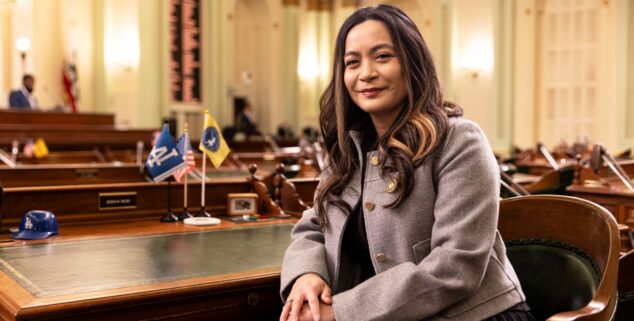 Jessica Caloza. Photo by Ellie Appleby, Capitol Weekly.
 On her birthday during her fourth year of college, Assemblymember Jessica Caloza (D-Los Angeles) stopped answering her phone.
Her worried mother drove from Eagle Rock to San Diego and found her very ill. When doctors saw her, Caloza learned she had pneumonia and had most likely been sick with it for weeks.
She recovered, but the experience stayed with her for a reason different than just the physical trauma of it all. She realized she was still insured under her mother’s plan because of the Affordable Care Act (ACA), a moment that changed how she understood the impact of policy.
“The amount of medical debt would have crushed me. It’s because of my mom and the ACA that I’m here today,” Caloza said.
The first Filipina elected to the Legislature, Caloza now represents Los Angeles, serving a working-class, immigrant-heavy district. She has built her career on a simple idea shaped by her own experience: that government can transform lives when it works.
She was born in Quezon City, the Philippines, the youngest of six children. Her father and three older siblings moved to the United States first, leaving her and her mother behind for a year as the family worked to establish a foothold. She arrived in Los Angeles at age 4, settling in Eagle Rock, where her parents took on minimum-wage jobs in retail, fast food and healthcare after their credentials from the Philippines were not recognized.
She later attended UC San Diego, where her illness forced her to take a quarter off and extend her studies into a fifth year. That extra time led her to Washington, D.C., through the UCDC Program. She graduated with a degree in international relations and ethnic studies, becoming the first in her family to earn a college degree in the United States.
Motivated by her own experience with the ACA, Caloza interned in the Obama administration before joining his 2012 reelection campaign as a field organizer — an opportunity she said she might not have had if she had graduated on time.
In that role, her willingness to take on any task led her to Charlottesville, Virginia, where she knocked on doors, made phone calls and organized in a battleground region. It was there, she said, that she learned about the power of meeting people where they are.
“I think the lifeblood of that campaign was scrappy, hungry young people who really wanted change and who were going to do everything that we could to make sure that he won, and that’s what happened,” Caloza said.
After the campaign, Caloza got a job in the Obama administration, working on education policy at the U.S. Department of Education. But it was back home in Los Angeles, she said, where she began to understand how government actually functions on the ground.
At City Hall, Caloza worked on immigration policy in the mayor’s Office of Immigrant Affairs during the 2014 unaccompanied minors crisis, before being pulled into then-Mayor Eric Garcetti’s executive team.
“My preferences are honestly secondary,” Caloza said. “If you’re in government, you have to sometimes sacrifice what you want to do versus where the needs are.”
That mindset followed her to the Los Angeles Board of Public Works, where she was appointed one of five commissioners that collectively oversee a $1 billion budget and thousands of city employees. The role gave her direct control over infrastructure, procurement and labor policies. She said the role has given her a clearer understanding that holding power only matters if it’s used.
“The title means nothing if you don’t do anything with it,” she said.
That understanding deepened during her time in the California Department of Justice, where she served as Deputy Chief of Staff to Attorney General Rob Bonta. There, Caloza said she saw how everything from government to courts to the private sector intersect and shape outcomes for everyday people.
“My preferences are honestly secondary….If you’re in government, you have to sometimes sacrifice what you want to do versus where the needs are.”
By the time she ran for the Assembly in 2024, Caloza had spent more than a decade working behind the scenes in government, learning not just how policy is written, but how it is implemented. That experience, those who worked with her say, showed in how she approached both campaigning and governing.
Susannah Delano, executive director of Close the Gap California, worked with Caloza during her Assembly campaign. Delano said Caloza stood out immediately in a crowded and competitive field.
“I was beyond impressed. She just put on a master class in terms of getting into a field comparatively late and quickly coming to lead the pack,” Delano said.
Even before she took office, Caloza had built a reputation inside government as someone who could navigate complex systems while staying grounded in the community. Nani Coloretti, a former Deputy Director of the Office of Management and Budget in the Biden administration and now Cabinet Secretary for Gov. Gavin Newsom, has known Caloza since their time in the Obama administration. She said Caloza’s reputation has only grown since then.
“She remembers people, she takes care of them. She is very much connected to the community that she represents and is a good advocate, but from her heart,” Coloretti said.
In Sacramento, that approach is reflected in her committee assignments, which include those for three critical Assembly committees: Budget, Housing and Health. She also chairs the Select Committee on Asia/California Trade and Investment, a role focused on strengthening international economic relations.
Caloza represents a district where for many people the pressures of rising costs, housing insecurity and immigration enforcement are not abstract policy debates but daily realities. She said the concerns she hears most often from constituents are tied directly to decisions made far beyond their neighborhoods.
“It’s hard to separate it from what’s happening at the federal level, because they’re all connected,” she said.
In her first term, Caloza is pushing a package of bills centered on affordability, labor, education and immigration. Among them is AB 1650, which targets immigration enforcement practices she says have created fear in communities like the one she represents. She said her focus remains on ensuring policy reflects the realities her constituents are living through.
“No one here is going to solve all the problems,” she said. “But the more people we have with lived experience… the better we can meet what our communities need.”
Want to see more stories like this? Sign up for The Roundup, the free daily newsletter about California politics from the editors of Capitol Weekly. Stay up to date on the news you need to know.
Sign up below, then look for a confirmation email in your inbox.
Leave a Reply