
Opinion
California can’t lead on climate while wild horses disappear
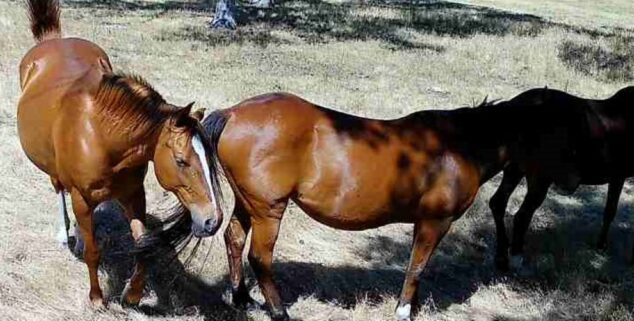 Black Mountain wild horses. Photo courtesy of Wild Horse Education.
 Capitol Weekly welcomes Opinions on California public policy or politics. Please read our guidelines for opinion pieces before submitting an Op-Ed. Submissions that do not adhere to our guidelines will not be considered for publication.
OPINION – California calls itself a leader on climate and conservation, but its treatment of wild horses tells a different story: when it comes to the National Environmental Policy Act (NEPA) — a bedrock environmental safeguard — the state is letting these herds wither away.
I have documented federal helicopter-driven roundups across the West for years and worked inside courtrooms and public‑lands planning processes. From that experience, I have seen how often wild horses are left out of the picture. When agencies treat these herds as afterthoughts, NEPA’s promise of informed, transparent decision‑making collapses and clears the way for removal and development.
Informed Californians can help secure a future for wild horses by understanding what is at stake and participating in federal public‑lands planning before decisions are locked in. Once wild horses lose their legitimate habitats to development and fragmentation, those herds — and their place on the landscape — are gone for good.
Black Mountain on the Central Coast is one case study, not the only one. The Los Padres National Forest is home to the only wild horse herd on that stretch of the coast. My field observation and Freedom of Information Act‑obtained Forest Service records show the Forest Service has “managed” the herd to functional extinction, even as the agency officially claims it is a healthy population.
On paper, Californians still have wild horses scattered across federal lands, some in areas that straddle the Nevada line. In reality, Devil’s Garden Plateau is the only herd that lives entirely within California’s borders and still meets basic genetic‑viability thresholds. The low end of the “Appropriate Management Level” population range that Bureau of Land Management (BLM) and the Forest Service use is set so low it allows barely more than a thousand wild horses statewide.
At the same time, BLM is advancing an oil and gas leasing plan that local groups have long warned will worsen air pollution, strain aquifers and threaten wildlife on the Central Coast. The agency is proceeding as if the Black Mountain wild horse herd isn’t there. In a related Forest Service wildfire “risk reduction” project, the herd appears only as a candidate for removal. When agencies ignore how development, habitat loss and fragmentation affect a herd’s survival, they fail to provide the full, honest picture NEPA requires.
Wildfire and climate resilience are where these omissions become costly. Research suggests that well‑managed wild horse grazing can help reduce fire fuels, lower the risk of explosive fire outbreaks and support more diverse plant communities, alongside deer, mountain lions, bears, bobcats, coyotes, foxes and countless birds, reptiles and amphibians that share their range. When agencies fail to treat wild horses as part of a functioning system in NEPA reviews, they weaken the legal protections that keep these herds on the landscape and undercut the wildlife that depends on the same habitat. This is a familiar pattern across the West.
Courts are beginning to push back. In 2024, a U.S. judge ruled that an environmental assessment had to include the potential impact of roundups themselves on wildfire risks, not just assert fewer horses translate to a healthier, safer landscape. Under the 1971 Wild Free‑Roaming Horses and Burros Act, Congress found that wild horses “contribute to the diversity of life forms within the Nation” and are to be protected.
Wild horses are a uniquely American story — for their evolution in North America, their beauty and their stoic symbolism. Yet their site‑specific legal protections must actually be used if we hope to safeguard them.
To be sure, wild horses share their habitats with multiple other uses. But they must be included in NEPA analyses, along with identifying mitigation measures from the impact of development — forage, water, roads and traffic — on critical horse habitats. It should not repeatedly fall to the public to point out that wild horses are missing from maps and analyses when everything from archaeological sites to livestock allotments appears routinely.
California’s leaders have shown they can stand up to federal agencies on offshore drilling, air quality and water. Californians can now do the same for wild horses by commenting on the Central Coast Field Office Oil and Gas Leasing and Development Supplemental EIS by March 13, urging that the Black Mountain Wild Horse Territory be included in the project plans and the horses fully considered. And they can keep speaking up on other federal plans that fail to treat wild horses as part of the living landscape, instead of as expendable leftovers.
Colette Kaluza is welfare team assistant director at Wild Horse Education and has observed hundreds of days at federal helicopter roundups.
Want to see more stories like this? Sign up for The Roundup, the free daily newsletter about California politics from the editors of Capitol Weekly. Stay up to date on the news you need to know.
Sign up below, then look for a confirmation email in your inbox.
wild horses are part of our American history and need to be protected
Tell BLM plainly: “The Black Mountain Wild Horse Territory is not in the project planning documents, and the wild horses must be considered.” Participate by submitting your comment by March 13 at BLM’s project page, linked in the article
Excellent expose on how California’s wild horses and burros have been shamelessly treated. The authorities have in scoundrel fashion chosen to use them as political sacrifice pawns in the dirty political power and control game. And in doing so they have grievously overlooked the very major positive contributions these wonderful returned N. Am. native keystone species make to California’s ecosystems. Surely this just has to change! It must change! It can change!
Being raised in Bishop Ca, I rode my horses all over the Owens Valley. We had 2 herds in the White Mountains. I loved finding them on my adventures. Not one time did I see damage by them. They enhance the environment by firebreaking in many areas. Burros actually dig water holes when none is around. They can find water.
Calif is supposed to be environmentally ahead of the other states. I assumed you know these facts about mustangs and burros.
Keep them on their alloted lands. There are more than 70 000 in permanent holding facilities. More in there than in the wild. Foaling season is never a round up season. Foals left to die alone. Mares heavy with foals drop and die being chased.
Time to stop the madness. Do the right thing. Share our planet, they do.
When all the wildness is gone…are we happy to just walk on cement. To see a herd of wild horses is like hiking to the top of Mt.Whitney. Come on people, please leave them be and instead of ridding them, manage them properly. There are so many people that know how to do manage that job. Let them do it. Once gone-is gone. Our mountain views have been eaten alive by 5-6 story buildings-let somethings on this earth stay wild. Viewing the wild horses alone, is a breath of fresh air….sanity.