
Opinion
California can’t afford to go backward on wildfire prevention
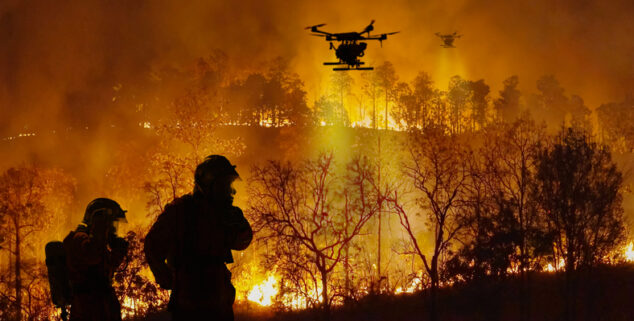 Firefighting drones spray chemical to help control wildfires. Image by Toa55.
 Capitol Weekly welcomes Opinions on California public policy or politics. Please read our guidelines for opinion pieces before submitting an Op-Ed.
OPINION – Wildfires in California are no longer a seasonal threat; they have become a year-round crisis. Over the past decade, they’ve destroyed tens of thousands of homes, claimed hundreds of lives, and burned more than 7 million acres. Today, one in eight Californians lives in a high or very high fire-hazard zone, and insurance companies are pulling out of the state, leaving families and businesses unable to protect what they’ve built.
That’s the reality that led lawmakers to pass SB 884 in 2022, a landmark law requiring utilities to submit 10-year undergrounding plans to permanently reduce wildfire risk. The goal was to move from reactive, project-by-project fixes to a coordinated statewide plan that hardens the grid, improves reliability, and keeps communities safe.
To put that law into practice, the California Public Utilities Commission (CPUC) adopted SPD-15, which was meant to reduce wildfire risk and create reliability and cost benefits through a long-term, undergrounding plan that could be evaluated for safety and cost efficiency.
But now, the CPUC is considering Resolution SPD-37, which would dismantle that progress.
SPD-37 rewrites the rules, replacing SB 884’s long-term framework with a piecemeal, project-by-project approval process. Instead of one comprehensive plan, each undergrounding segment would be submitted for approval separately. This prolonged process will trigger redundant reviews, delays, and uncertainty that would slow critical wildfire-mitigation work and drive up costs.
Undergrounding is one of the most effective wildfire-prevention measures we have. It eliminates ignition sources, reduces Public Safety Power Shutoffs, and strengthens reliability. It also helps stabilize California’s collapsing homeowners insurance market by lowering the wildfire risk that has driven major carriers to pull out of the state.
SB 884 was designed as a long-term investment in both safety and economic stability. Resolution SPD-37 would bury the process in bureaucracy and pushes prevention, and the security that comes with it, further out of reach.
IBEW 1245 members – the men and women who build, maintain, and repair California’s power grid — have seen what’s at stake. We’ve been there on the ground in the aftermath of the Camp Fire, the Tubbs Fire, the Dixie Fire, and so many others. We restore power, clear hazards, and help communities start to rebuild their lives.
Every year we delay undergrounding, families face greater risk as fires grow stronger, faster, and more destructive.
We can’t solve a crisis of this magnitude by slowing down the program designed to make California safer. Three years after SB 884 became law, the state still doesn’t have a functioning undergrounding program. It’s time to move forward, not backward.
The CPUC must honor the intent of SB 884 and put in place a durable, statewide undergrounding framework that protects lives, safeguards homes, and strengthens the stability of our power system for generations to come.
Bob Dean is Business Manager, IBEW Local 1245.
Want to see more stories like this? Sign up for The Roundup, the free daily newsletter about California politics from the editors of Capitol Weekly. Stay up to date on the news you need to know.
Sign up below, then look for a confirmation email in your inbox.
Leave a Reply